OPINION.
A good faith attempt at accuracy was made. Not responsible for error. Please do check quotations for accuracy, and kindly inform if any or all error is found.
PROPOSITION ONE: THE CONSTITUTION IS THE SUPREME RULE, AND EVERY INSTRUMENT INFERIOR TO IT IS VOID TO THE EXTENT OF THE CONFLICT
The foundational axiom is not borrowed from commentary or tradition. It emerges from the primary text itself. Article VI §2:
“This Constitution, and the Laws of the United States which shall be made in Pursuance thereof; and all Treaties made, or which shall be made, under the Authority of the United States, shall be the supreme Law of the Land; and the Judges in every State shall be bound thereby, any Thing in the Constitution or Laws of any State to the Contrary notwithstanding.”
The operative word is “Pursuance.” Only laws made in pursuance of the Constitution carry the force of supreme law. A law contrary to it carries none. The Supreme Court’s own articulation of this in Marbury is not interpretive gloss — it is a reading of the text back to itself:
“It is emphatically the province and duty of the judicial department to say what the law is. Those who apply the rule to particular cases, must of necessity expound and interpret that rule. If two laws conflict with each other, the courts must decide on the operation of each.”
…
“If, then, the courts are to regard the constitution, and the constitution is superior to any ordinary act of the legislature, the constitution, and not such ordinary act, must govern the case to which they both apply.”
…
"[A] law repugnant to the constitution is void, and that courts, as well as other departments, are bound by that instrument.”
— Marbury v. Madison, 5 U.S. 137 (1803)
“An unconstitutional act is not a law; it confers no rights; it imposes no duties; it affords no protection; it creates no office; it is in legal contemplation as inoperative as though it had never been passed.”
— Norton v. Shelby County, 118 U.S. 425 (1886)
PROPOSITION TWO: ARTICLE III §2 DISTINGUISHES LAW AND EQUITY AS SEPARATE JURISDICTIONS — NOT AS MATTERS OF CONVENIENCE
Article III §2 reads:
“The judicial Power shall extend to all Cases, in Law and Equity, arising under this Constitution, the Laws of the United States, and Treaties made, or which shall be made, under their Authority;—to all Cases affecting Ambassadors, other public Ministers and Consuls;—to all Cases of admiralty and maritime Jurisdiction;—to Controversies to which the United States shall be a Party;—to Controversies between two or more States;—between a State and Citizens of another State,—between Citizens of different States,—between Citizens of the same State claiming Lands under Grants of different States, and between a State, or the Citizens thereof, and foreign States, Citizens or Subjects.”
The Constitution names “Law” and “Equity” as distinct categories of judicial power. This is not rhetorical surplusage. The Seventh Amendment reinforces it in the affirmative:
“In Suits at common law, where the value in controversy shall exceed twenty dollars, the right of trial by jury shall be preserved, and no fact tried by a jury, shall be otherwise re-examined in any Court of the United States, than according to the rules of the common law.”
The guarantee is to common law suits specifically. Equity proceedings never carried a jury. The constitutional structure therefore presupposes the two categories remain distinct, because the jury-right guarantee is meaningless if a court can reclassify a common law suit as equitable at will.
The Supreme Court confirmed this in Bennett v. Butterworth, 52 U.S. 669 (1850):
In Texas, the common law has been adopted, but the forms and rules of pleading in common law cases have not; and although the forms of proceedings and practice in the State courts have been adopted in the District Court of the United States, yet such adoption must not be understood as confounding the principles of law and equity; nor as authorizing legal and equitable claims to be blended together in one suit.
The Constitution of the United States has recognized the distinction between law
and equity, and it must be observed in the federal courts, although there is no distinction between them by the laws of Texas.
…
“Whatever may be the laws of Texas in this respect, they do not govern the proceedings in the courts of the United States. And although the forms of proceedings and practice in the State courts have been adopted in the District Court, yet the adoption of the State practice must not be understood as confounding the principles of law and equity, nor as authorizing legal and equitable claims to be blended together in one suit. The Constitution of the United States, in creating and defining the judicial power of the general government, establishes this distinction between law and equity; and a party who claims a legal title must proceed at law, and may undoubtedly proceed according to the forms of practice in such cases in the State court. But if the claim is an equitable one, he must proceed according to rules which this court has prescribed (under the authority of the act of August 28d, 1842), regulating proceedings in equity in the courts of the United States.”
The holding is absolute: even where a state makes no distinction between law and equity — even where state practice has blended them — the constitutional recognition of the distinction still governs in federal court. State law cannot alter a constitutional category.
PROPOSITION THREE: THE RULES ENABLING ACT OF 1934 ITSELF PROHIBITS ABRIDGING SUBSTANTIVE RIGHTS — AND THE JURY RIGHT IS SUBSTANTIVE
Congress authorized the Supreme Court to make procedural rules by the Rules Enabling Act of 1934. But it wrote the constraint into the statute itself. As our Cornell LII source directly states:
“the limitations of the Rules Enabling Act of 1934 state that the new procedure enacted by the Supreme Court may “not abridge, modify, or enlarge any of the substantive right” (See: 28 U.S. Code § 2072(b)).”
" For instance, the Supreme Court cannot implement a rule that would take away the fundamental right to a jury trial for criminal defendants."
The Rules Enabling Act is therefore self-limiting. Any procedural rule produced under its authority that operates to abridge the Seventh Amendment right to jury trial exceeds the grant of authority under which the rule was made. A rule that exceeds its enabling authority is void — not just procedurally irregular, but void — for the same reason an Act of Congress that exceeds constitutional authority is void under Marbury.
The 1938 FRCP merger of law and equity into a single “civil action” was made pursuant to this Act. The question the Act’s own text forces is: did that merger abridge the Article III §2 absolute & conjunction, respectively (..“all Cases, in Law and Equity”); The Supremacy Clause; Seventh Amendment right; Marbury v. Madison, 5 U.S. 137 (1803); Norton v. Shelby County, 118 U.S. 425 (1886); Bennett v. Butterworth, 52 U.S. 669 (1850); God-given right? The answer comes directly from the subsequent case law — which shows the Court spending the next twenty-five years trying to contain the merger’s jury-stripping, right-stripping and repugnant effects.
PROPOSITION FOUR: THE COURTS THEMSELVES ACKNOWLEDGED THE MERGER THREATENED THE JURY RIGHT AND BUILT A STRUCTURAL FIX — WHICH PROVES THE PROBLEM EXISTS
Beacon Theatres, Inc. v. Westover, 359 U.S. 500 (1959) is the admission in writing. The District Court had used FRCP Rules 42(b) and 57 to try equitable issues first — which would have collaterally estopped the party’s right to jury trial on the legal issues. The Supreme Court reversed:
“If petitioner would have been entitled to a jury trial in a treble damage suit, he cannot be deprived of that right merely because the prospective defendant took advantage of the availability of declaratory relief to sue petitioner first.” (from Syllabus)
“It follows that if Beacon would have been entitled to a jury trial in a treble damage suit against Fox it cannot be deprived of that right merely because Fox took advantage of the availability of declaratory relief to sue Beacon first.”
“Viewed in this manner, the use of discretion by the District Court under Rule 42 (b) to deprive petitioner of a full jury trial of the issues in the antitrust controversy cannot be justified. P. 508.”
“Mandamus is available under the All Writs Act, 28 U. S. C. § 1651, to require jury trial where it has been improperly denied. P. 511.” (from Syllabus)
“Viewed in this manner, the use of discretion by the trial court under Rule 42 (b) to deprive Beacon of a full jury trial on its counterclaim and cross-claim, as well as on Fox’s plea for declaratory relief, cannot be justified.”
“Respondent claims mandamus is not available under the All Writs Act, 28 U. S. C. § 1651. Whatever differences of opinion there may be in other types of cases, we think the right to grant mandamus to require jury trial where it has been improperly denied is settled.” The judgment of the Court of Appeals is
Reversed." (bold added)
" “[t]he right to trial by jury as declared by the Seventh Amendment to the Constitution or as given by a statute of the United States shall be preserved . . . inviolate.” 16 "
"Since the right to jury trial is a constitutional one, however, while no similar requirement protects trials by the court,17 that discretion is very narrowly limited and must, wherever possible, be exercised to preserve jury trial. As this Court said in Scott v. Neely, 140 U. S. 106, 109-110: '“In the Federal courts this [jury] right cannot be dispensed with, except by the assent of the parties entitled to it, nor can it be impaired by any blending with a claim, properly cognizable at law, of a demand for equitable relief in aid of the legal action or during its pendency.” 18 (Opinion of the Court)
Footnotes Captured as:
16 Fed. Rules Civ. Proc., 38 (a). In delegating to the Supreme
Court responsibility for drawing up rules, Congress declared that:
“Such rules shall not abridge, enlarge or modify any substantive
right and shall preserve the right of trial by jury as at common law
and as declared by the Seventh Amendment to the Constitution.”
28 U. S. C. § 2072. The Seventh Amendment reads: “In suits at
common law, where the value in controversy shall exceed twenty
dollars, the right of trial by jury shall be preserved, and no fact tried
by a jury, shall be otherwise re-examined in any Court of the United
States, than according to the rules of the common law.”
17 See Hurwitz v. Hurwitz, 78 U. S. App. D. C. 66, 136 F. 2d 796,
798-799; cf. The Genesee Chief v. Fitzhugh, 12: How. 443, 459-460.
18 This Court has long emphasized the importance of the jury trial.
See Parsons v. Bedford, 3 Pet. 433, 446. See also Galloway v. United
States, 319 U. S. 372. Id., at 396 (dissenting opinion).
The Court further confirmed in Dairy Queen, Inc. v. Wood, 369 U.S. 469 (1962) that this principle admits no exception through labeling:
“(a) Where both legal and equitable issues are presented in a single case, any legal issues for which 'a trial by jury is timely and properly demanded must be submitted to a jury. Beacon Theatres, Inc., v. Westover, 359 U. S. 500. Pp. 470-473”
…
“(d) The legal claim here involved was not rendered “purely equitable” by the nature of the defenses interposed by petitioner. P. 479.
Judgment reversed and cause remanded for further proceedings.” (bold added) (from syllabus)
“At the outset, we may dispose of one of the grounds upon which the trial court acted in striking the demand for trial by jury-that based upon the view that the right to trial by jury may be lost as to legal issues where those issues are characterized as “incidental” to equitable issues-for our previous decisions make it plain that no such rule may be applied in the federal courts. In Scott v. Neely, decided in 1891, this Court held that a court of equity could not even take jurisdiction of a suit “in which a claim properly cognizable only at law is united in the same pleadings with a claim for equitable relief.” 3 That holding, which was based upon both the historical separation between law and equity and the duty of the Court to insure “that the right to a trial by a jury in the legal action may be preserved intact,” 4 created considerable inconvenience in that it necessitated two separate trials in the same case whenever that case contained both legal and equitable claims. Consequently, when the procedure in the federal courts was modernized by the adoption of the Federal Rules of Civil Procedure in 1938, it was deemed advisable to abandon that part of the holding of Scott v. Neely which rested upon the separation of law and equity and to permit the joinder of legal and equitable claims in a single action. Thus Rule 18 (a) provides that a plaintiff “may join either as independent or as alternate claims as many claims either legal or equitable or both as he may have against an opposing party.” And Rule 18 (b) provides: “Whenever a claim is one heretofore cognizable only after another claim has been prosecuted to a conclusion, the two claims may be joined in a single action; but the court shall grant relief in that action only in accordance with the relative substantive rights of the parties. In particular, a plaintiff may state a claim for money and a claim to have set aside a conveyance fraudulent as to him, without first having obtained a judgment establishing the claim for money.” The Federal Rules did not, however, purport to change the basic holding of Scott v. Neely that the right to trial by jury of legal claims must be preserved.5 Quite the contrary, Rule 38 (a) expressly reaffirms that constitutional principle, declaring: “The right of trial by jury as declared by the Seventh Amendment to the Constitution or as given by a statute of the United States shall be preserved to the parties inviolate.” Nonetheless, after the adoption of the Federal Rules, attempts were made indirectly to undercut that right by having federal courts in which cases involving both legal and equitable claims were filed decide the equitable claim first. The result of this procedure in those cases in which it was followed was that any issue common to both the legal and equitable claims was finally determined by the court and the party seeking trial by jury on the legal claim was deprived of that right as to these common issues. This procedure finally came before us in Beacon Theatres, Inc., v. Westover, 6 a case which, like this one, arose from the denial of a petition for mandamus to compel a district judge to vacate his order striking a demand for trial by jury. Our decision reversing that case not only emphasizes the responsibility of the Federal Courts of Appeals to grant mandamus -where necessary to protect the constitutional right to trial by jury but also limits the issues open for determination here by defining the protection to which that right is entitled in cases involving both legal and equitable claims. The holding in Beacon Theatres was that where both legal and equitable issues are presented in a single case, “only under the most imperative circumstances, circumstances which in view of the flexible procedures of the Federal Rules we cannot now anticipate, can the right to a jury trial of legal issues be lost through prior determination of equitable claims.”7 That holding, of course, applies whether the trial judge chooses to characterize the legal issues presented as “incidental” to equitable issues or not.’ Consequently, in a case such as this where there cannot even be a contention of such “imperative circumstances,” Beacon Theatres requires that any legal issues for which a trial by jury is timely and properly demanded be submitted to a jury. There being no question of the timeliness on correctness of the demand involved here, the sole question which we must decide is whether the action now pending before the District Court contains legal issues.”
…
“Nor is the legal claim here rendered “purely equitable” by the nature of the defenses interposed by petitioner. Petitioner’s primary defense to the charge of breach of contract-that is, that the contract was modified by a subsequent oral agreement–presents a purely legal question having nothing whatever to do either with novation, as the district judge suggested, or reformation, as suggested by the respondents here. Such a defense goes to the question of just what, under the law, the contract between the respondents and petitioner is and, in an action to collect a debt for breach of a contract between these parties, petitioner has a right to have the jury determine not only whether the contract has been breached and the extent of the damages if any but also just what the contract is. We conclude therefore that the district judge erred in refusing to grant petitioner’s demand for a trial by jury on the factual issues related to the question of whether there has been a breach of contract. Since these issues are common with those upon which respondents’ claim to equitable relief is based, the legal claims involved in the action must be determined prior to any final court determination of respondents’ equitable claims.20 The Court of Appeals should have corrected the error of the district judge by granting the petition for mandamus. The judgment is therefore reversed and the cause remanded for further proceedings consistent with this opinion.
Reversed and remanded.” (bold added)
Footnotes captured as:
3 140 U. S. 106, 117. See also Cates v. Allen, 149 U. S. 451, in
which the principles expressedaif-d applied in Scott v. Neely were
explicitly reaffirmed.
4 Id., at 110.
5* “Subdivision (b) [of Rule 18] does not disturb the doctrine of
those cases [Scott v. Neely and Cates v. Allen] but is expressly bottomed upon their principles. This is true because the Federal Rules
abolish the distinction between law and equity, permit the joinder of
legal and. equitable claims, and safeguard the right to jury trial of
legal issues.” 3 Moore, Federal Practice, 1831-1832.
6 359 U. S. 500.
7 Id., at 510-511.
20 This does not, of course, interfere with the District Court’s power to grant temporary relief pending a final adjudication on the merits. Such temporary relief has already been granted in this case (see McCullough v. Dairy Queen, Inc., 290 F. 2d 871) and is no part of the issues before this Court.
*reader, PLEASE NOTE, there appears to have been a typo in the original, in which TWO (2) superscript 4’s were rendered instead of the expected serial 4, 5 pattern. This was corrected, in good faith.
Notice the logic: the Court upholds the jury right as inviolable while simultaneously declining to strike the merger rule itself. This is the structural tension. The Court is patching a constitutional wound with a sequencing bandage. The wound — the merger of law and equity against Bennett’s constitutional holding — remains.
PROPOSITION FIVE: “STEALTHY ENCROACHMENTS” IS OPERATIVE LAW, NOT METAPHOR
Byars v. United States, 273 U.S. 28 (1927) established the interpretive rule that applies to all of this:
" 3. Constitutional provisions for the security of person and property are to be liberally construed, and “it is the duty of courts to be watchful for the constitutional rights of the citizen, and against any stealthy encroachments thereon.” P. 273 U. S. 32." (from syllabus)
“While it is true that the mere participation in a state search of one who is a federal officer does not render it a federal undertaking, the court must be vigilant to scrutinize the attendant facts with an eye to detect and a hand to prevent violations of the Constitution by circuitous and indirect methods. Constitutional provisions for the security of person and property are to be liberally construed, and “it is the duty of courts to be watchful for the constitutional rights of the citizen, and against any stealthy encroachments thereon.” Boyd v. United States, 116 U. S. 616, 116 U. S. 635; Gouled v. United States, supra, p. 255 U. S. 304, supra.”
The phrase “stealthy encroachments” is the Court’s own framing. An encroachment is stealthy when it does not announce itself as a constitutional violation — when it proceeds under procedural or administrative cover, gradually eroding a guaranteed right without ever producing a single moment in which a court is forced to say “we are taking this right away.” Reclassifying common law suits as equitable, then deciding equitable issues first, then applying collateral estoppel to foreclose the jury on the legal issues — each step procedurally defensible, the aggregate constitutionally void — is precisely a stealthy encroachment.
The duty Byars imposes on courts is active, not passive: they must be watchful. The logic therefore requires that a court confronting the merger’s jury-stripping operation apply Marbury’s void-if-repugnant rule, not Beacon’s sequencing patch.
PROPOSITION SIX: THE ELEVENTH AMENDMENT — REPUGNANCY, INCOHERENCE, AND THE LIMITS OF SEVERABILITY
Article III §2 extends judicial power to controversies “between a State and Citizens of another State.” This is clear text. The Eleventh Amendment then provides:
“The Judicial power of the United States shall not be construed to extend to any suit in law or equity, commenced or prosecuted against one of the United States by Citizens of another State, or by Citizens or Subjects of any Foreign State.”
The conflict with Article III §2 is direct. The Supremacy Clause places the Constitution above all law — but the Eleventh Amendment is itself part of the Constitution. The resolution the mainstream offers is that later amendments supersede earlier provisions by the Art. V amending process. This is formally valid.
But here is the incoherence, not the repugnancy: Hamilton in Federalist No. 81 had argued before ratification that Article III §2 never meant what Chisholm later said it meant:
“It is inherent in the nature of sovereignty not to be amenable to the suit of an individual WITHOUT ITS CONSENT. This is the general sense, and the general practice of mankind.”
“Unless, therefore, there is a surrender of this immunity in the plan of the convention, it will remain with the States.”
“To ascribe to the federal courts, by mere implication, and in destruction of a pre-existing right of the State governments, a power which would involve such a consequence, would be altogether forced and unwarrantable.”
Hamilton’s argument is that the immunity was always inherent — that Article III §2 never actually granted what Chisholm claimed it granted. If Hamilton is right, the Eleventh Amendment was unnecessary. If Chisholm was right that Article III §2 did grant it, then the Eleventh Amendment is a direct restriction on Article III — a provision of the Constitution restricting another provision of the Constitution.
Repugnancy in this context means: Article III §2 grants jurisdiction over State/Citizen controversies; the Eleventh Amendment withdraws it. Both cannot simultaneously operate without contradiction.
Incoherence means: the operative doctrine (expansive sovereign immunity, including suits by a state’s own citizens, as established post-Hans) goes far beyond the Eleventh Amendment’s actual text, which addresses only out-of-state citizens. The text of the Amendment and the doctrine built upon it do not match. What courts actually apply is not the Eleventh Amendment as written — it is a judicial construction of sovereign immunity dressed in the Amendment’s citation.
Severability cannot restore Article III §2’s original jurisdictional grant here because the Eleventh Amendment is a single sentence. There is nothing to sever. Severability is a doctrine for statutes with divisible provisions; applied to a constitutional amendment consisting of one sentence, it has no purchase. The only available tools are: (1) hold the Amendment to its actual text — which only bars out-of-state citizen suits — or (2) accept that Hans and its progeny have substituted a judicial doctrine for the constitutional text, which is precisely what Marbury prohibits judges from doing to the Constitution itself.
THE COMPLETE LOGICAL CHAIN — INTERNAL AND SELF-SUFFICIENT
- Article VI §2: “This Constitution, and the Laws of the United States which shall be made in Pursuance thereof; and all Treaties made, or which shall be made, under the Authority of the United States, shall be the supreme Law of the Land; and the Judges in every State shall be bound thereby, any Thing in the Constitution or Laws of any State to the Contrary notwithstanding.”
- Article III §2 + Seventh Amendment: Law and equity are constitutionally distinct categories. Common law suits carry a jury right that cannot be re-examined except by common law rules.
“The judicial Power shall extend to all Cases, in Law and Equity, arising under this Constitution, the Laws of the United States, and Treaties made, or which shall be made, under their Authority;—to all Cases affecting Ambassadors, other public Ministers and Consuls;—to all Cases of admiralty and maritime Jurisdiction;—to Controversies to which the United States shall be a Party;—to Controversies between two or more States;—between a State and Citizens of another State,—between Citizens of different States,—between Citizens of the same State claiming Lands under Grants of different States, and between a State, or the Citizens thereof, and foreign States, Citizens or Subjects.”
“In Suits at common law, where the value in controversy shall exceed twenty dollars, the right of trial by jury shall be preserved, and no fact tried by a jury, shall be otherwise re-examined in any Court of the United States, than according to the rules of the common law.”
- Marbury v. Madison: “If, then, the courts are to regard the constitution, and the constitution is superior to any ordinary act of the legislature, the constitution, and not such ordinary act, must govern the case to which they both apply.” … “[A] law repugnant to the constitution is void; and that courts, as well as other departments, are bound by that instrument.” (5 U.S. 137)
- Bennett v. Butterworth: “The Constitution of the United States has recognized the distinction between law and equity, and it must be observed in the federal courts, although there is no distinction between them by the laws of Texas.” The blending of law and equity in one suit is constitutionally prohibited in federal courts, regardless of state practice. (52 U.S. 669)
- Rules Enabling Act: Rules made under its authority “may not abridge, modify, or enlarge any substantive right.” The jury right under the Seventh Amendment is substantive. “(b) Such rules shall not abridge, enlarge or modify any substantive right. All laws in conflict with such rules shall be of no further force or effect after such rules have taken effect.” (28 U.S.C. § 2072(b))
- Byars v. United States: "the court must be vigilant to scrutinize the attendant facts with an eye to detect and a hand to prevent violations of the Constitution by circuitous and indirect methods. Constitutional provisions for the security of person and property are to be liberally construed, and “it is the duty of courts to be watchful for the constitutional rights of the citizen, and against any stealthy encroachments thereon.” Boyd v. United States, 116 U. S. 616, 116 U. S. 635; Gouled v. United States, supra, p. 255 U. S. 304, supra.” (273 U.S. 28)
- Beacon Theatres + Dairy Queen: The Court itself confirms that the merger’s operation can deprive a party of the jury right — then patches it with sequencing rules rather than voiding the offending rules. “Only under the most imperative circumstances… can the right to a jury trial of legal issues be lost through prior determination of equitable claims.” (359 U.S. 500; 369 U.S. 469). The patch does not cure the void.
- 5 U.S.C. § 556(d): In administrative proceedings — the most common forum where the merged law/equity regime now operates — "(d) Except as otherwise provided by statute, the proponent of a rule or order has the burden of proof. Any oral or documentary evidence may be received, but the agency as a matter of policy shall provide for the exclusion of irrelevant, immaterial, or unduly repetitious evidence. A sanction may not be imposed or rule or order issued except on consideration of the whole record or those parts thereof cited by a party and supported by and in accordance with the reliable, probative, and substantial evidence. The agency may, to the extent consistent with the interests of justice and the policy of the underlying statutes administered by the agency, consider a violation of section 557(d) of this title sufficient grounds for a decision adverse to a party who has knowingly committed such violation or knowingly caused such violation to occur. A party “is entitled to present his case or defense by oral or documentary evidence, to submit rebuttal evidence, and to conduct such cross-examination as may be required for a full and true disclosure of the facts.” (5 U.S.C. § 556(d)) These are the residual due-process floors where the jury right has been entirely abolished. Their very necessity confirms what was lost.
- Eleventh Amendment / Federalist No. 81: Hamilton’s own pre-ratification argument that sovereign immunity was inherent in Article III — never surrendered by the plan of the Convention — points directly to an incoherence: either the Amendment was unnecessary (confirming what was already implicit), or it was necessary (confirming that Article III §2 had actually granted what Chisholm said, making the Amendment a constitutional provision restricting a constitutional grant). In neither reading does the expansive Hans doctrine follow from the Amendment’s text. “Internally consistent” applied to the text — not the doctrine — exposes this gap rather than closing it.
CONCLUSION: WHAT “INTERNALLY CONSISTENT” ACTUALLY DOES
The demand that a constitutional argument be “internally consistent” is not a safe harbor for the overlay. Applied honestly — applied to the primary text rather than to the accumulated doctrine — internal consistency exposes every one of these faults:
- The FRCP merger cannot be internally consistent with Bennett’s holding that the Constitution mandates the distinction.
- The REA rules cannot be internally consistent with their own enabling clause if they abridge a substantive right.
- Hans’s expansion of the Eleventh Amendment cannot be internally consistent with the Amendment’s own text, which specifies only out-of-state citizens.
- Judicial doctrines that substitute for constitutional text cannot be internally consistent with Marbury, which holds that the Constitution — not ordinary law — governs where the two conflict.
“Internally consistent” is not a tool for defending the overlay. It is a scalpel that, used honestly, cuts it away.
See also:
Chisholm v. Georgia, 2 U.S. 419 (1793)
https://supreme.justia.com/cases/federal/us/2/419/
Hans v. Louisiana, 134 U.S. 1 (1890)
https://supreme.justia.com/cases/federal/us/134/1/
For which I intent to follow up when I am more rested, thank you.
Partial Bill of Rights
Fourth Amendment
The right of the people to be secure in their persons, houses, papers, and effects, against unreasonable searches and seizures, shall not be violated, and no Warrants shall issue, but upon probable cause, supported by Oath or affirmation, and particularly describing the place to be searched, and the persons or things to be seized.
Fifth Amendment
No person shall be held to answer for a capital, or otherwise infamous crime, unless on a presentment or indictment of a Grand Jury, except in cases arising in the land or naval forces, or in the Militia, when in actual service in time of War or public danger; nor shall any person be subject for the same offence to be twice put in jeopardy of life or limb; nor shall be compelled in any criminal case to be a witness against himself, nor be deprived of life, liberty, or property, without due process of law; nor shall private property be taken for public use, without just compensation.
Sixth Amendment
In all criminal prosecutions, the accused shall enjoy the right to a speedy and public trial, by an impartial jury of the State and district wherein the crime shall have been committed, which district shall have been previously ascertained by law, and to be informed of the nature and cause of the accusation; to be confronted with the witnesses against him; to have compulsory process for obtaining witnesses in his favor, and to have the Assistance of Counsel for his defence.
Seventh Amendment
In Suits at common law, where the value in controversy shall exceed twenty dollars, the right of trial by jury shall be preserved, and no fact tried by a jury, shall be otherwise re-examined in any Court of the United States, than according to the rules of the common law.
Eighth Amendment
Excessive bail shall not be required, nor excessive fines imposed, nor cruel and unusual punishments inflicted.
Ninth Amendment
The enumeration in the Constitution, of certain rights, shall not be construed to deny or disparage others retained by the people.
Tenth Amendment
The powers not delegated to the United States by the Constitution, nor prohibited by it to the States, are reserved to the States respectively, or to the people.
Where not repugnant:
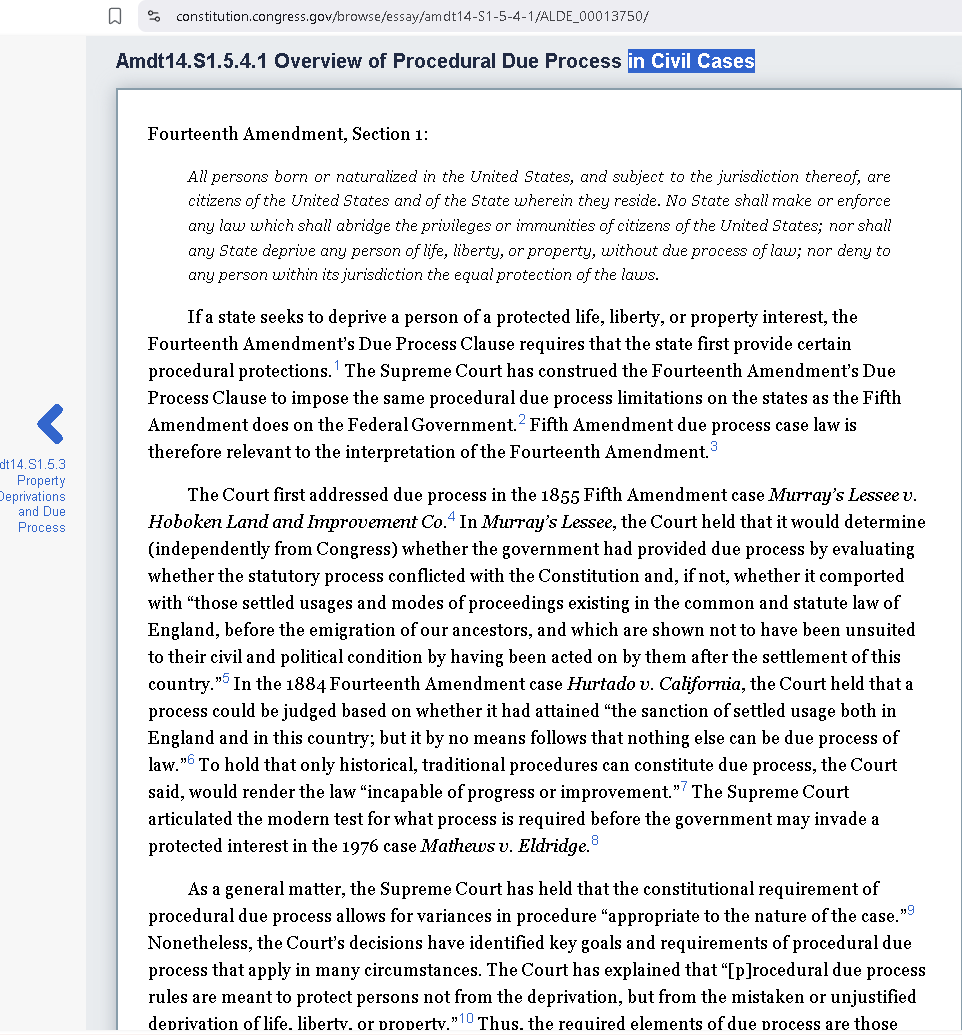
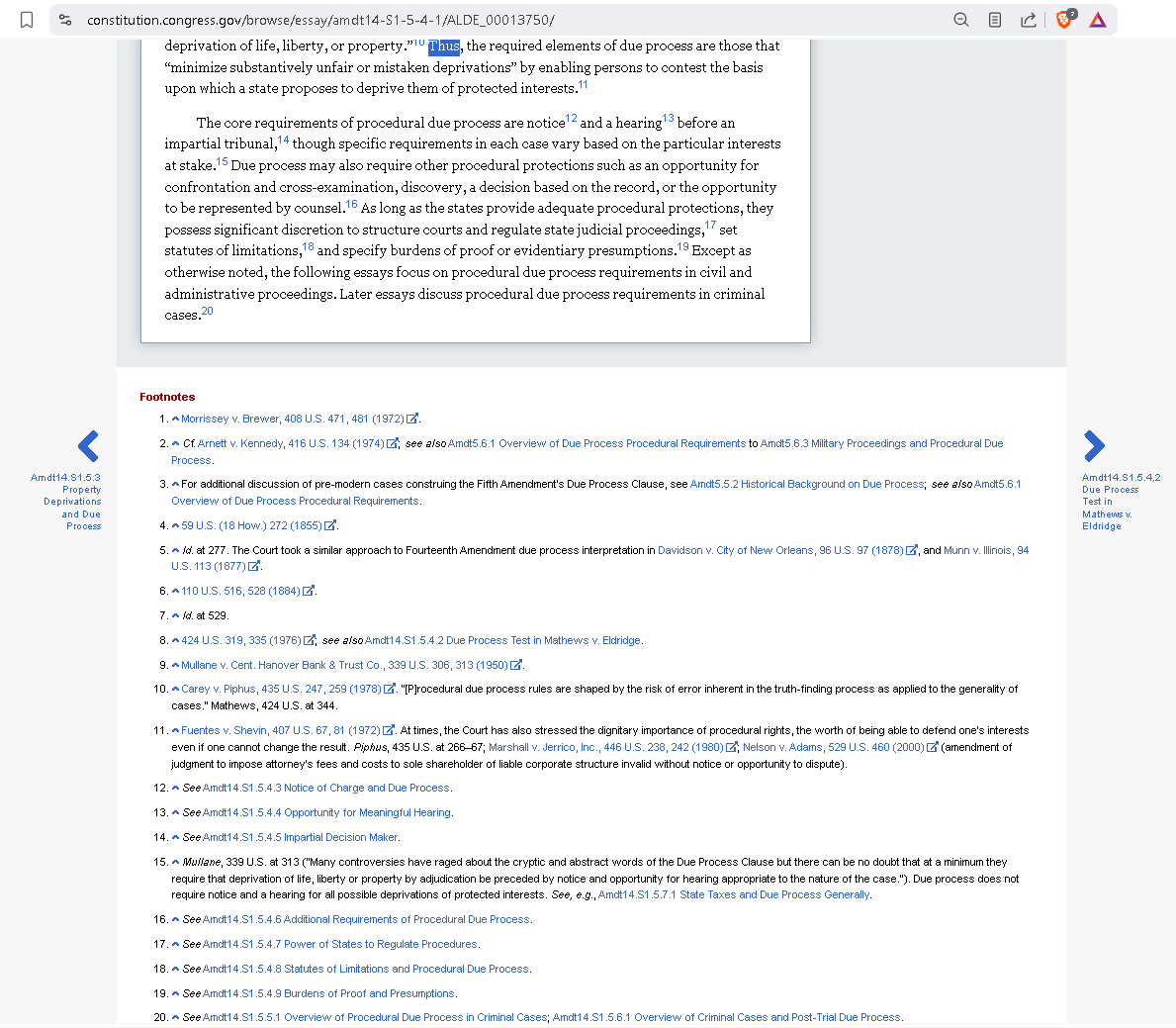
https://constitution.congress.gov/browse/essay/amdt14-S1-5-4-1/ALDE_00013750/