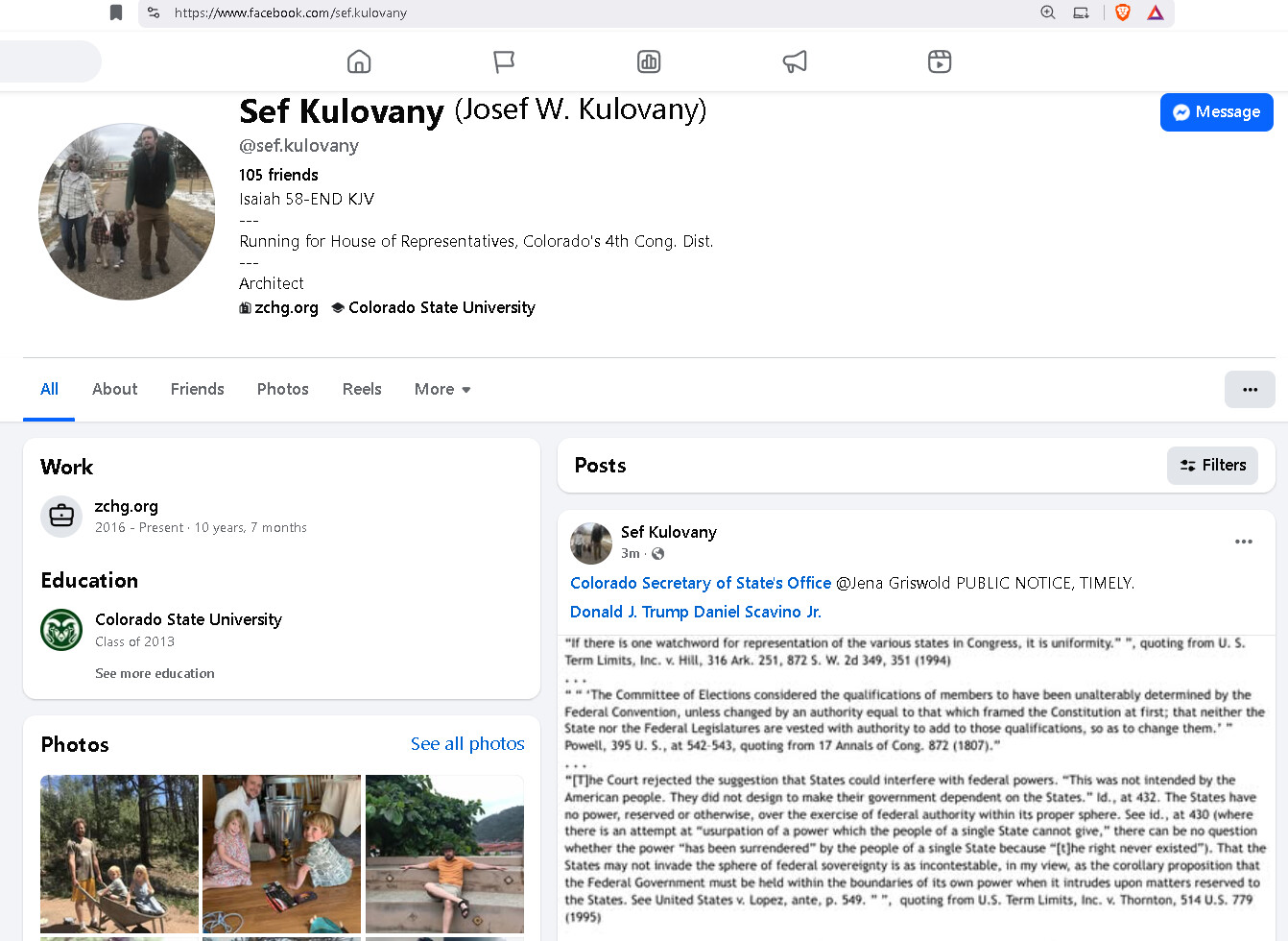
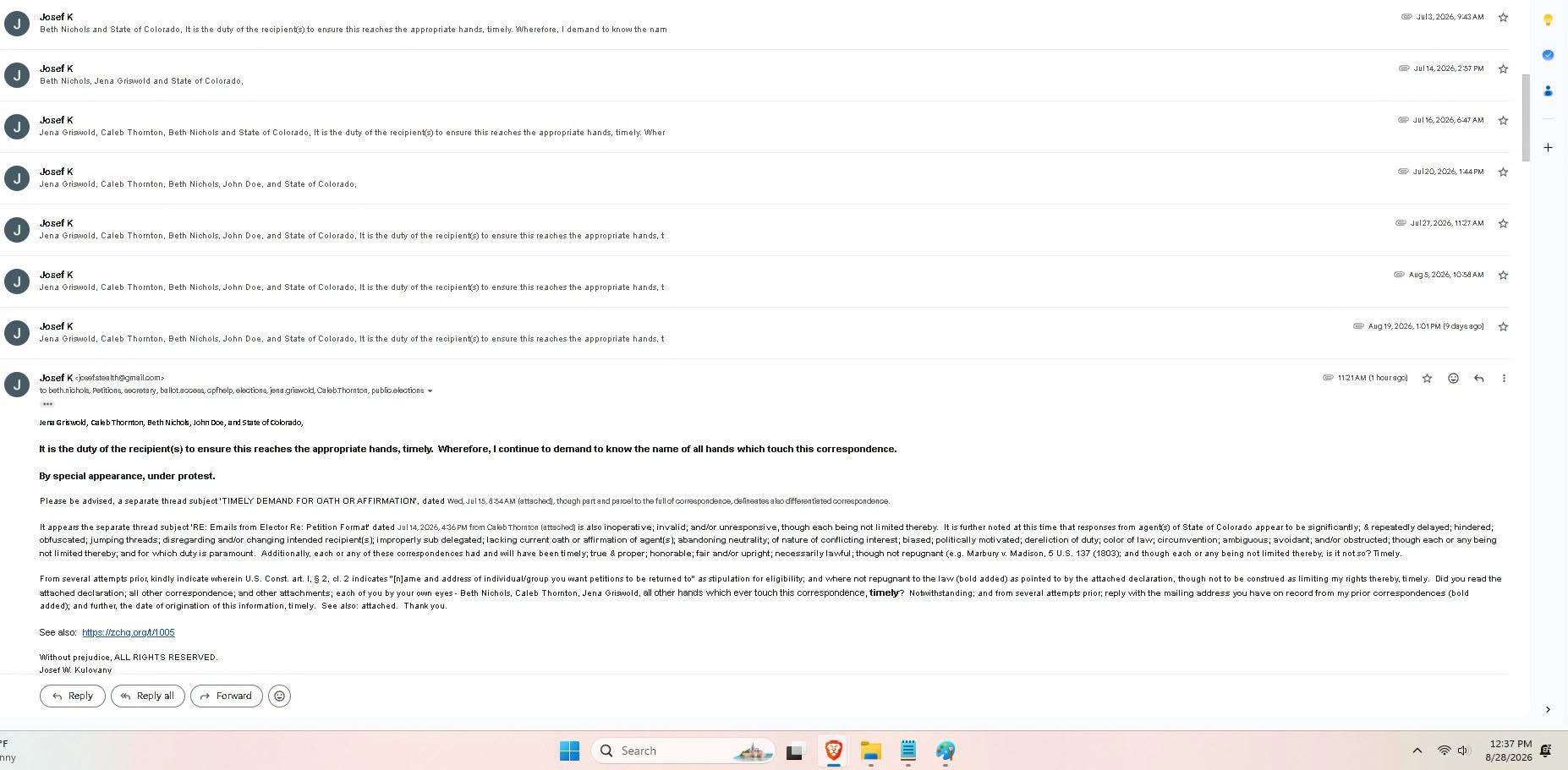
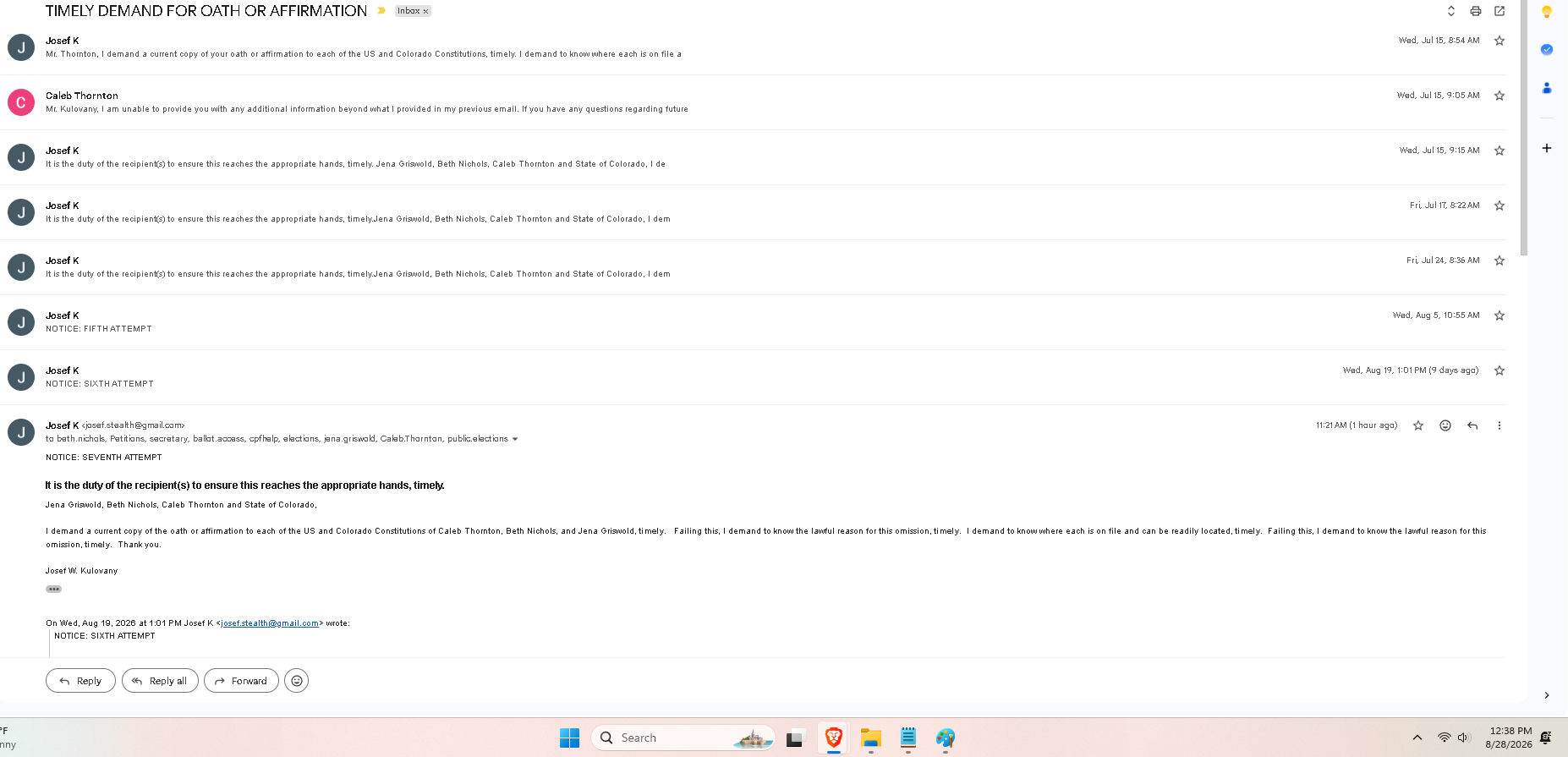
Josef W. Kulovany for Colorado’s 4th Congressional District in the House of Representatives
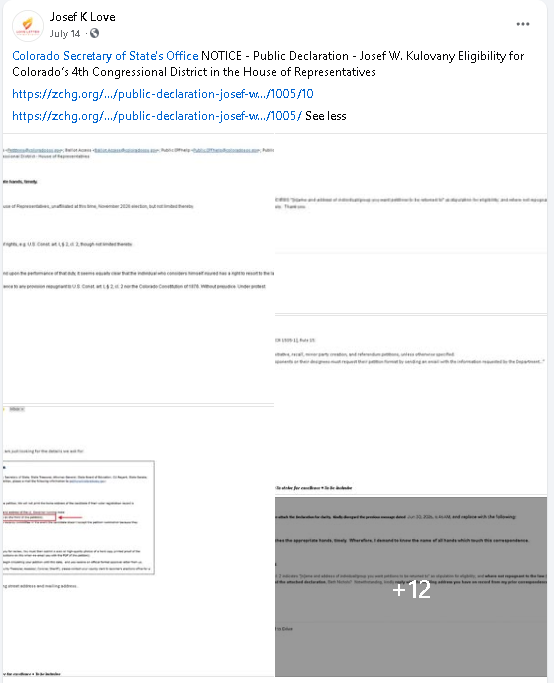
Josef W. Kulovany Candidacy.pdf (67.2 KB)
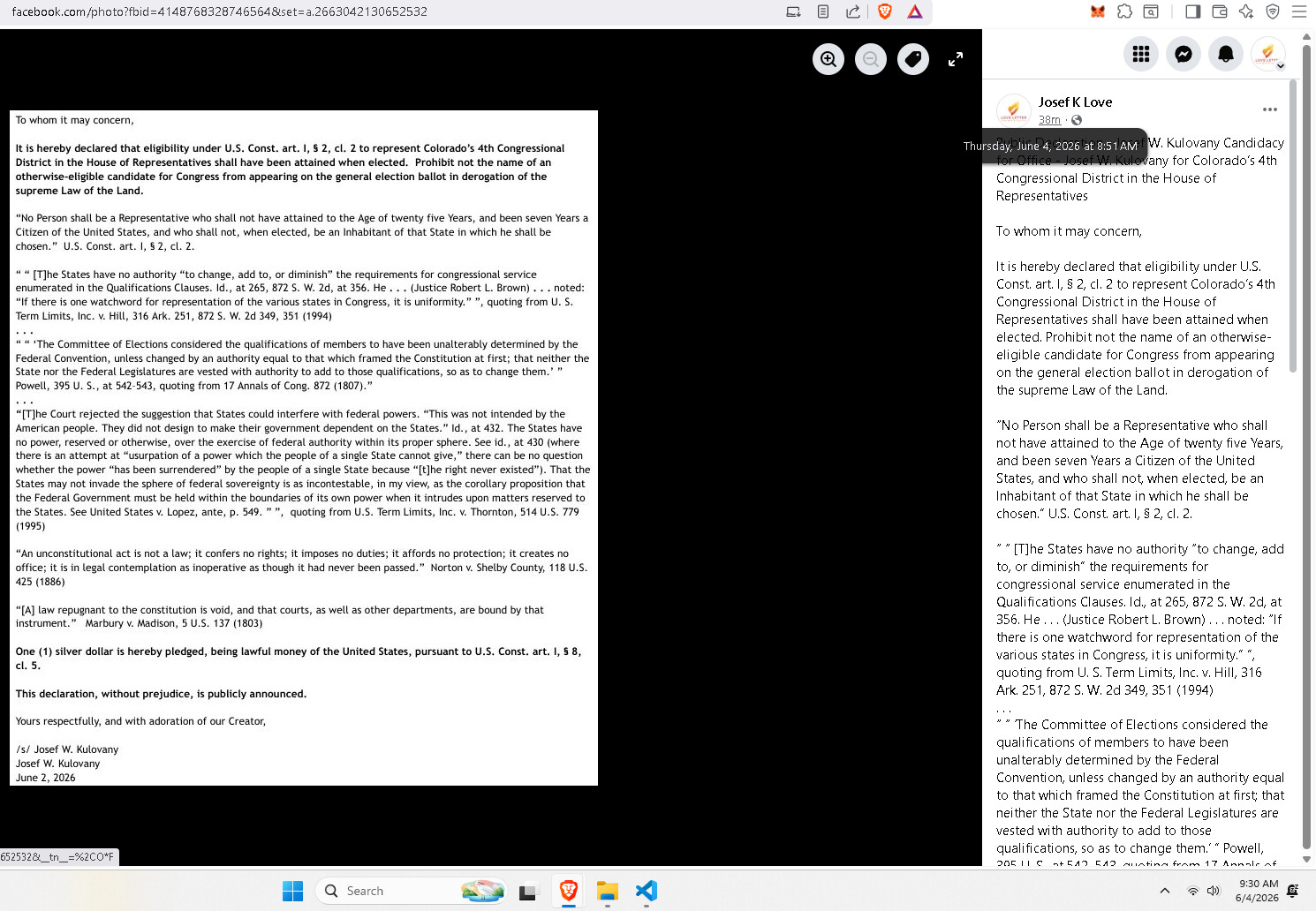
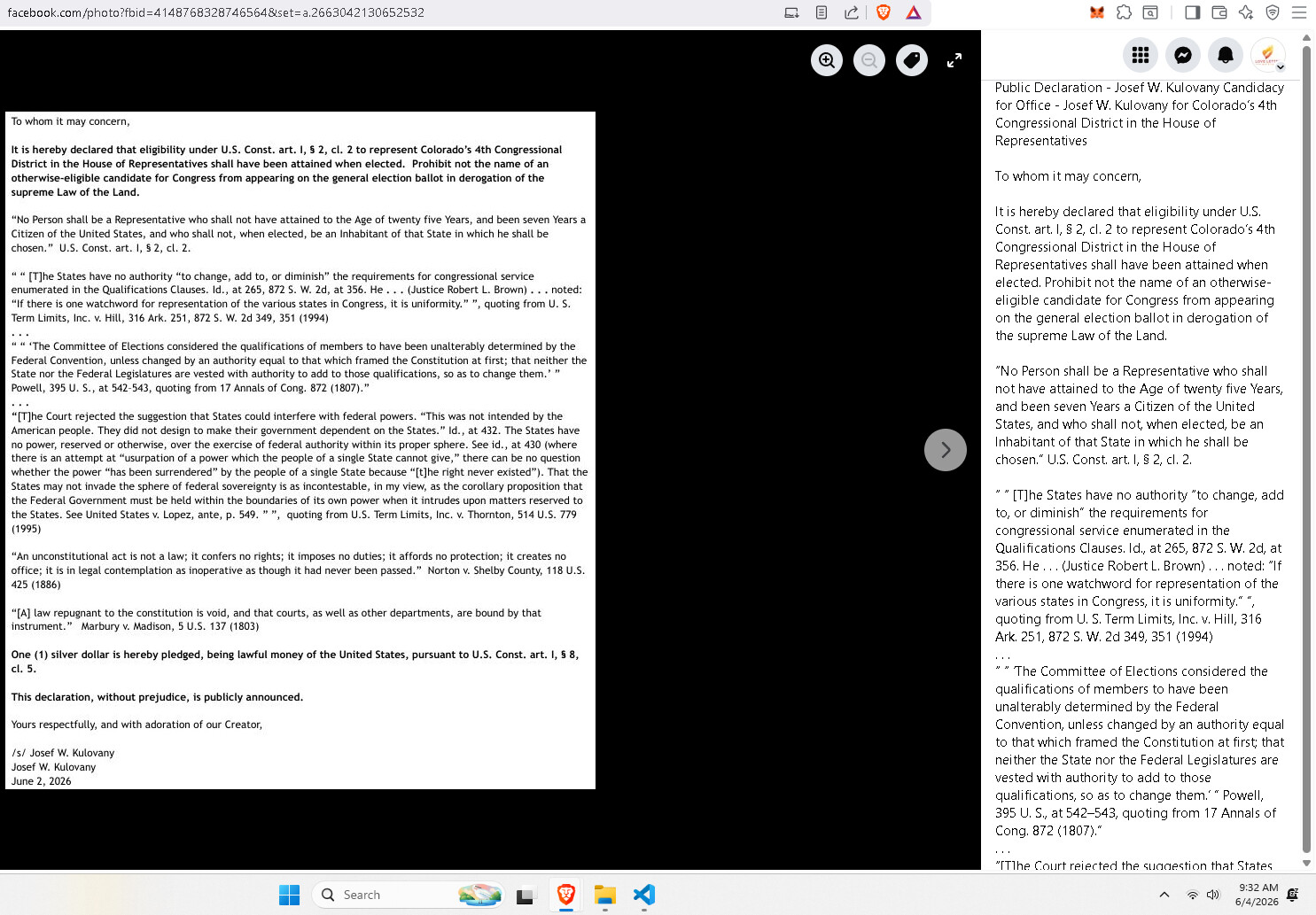
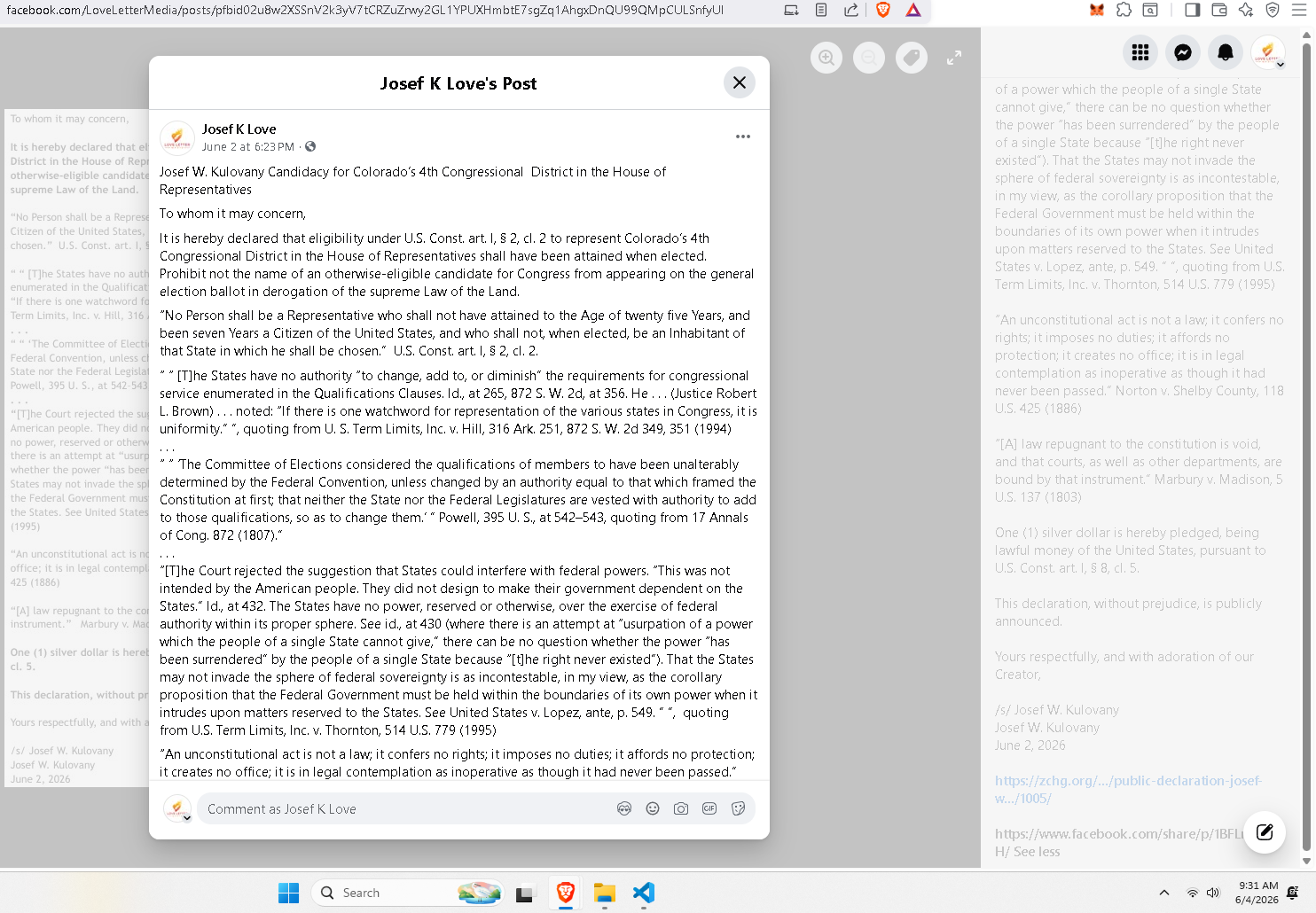
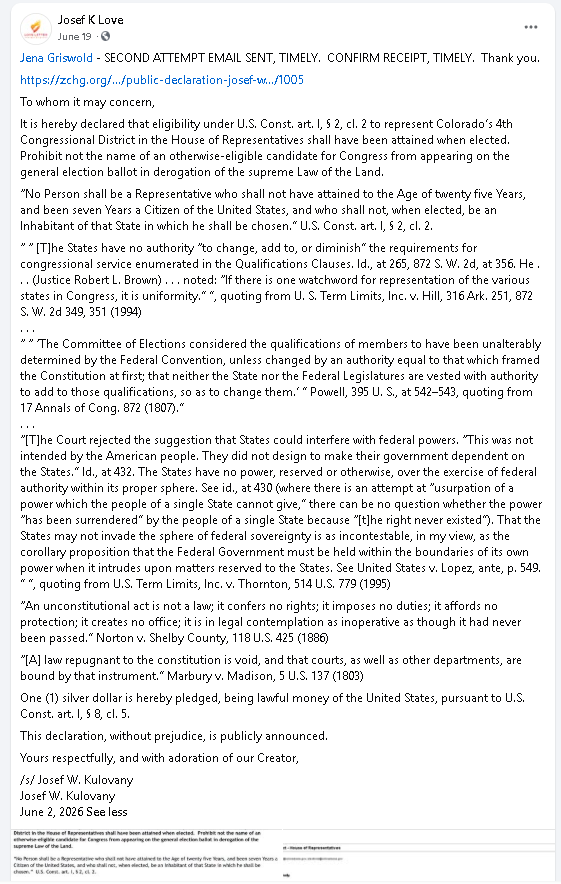
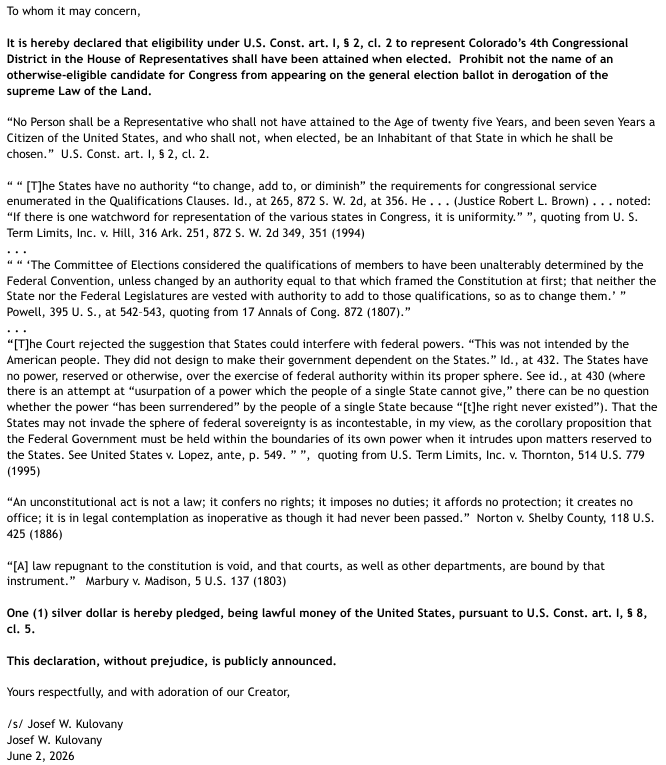
To whom it may concern,
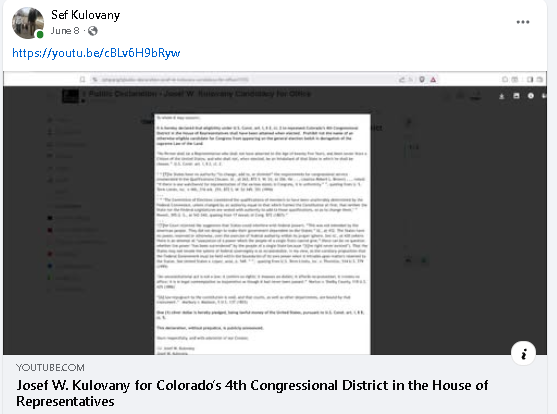
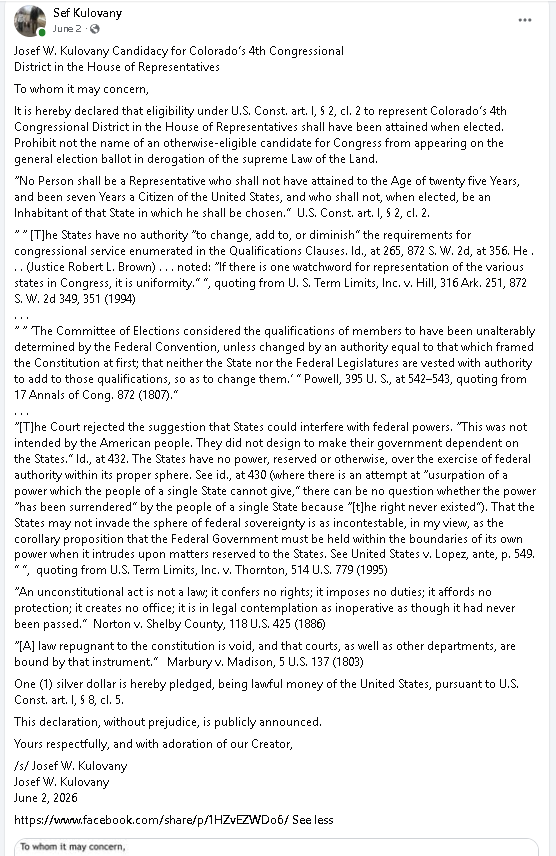
It is hereby declared that eligibility under U.S. Const. art. I, § 2, cl. 2 to represent Colorado’s 4th Congressional District in the House of Representatives shall have been attained when elected. Prohibit not the name of an otherwise-eligible candidate for Congress from appearing on the general election ballot in derogation of the supreme Law of the Land.
“No Person shall be a Representative who shall not have attained to the Age of twenty five Years, and been seven Years a Citizen of the United States, and who shall not, when elected, be an Inhabitant of that State in which he shall be chosen.” U.S. Const. art. I, § 2, cl. 2.
“ “ [T]he States have no authority “to change, add to, or diminish” the requirements for congressional service enumerated in the Qualifications Clauses. Id., at 265, 872 S. W. 2d, at 356. He . . . (Justice Robert L. Brown) . . . noted: “If there is one watchword for representation of the various states in Congress, it is uniformity.” ”, quoting from U. S. Term Limits, Inc. v. Hill, 316 Ark. 251, 872 S. W. 2d 349, 351 (1994)
. . .
“ “ ‘The Committee of Elections considered the qualifications of members to have been unalterably determined by the Federal Convention, unless changed by an authority equal to that which framed the Constitution at first; that neither the State nor the Federal Legislatures are vested with authority to add to those qualifications, so as to change them.’ ” Powell, 395 U. S., at 542–543, quoting from 17 Annals of Cong. 872 (1807).”
. . .
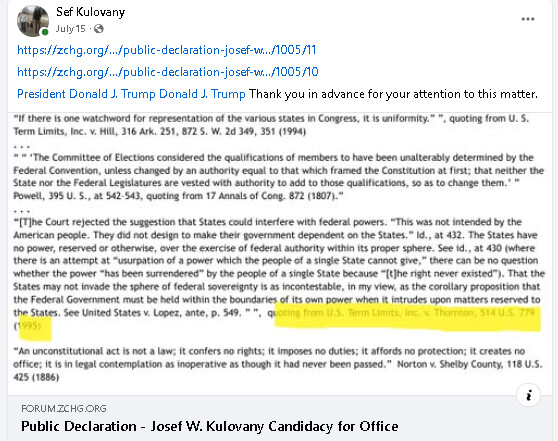
“[T]he Court rejected the suggestion that States could interfere with federal powers. “This was not intended by the American people. They did not design to make their government dependent on the States.” Id., at 432. The States have no power, reserved or otherwise, over the exercise of federal authority within its proper sphere. See id., at 430 (where there is an attempt at “usurpation of a power which the people of a single State cannot give,” there can be no question whether the power “has been surrendered” by the people of a single State because “[t]he right never existed”). That the States may not invade the sphere of federal sovereignty is as incontestable, in my view, as the corollary proposition that the Federal Government must be held within the boundaries of its own power when it intrudes upon matters reserved to the States. See United States v. Lopez, ante, p. 549. ” ”, quoting from U.S. Term Limits, Inc. v. Thornton, 514 U.S. 779 (1995)
“An unconstitutional act is not a law; it confers no rights; it imposes no duties; it affords no protection; it creates no office; it is in legal contemplation as inoperative as though it had never been passed.” Norton v. Shelby County, 118 U.S. 425 (1886)
“[A] law repugnant to the constitution is void, and that courts, as well as other departments, are bound by that instrument.” Marbury v. Madison, 5 U.S. 137 (1803)
One (1) silver dollar is hereby pledged, being lawful money of the United States, pursuant to U.S. Const. art. I, § 8, cl. 5.
This declaration, without prejudice, is publicly announced.
Yours respectfully, and with adoration of our Creator,
/s/ Josef W. Kulovany
Josef W. Kulovany
June 2, 2026