McDonel v. State, 90 Ind. 320, 323 (1883) .
Source
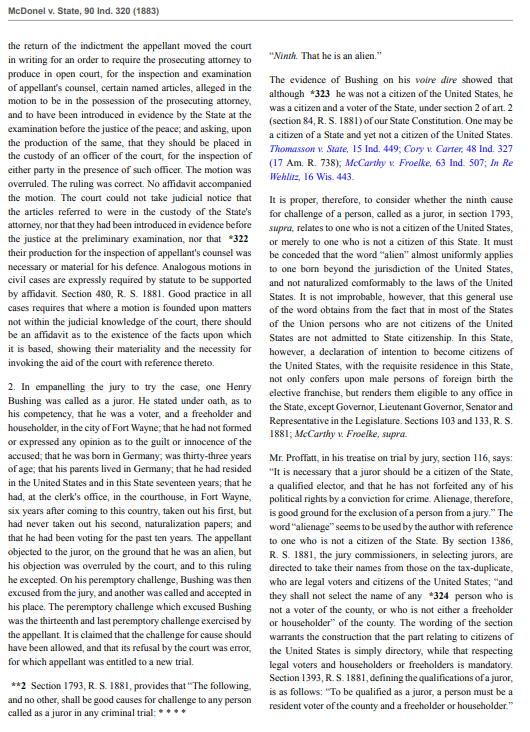
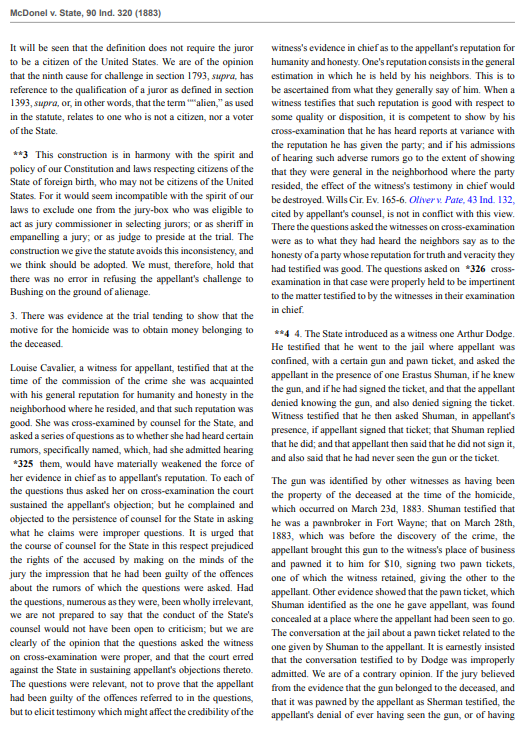
- In empanelling the jury to try the case, one Henry
Bushing was called as a juror. He stated under oath, as to
his competency, that he was a voter, and a freeholder and
householder, in the city of Fort Wayne; that he had not formed
or expressed any opinion as to the guilt or innocence of the
accused; that he was born in Germany; was thirty-three years
of age; that his parents lived in Germany; that he had resided
in the United States and in this State seventeen years; that he
had, at the clerk’s office, in the courthouse, in Fort Wayne,
six years after coming to this country, taken out his first, but
had never taken out his second, naturalization papers; and
that he had been voting for the past ten years. The appellant
objected to the juror, on the ground that he was an alien, but
his objection was overruled by the court, and to this ruling
he excepted. On his peremptory challenge, Bushing was then
excused from the jury, and another was called and accepted in
his place. The peremptory challenge which excused Bushing
was the thirteenth and last peremptory challenge exercised by
the appellant. It is claimed that the challenge for cause should
have been allowed, and that its refusal by the court was error,
for which appellant was entitled to a new trial.
**2 Section 1793, R. S. 1881, provides that “The following,
and no other, shall be good causes for challenge to any person
called as a juror in any criminal trial: * * * *
“Ninth. That he is an alien.”
The evidence of Bushing on his voire dire showed that
although *323 he was not a citizen of the United States, he
was a citizen and a voter of the State, under section 2 of art. 2
(section 84, R. S. 1881) of our State Constitution (Indiana). One may be
a citizen of a State and yet not a citizen of the United States.
Thomasson v. State, 15 Ind. 449; Cory v. Carter, 48 Ind. 327
(17 Am. R. 738); McCarthy v. Froelke, 63 Ind. 507; In Re
Wehlitz, 16 Wis. 443.
It is proper, therefore, to consider whether the ninth cause
for challenge of a person, called as a juror, in section 1793,
supra, relates to one who is not a citizen of the United States,
or merely to one who is not a citizen of this State. It must
be conceded that the word “alien” almost uniformly applies
to one born beyond the jurisdiction of the United States,
and not naturalized comformably to the laws of the United
States. It is not improbable, however, that this general use
of the word obtains from the fact that in most of the States
of the Union persons who are not citizens of the United
States are not admitted to State citizenship. In this State,
however, a declaration of intention to become citizens of
the United States, with the requisite residence in this State,
not only confers upon male persons of foreign birth the
elective franchise, but renders them eligible to any office in
the State, except Governor, Lieutenant Governor, Senator and
Representative in the Legislature. Sections 103 and 133, R. S.
1881; McCarthy v. Froelke, supra.
Mr. Proffatt, in his treatise on trial by jury, section 116, says:
“It is necessary that a juror should be a citizen of the State,
a qualified elector, and that he has not forfeited any of his
political rights by a conviction for crime. Alienage, therefore,
is good ground for the exclusion of a person from a jury.” The
word “alienage” seems to be used by the author with reference
to one who is not a citizen of the State. By section 1386,
R. S. 1881, the jury commissioners, in selecting jurors, are
directed to take their names from those on the tax-duplicate,
who are legal voters and citizens of the United States; “and
they shall not select the name of any *324 person who is
not a voter of the county, or who is not either a freeholder
or householder” of the county. The wording of the section
warrants the construction that the part relating to citizens of
the United States is simply directory, while that respecting
legal voters and householders or freeholders is mandatory.
Section 1393, R. S. 1881, defining the qualifications of a juror,
is as follows: “To be qualified as a juror, a person must be a
resident voter of the county and a freeholder or householder.”
It will be seen that the definition does not require the juror
to be a citizen of the United States. We are of the opinion
that the ninth cause for challenge in section 1793, supra, has
reference to the qualification of a juror as defined in section
1393, supra, or, in other words, that the term ““alien,” as used
in the statute, relates to one who is not a citizen, nor a voter
of the State.
**3 This construction is in harmony with the spirit and
policy of our Constitution and laws respecting citizens of the
State of foreign birth, who may not be citizens of the United
States. For it would seem incompatible with the spirit of our
laws to exclude one from the jury-box who was eligible to
act as jury commissioner in selecting jurors; or as sheriff in
empanelling a jury; or as judge to preside at the trial. The
construction we give the statute avoids this inconsistency, and
we think should be adopted. We must, therefore, hold that
there was no error in refusing the appellant’s challenge to
Bushing on the ground of alienage.
Source