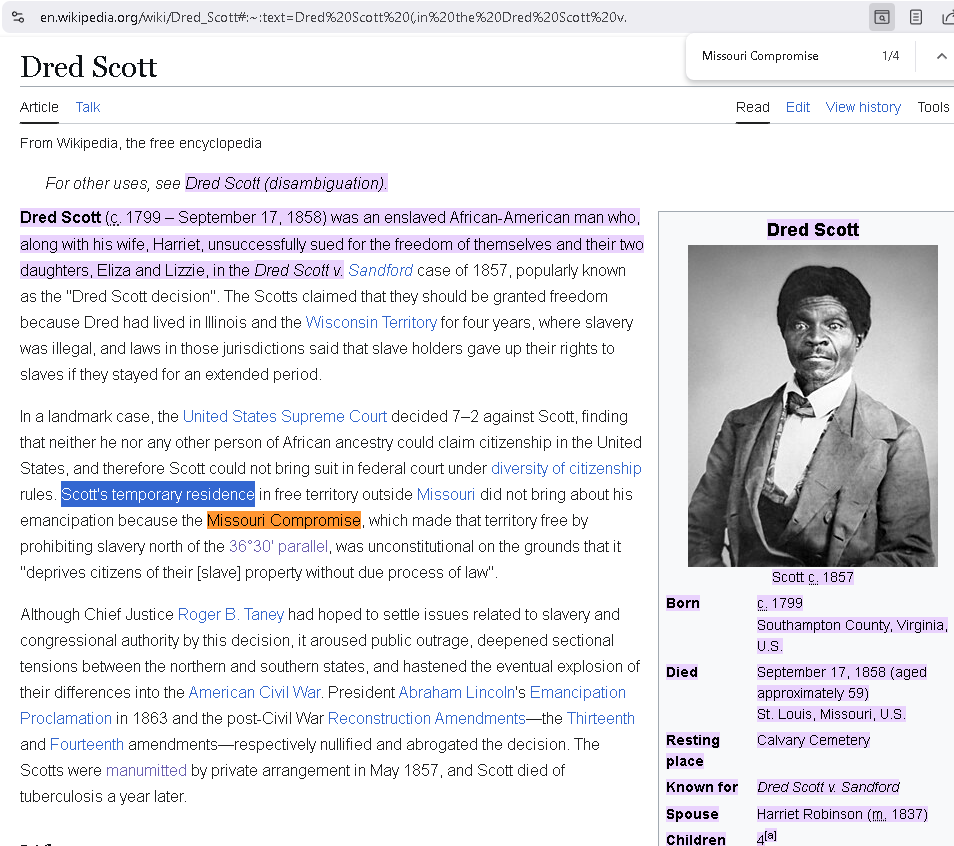
Scott’s Temporary Residence
https://constitution.congress.gov/constitution/article-6/
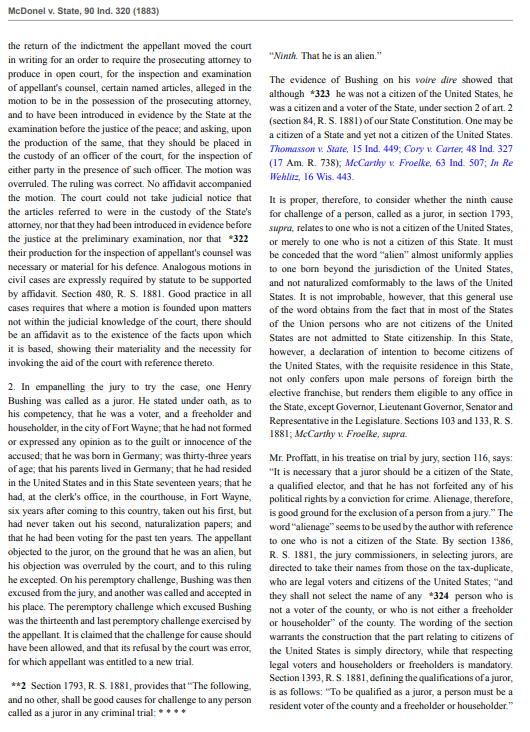
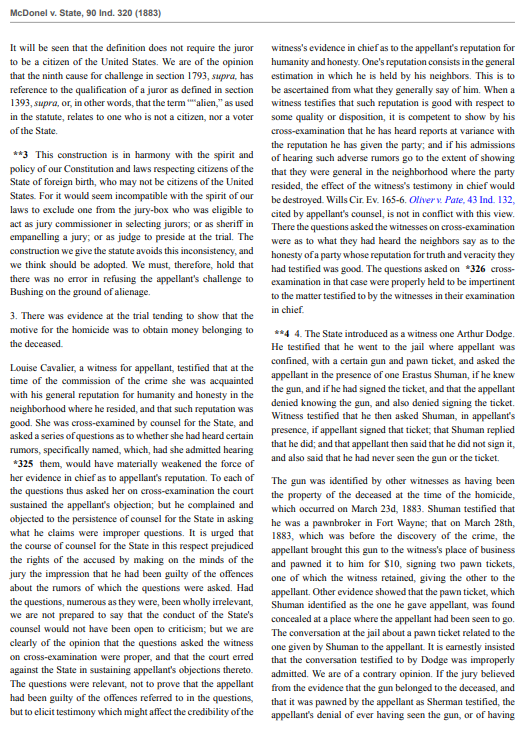
It will be seen that the definition does not require the juror
to be a citizen of the United States. We are of the opinion
that the ninth cause for challenge in section 1793, supra, has
reference to the qualification of a juror as defined in section
1393, supra, or, in other words, that the term ““alien,” as used
in the statute, relates to one who is not a citizen, nor a voter
of the State.
**3 This construction is in harmony with the spirit and
policy of our Constitution and laws respecting citizens of the
State of foreign birth, who may not be citizens of the United
States. For it would seem incompatible with the spirit of our
laws to exclude one from the jury-box who was eligible to
act as jury commissioner in selecting jurors; or as sheriff in
empanelling a jury; or as judge to preside at the trial. The
construction we give the statute avoids this inconsistency, and
we think should be adopted. We must, therefore, hold that
there was no error in refusing the appellant’s challenge to
Bushing on the ground of alienage.
Article I
Section 2: The House of Representatives
The House of Representatives shall be composed of Members chosen every second Year by the People of the several States, and the Electors in each State shall have the Qualifications requisite for Electors of the most numerous Branch of the State Legislature.
No Person shall be a Representative who shall not have attained to the Age of twenty five Years, and been seven Years a Citizen of the United States, and who shall not, when elected, be an Inhabitant of that State in which he shall be chosen.
Representatives and direct Taxes shall be apportioned among the several States which may be included within this Union, according to their respective Numbers, which shall be determined by adding to the whole Number of free Persons, including those bound to Service for a Term of Years, and excluding Indians not taxed, three fifths of all other Persons. The actual Enumeration shall be made within three Years after the first Meeting of the Congress of the United States, and within every subsequent Term of ten Years, in such Manner as they shall by Law direct.The Number of Representatives shall not exceed one for every thirty Thousand, but each State shall have at Least one Representative; and until such enumeration shall be made, the State of New Hampshire shall be entitled to chuse three, Massachusetts eight, Rhode-Island and Providence Plantations one, Connecticut five, New-York six, New Jersey four, Pennsylvania eight, Delaware one, Maryland six, Virginia ten, North Carolina five, South Carolina five, and Georgia three.
When vacancies happen in the Representation from any State, the Executive Authority thereof shall issue Writs of Election to fill such Vacancies.
The House of Representatives shall choose their Speaker and other Officers; and shall have the sole Power of Impeachment.
Section 3: The Senate
The Senate of the United States shall be composed of two Senators from each State, chosen by the Legislature thereof, for six Years; and each Senator shall have one Vote.
Immediately after they shall be assembled in Consequence of the first Election, they shall be divided as equally as may be into three Classes. The Seats of the Senators of the first Class shall be vacated at the Expiration of the second Year, of the second Class at the Expiration of the fourth Year, and of the third Class at the Expiration of the sixth Year, so that one third may be chosen every second Year; and if Vacancies happen by Resignation, or otherwise, during the Recess of the Legislature of any State, the Executive thereof may make temporary Appointments until the next Meeting of the Legislature, which shall then fill such Vacancies.
No Person shall be a Senator who shall not have attained to the Age of thirty Years, and been nine Years a Citizen of the United States, and who shall not, when elected, be an Inhabitant of that State for which he shall be chosen.
Article II
Section 1
No Person except a natural born Citizen, or a Citizen of the United States, at the time of the Adoption of this Constitution, shall be eligible to the Office of President; neither shall any Person be eligible to that Office who shall not have attained to the Age of thirty five Years, and been fourteen Years a Resident within the United States.
Article III
Section 2
The judicial Power shall extend to all Cases, in Law and Equity, arising under this Constitution, the Laws of the United States, and Treaties made, or which shall be made, under their Authority;–to all Cases affecting Ambassadors, other public Ministers and Consuls;–to all Cases of admiralty and maritime Jurisdiction;–to Controversies to which the United States shall be a Party;–to Controversies between two or more States;–between a State and Citizens of another State;–between Citizens of different States;–between Citizens of the same State claiming Lands under Grants of different States, and between a State, or the Citizens thereof, and foreign States, Citizens or Subjects.
Article IV
Section 1
Full Faith and Credit shall be given in each State to the public Acts, Records, and judicial Proceedings of every other State. And the Congress may by general Laws prescribe the Manner in which such Acts, Records and Proceedings shall be proved, and the Effect thereof.
Section 2
The Citizens of each State shall be entitled to all Privileges and Immunities of Citizens in the several States.
A Person charged in any State with Treason, Felony, or other Crime, who shall flee from Justice, and be found in another State, shall on Demand of the executive Authority of the State from which he fled, be delivered up, to be removed to the State having Jurisdiction of the Crime.
No Person held to Service or Labour in one State, under the Laws thereof, escaping into another, shall, in Consequence of any Law or Regulation therein, be discharged from such Service or Labour, but shall be delivered up on Claim of the Party to whom such Service or Labour may be due.
Section 3
New States may be admitted by the Congress into this Union; but no new State shall be formed or erected within the Jurisdiction of any other State; nor any State be formed by the Junction of two or more States, or Parts of States, without the Consent of the Legislatures of the States concerned as well as of the Congress.
The Congress shall have Power to dispose of and make all needful Rules and Regulations respecting the Territory or other Property belonging to the United States; and nothing in this Constitution shall be so construed as to Prejudice any Claims of the United States, or of any particular State.
11th Amendment
The Judicial power of the United States shall not be construed to extend to any suit in law or equity, commenced or prosecuted against one of the United States by Citizens of another State, or by Citizens or Subjects of any Foreign State.
SEC.2. And be it further enacted, That the said state shall consist of all the
territory included within the following boundaries, to wit: Beginning in the middle
of the Mississippi river, on the parallel of thirty-six degrees of north latitude;
thence west, along that parallel of latitude, to the St. Francois river; thence up,
and following the course of that river, in the middle of the main channel thereof,
to the parallel of latitude of thirty-six degrees and thirty minutes; thence west,
along the same, to a point where the said parallel is intersected by a meridian
line passing through the middle of the mouth of the Kansas river, where the same
empties into the Missouri river, thence, from the point aforesaid north, along the
said meridian line, to the intersection of the parallel of latitude which passes
through the rapids of the river Des Moines, making the said line to correspond
with the Indian boundary line; thence east, from the point of intersection last
aforesaid, along the said parallel of latitude, to the middle of the channel of the
main fork of the said river Des Moines ; thence down arid along the middle of the
main channel of the said river Des Moines, to the mouth of the same, where it
empties into the Mississippi river; thence, due east, to the middle of the main
channel of the Mississippi river; thence down, and following the course of the
Mississippi river, in the middle of the main channel thereof, to the place of
beginning : Provided, The said state shall ratify the boundaries aforesaid . And
provided also, That the said state shall have concurrent jurisdiction on the river
Mississippi, and every other river bordering on the said state so far as the said
rivers shall form a common boundary to the said state; and any other state or
states, now or hereafter to be formed and bounded by the same, such rivers to
be common to both; and that the river Mississippi, and the navigable rivers and
waters leading into the same, shall be common highways, and for ever free, as
well to the inhabitants of the said state as to other citizens of the United States,
without any tax, duty impost, or toll, therefor, imposed by the said state.
SEC. 3. And be it further enacted, That all free white male citizens of the United
States, who shall have arrived at the age of twenty-one years, and have resided
in said territory: three months previous to the day of election, and all other
persons qualified to vote for representatives to the general assembly of the said
territory, shall be qualified to be elected and they are hereby qualified and
authorized to vote, and choose representatives to form a convention, who shall
be apportioned amongst the several counties as follows :
From the county of Howard, five representatives. From the county of Cooper,
three representatives. From the county of Montgomery, two representatives.
From the county of Pike, one representative. From the county of Lincoln, one
representative. From the county of St. Charles, three representatives. From the
county of Franklin, one representative. From the county of St. Louis, eight
representatives. From the county of Jefferson, one representative. From the
county of Washington, three representatives. From the county of St. Genevieve,
four representatives. From the county of Madison, one representative. From the
county of Cape Girardeau, five representatives. From the county of New Madrid,
two representatives. From the county of Wayne, and that portion of the county of
Lawrence which falls within the boundaries herein designated, one
representative.
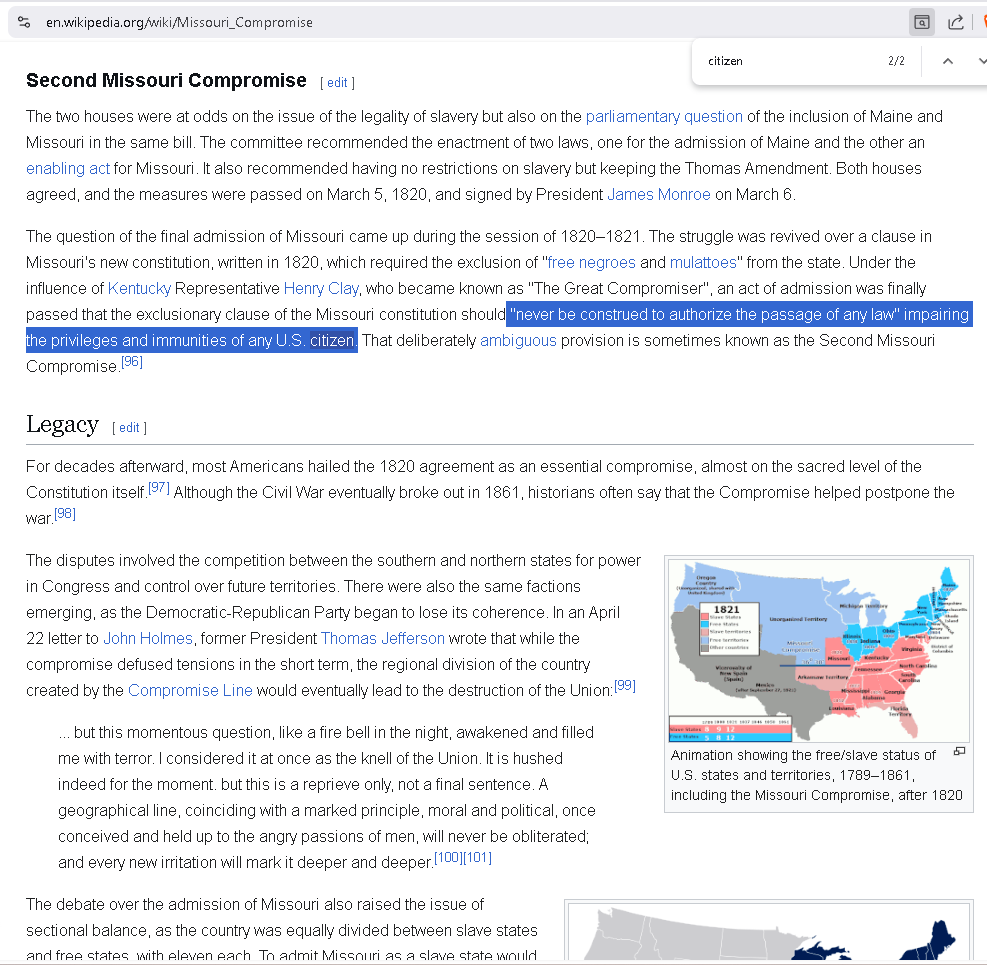
An Act to authorize the people of the Missouri territory to form a constitution and
state government, and for the admission of such state into the Union on an equal
footing with the original states, and to prohibit slavery in certain territories.
Be it enacted by the Senate and House of Representatives of the United States
of America, in Congress assembled, That the inhabitants of that portion of the
Missouri territory included within the boundaries herein after designated, be, and
they are hereby, authorized to form for themselves a constitution and state
government, and to assume such name as they shall deem proper; and the said
state, when formed, shall be admitted into the Union, upon an equal footing with
the original states, in all respects whatsoever
“that this nation, under God, shall have a new birth of freedom—and that government of the people, by the people, for the people, shall not perish from the earth.”
14th Amendment
Section 1
All persons born or naturalized in the United States, and subject to the jurisdiction thereof, are citizens of the United States and of the State wherein they reside. No State shall make or enforce any law which shall abridge the privileges or immunities of citizens of the United States; nor shall any State deprive any person of life, liberty, or property, without due process of law; nor deny to any person within its jurisdiction the equal protection of the laws.
Section 2
Representatives shall be apportioned among the several States according to their respective numbers, counting the whole number of persons in each State, excluding Indians not taxed. But when the right to vote at any election for the choice of electors for President and Vice-President of the United States, Representatives in Congress, the Executive and Judicial officers of a State, or the members of the Legislature thereof, is denied to any of the male inhabitants of such State, being twenty-one years of age, and citizens of the United States, or in any way abridged, except for participation in rebellion, or other crime, the basis of representation therein shall be reduced in the proportion which the number of such male citizens shall bear to the whole number of male citizens twenty-one years of age in such State.
Section 3
No person shall be a Senator or Representative in Congress, or elector of President and Vice-President, or hold any office, civil or military, under the United States, or under any State, who, having previously taken an oath, as a member of Congress, or as an officer of the United States, or as a member of any State legislature, or as an executive or judicial officer of any State, to support the Constitution of the United States, shall have engaged in insurrection or rebellion against the same, or given aid or comfort to the enemies thereof. But Congress may by a vote of two-thirds of each House, remove such disability.
Section 4
The validity of the public debt of the United States, authorized by law, including debts incurred for payment of pensions and bounties for services in suppressing insurrection or rebellion, shall not be questioned. But neither the United States nor any State shall assume or pay any debt or obligation incurred in aid of insurrection or rebellion against the United States, or any claim for the loss or emancipation of any slave; but all such debts, obligations and claims shall be held illegal and void.
Section 5
The Congress shall have power to enforce, by appropriate legislation, the provisions of this article.
15th Amendment
Section 1
The right of citizens of the United States to vote shall not be denied or abridged by the United States or by any State on account of race, color, or previous condition of servitude.
Section 2
The Congress shall have power to enforce this article by appropriate legislation.
19th Amendment
The right of citizens of the United States to vote shall not be denied or abridged by the United States or by any State on account of sex.
Congress shall have power to enforce this article by appropriate legislation.
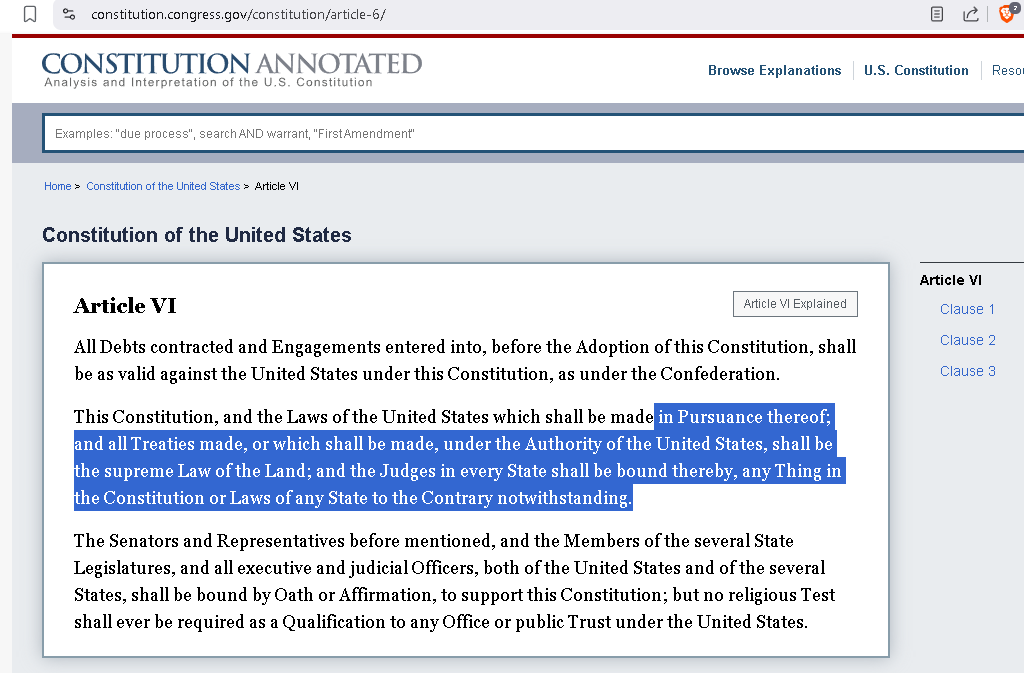
Article VI
All Debts contracted and Engagements entered into, before the Adoption of this Constitution, shall be as valid against the United States under this Constitution, as under the Confederation.
This Constitution, and the Laws of the United States which shall be made in Pursuance thereof; and all Treaties made, or which shall be made, under the Authority of the United States, shall be the supreme Law of the Land; and the Judges in every State shall be bound thereby, any Thing in the Constitution or Laws of any State to the Contrary notwithstanding.
“the Laws of the United States which shall be made in Pursuance thereof;”
“all Treaties made, or which shall be made, under the Authority of the United States,”
“Treaties” are “made, under the Authority of the United States,”
“The United States”.. “shall be in Pursuance thereof;”
In Pursuance of what? (yes, Pursuance is intentionally capitalized)
“the supreme Law of the Land;”.
… “and the Judges in every State shall be bound thereby, any Thing in the Constitution or Laws of any State to the Contrary notwithstanding.”
Source
“NOTWITHSTANDING. conj. [This word is properly a participial adjective, as it is compounded of not and withstanding, and answers exactly to the Latin non obstante.]”
“Answers exactly to the Latin non obstante”: It is an English loan-translation of the Medieval Latin legal phrase non obstante, which means “not standing in the way” or “being no hindrance”.
Courts often construe remedial statutes liberally.
Example:
Tcherepnin v. Knight, 389 U.S. 332, 336 (1967).
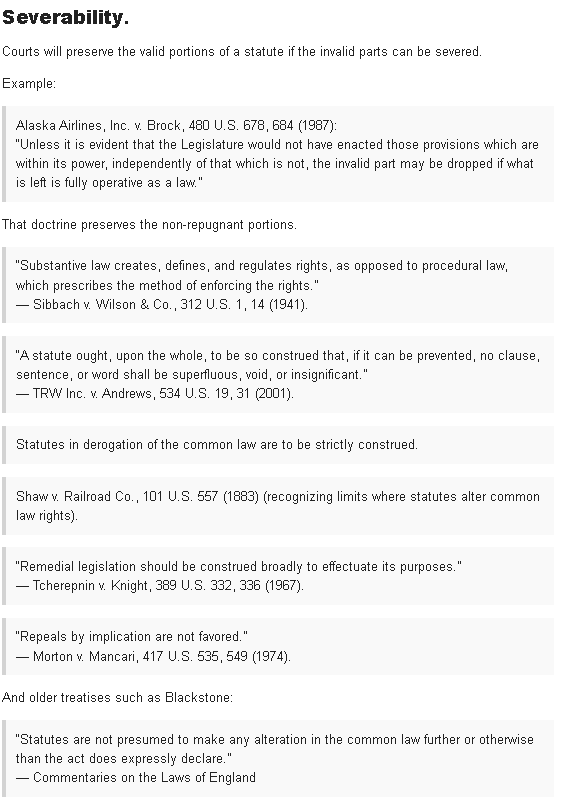
Severability.
Courts will preserve the valid portions of a statute if the invalid parts can be severed.
Example:
Alaska Airlines, Inc. v. Brock, 480 U.S. 678, 684 (1987):
“Unless it is evident that the Legislature would not have enacted those provisions which are within its power, independently of that which is not, the invalid part may be dropped if what is left is fully operative as a law.”
That doctrine preserves the non-repugnant portions.
“Substantive law creates, defines, and regulates rights, as opposed to procedural law, which prescribes the method of enforcing the rights.”
— Sibbach v. Wilson & Co., 312 U.S. 1, 14 (1941).
“A statute ought, upon the whole, to be so construed that, if it can be prevented, no clause, sentence, or word shall be superfluous, void, or insignificant.”
— TRW Inc. v. Andrews, 534 U.S. 19, 31 (2001).
Statutes in derogation of the common law are to be strictly construed.
Shaw v. Railroad Co., 101 U.S. 557 (1883) (recognizing limits where statutes alter common law rights).
“Remedial legislation should be construed broadly to effectuate its purposes.”
— Tcherepnin v. Knight, 389 U.S. 332, 336 (1967).
“Repeals by implication are not favored.”
— Morton v. Mancari, 417 U.S. 535, 549 (1974).
And older treatises such as Blackstone:
“Statutes are not presumed to make any alteration in the common law further or otherwise than the act does expressly declare.”
— Commentaries on the Laws of England
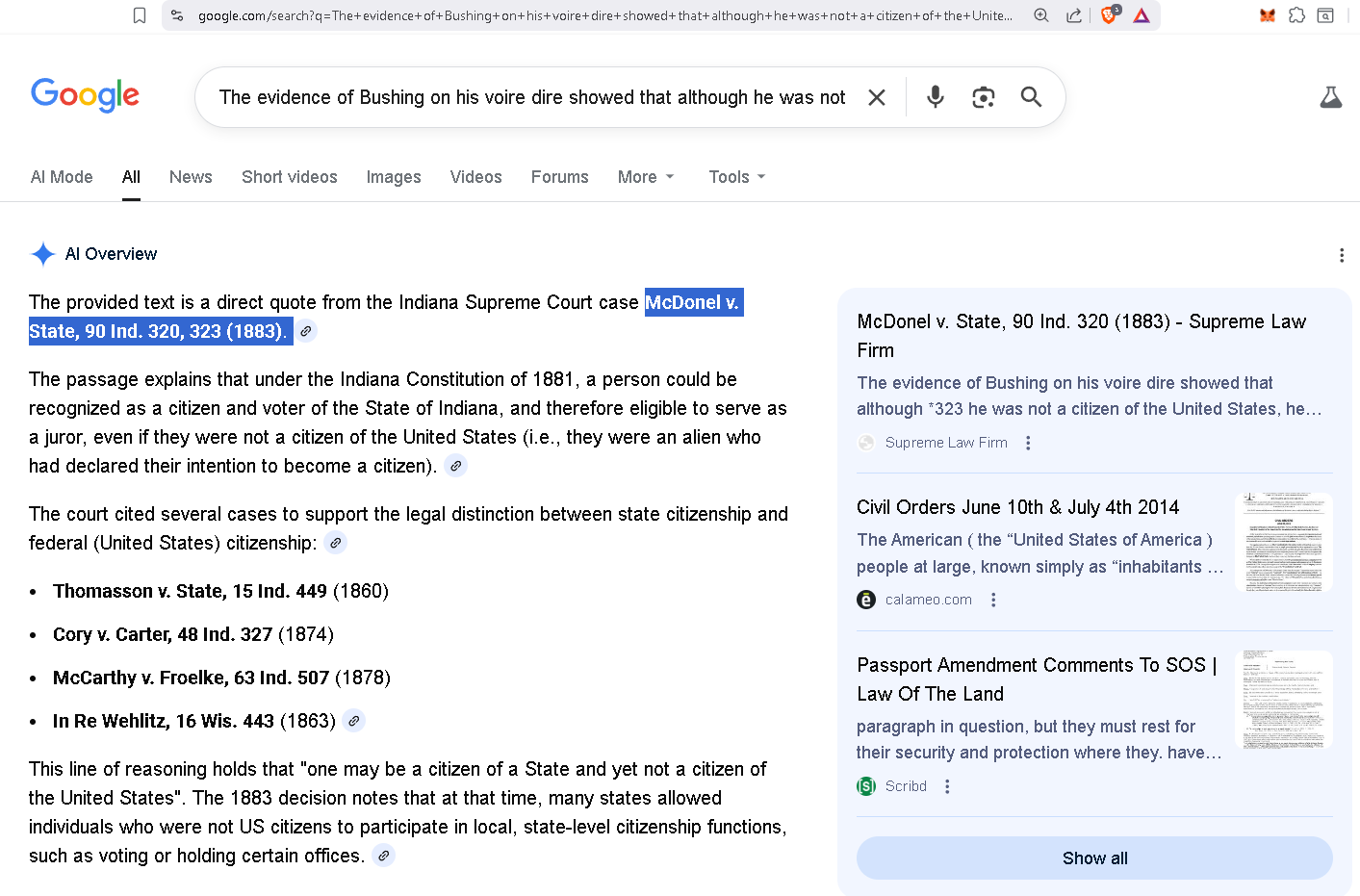
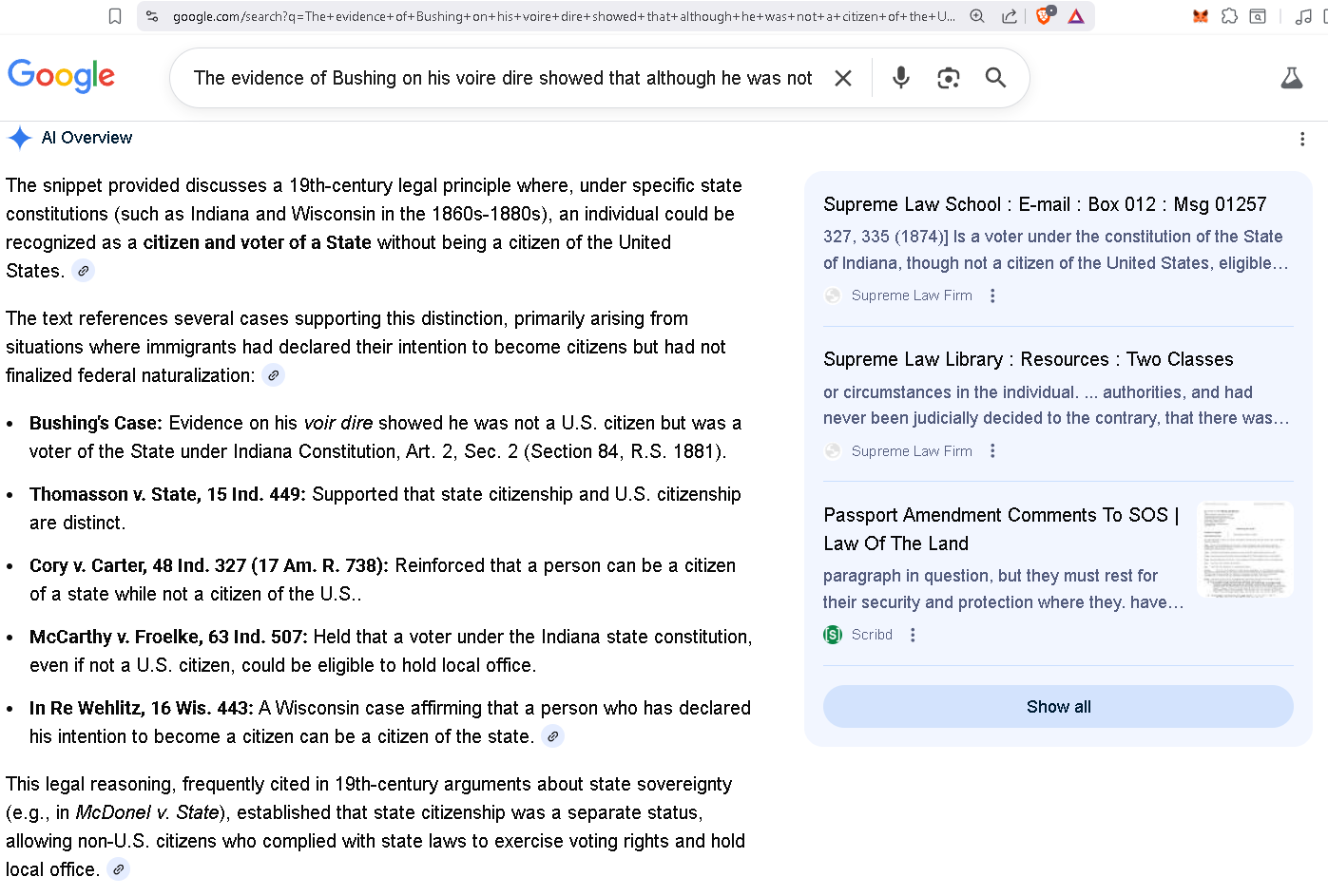
The evidence of Bushing on his voire dire showed that although he was not a citizen of the United States, he was a citizen and a voter of the State, under section 2 of art. 2 (section 84, R.S. 1881) of our State Constitution. One may be a citizen of a State and yet not a citizen of the United States. Thomasson v. State, 15 Ind. 449; Cory v. carter, 48 Ind. 327 (17 Am. R. 738); McCarthy v. Froelke, 63 Ind. 507; In Re Wehlitz, 16 Wis. 443