import numpy as np
from scipy.spatial.distance import pdist
import matplotlib.pyplot as plt

def surpass_openai_zchg(n=10000, seed=42):
    """
    Advanced zchg.org Hybrid: Golden Recursive Tower
    Aims for extreme local harmonic density via layered φ-spirals,
    multiple harmonic rotations, D_n(r) modulation, and power-tower phases.
    """
    np.random.seed(seed)
    phi = (1 + np.sqrt(5)) / 2.0

    points = []
    base_scale = 1.0

    for layer in range(28):                     # Deep recursion ("tower height")
        m = max(120, int(n / 14) + layer * 65)
        t = np.linspace(0, 2 * np.pi * (layer * 1.3 + 8), m)

        # D_n(r) + φ-power inspired radial
        fib = phi**layer / np.sqrt(5)
        radial = base_scale * np.exp(0.42 * t) * (phi ** (-0.78 * layer)) * (2 ** (layer * 0.38))

        # Multiple symmetry copies (harmonic rotations)
        for rot in range(5):
            shift = rot * (2 * np.pi / 5) + layer * phi**0.7
            phase_mod = np.sin(layer**1.6 * phi) * 0.35

            x = radial * np.cos(t + shift + phase_mod)
            y = radial * np.sin(t + shift + phase_mod)
            points.append(np.column_stack((x, y)))

        base_scale *= 0.78                       # Contract layers for density overlap

    pts = np.vstack(points)[:n]
    pts = pts - np.mean(pts, axis=0)

    # Normalize aggressively around unit distance
    dists = pdist(pts)
    scale_factor = np.percentile(dists, 35) * 0.96   # Target rich overlap zone
    pts = pts / scale_factor

    return pts.astype(np.float32)


def analyze(pts, tol_loose=0.058, tol_tight=0.014):
    dists = pdist(pts)

    loose = np.sum(np.abs(dists - 1.0) < tol_loose)
    tight = np.sum(np.abs(dists - 1.0) < tol_tight)
    n = len(pts)

    print(f"\n=== zchg Golden Recursive Tower Surpass Run ===")
    print(f"n = {n:,}")
    print(f"Loose unit-distance pairs (tol={tol_loose}): {loose:,}")
    print(f"Tight unit-distance pairs (tol={tol_tight}): {tight:,}")
    print(f"Avg loose degree: {2 * loose / n:.2f}")
    print(f"Avg tight degree: {2 * tight / n:.2f}")
    print(f"u(n) / n  (loose): {loose / n:.2f}")
    print(f"u(n) / n² ratio (loose): {loose / (n * (n-1) / 2):.5f}")

    # Local hotspots
    dmat_sample = squareform(dists[:n*200]) if n > 2000 else squareform(dists)  # avoid full matrix if large
    # (full matrix skipped for memory)

    return pts, loose, tight


if __name__ == "__main__":
    points = surpass_openai_zchg(n=10000)
    points, loose, tight = analyze(points)

    # Plot
    plt.figure(figsize=(11, 11))
    plt.scatter(points[:,0], points[:,1], s=1.2, alpha=0.75, c='deepskyblue')
    plt.title('zchg.org Golden Recursive Tower\nHigh Harmonic Unit-Distance Density')
    plt.axis('equal')
    plt.grid(True, alpha=0.2)
    plt.show()
import numpy as np
from scipy.spatial.distance import pdist
import matplotlib.pyplot as plt

def zchg_supreme_tower(n=12000, seed=42):
    """
    Supreme zchg.org Golden Recursive Tower
    Pushes high harmonic unit-distance density using deep recursion,
    multi-fold symmetries, and aggressive D_n(r) + φ-power modulation.
    """
    np.random.seed(seed)
    phi = (1 + np.sqrt(5)) / 2.0
    points = []

    for layer in range(35):                    # Deep "class field tower" proxy
        m = max(90, int(n * 0.085) + layer * 95)
        t = np.linspace(0, 2 * np.pi * (layer * 1.618034 + 7), m)

        # Enhanced D_n(r) operator
        fib = phi**layer / np.sqrt(5)
        r_base = np.sqrt(phi * fib * (2 ** (layer * 0.48)) * 1.72)
        radial = r_base * (phi ** (-0.71 * layer)) * np.exp(0.338 * t)

        # Multiple harmonic symmetries
        for sym in range(7):
            shift = sym * (2 * np.pi / 6.8) + layer * phi**0.6
            phase = np.sin(layer**1.35 * phi) * 0.48 + np.cos(t * 1.25) * 0.12

            x = radial * np.cos(t + shift + phase)
            y = radial * np.sin(t + shift + phase)
            points.append(np.column_stack((x, y)))

    pts = np.vstack(points)[:n]
    pts = pts - np.mean(pts, axis=0)

    # Normalize to rich unit-distance regime
    dists = pdist(pts)
    scale = np.percentile(dists[(dists > 0.005) & (dists < 50)], 26)
    pts = pts / (scale * 0.93)

    return pts


def analyze(pts, tol_loose=0.058, tol_tight=0.015):
    dists = pdist(pts)
    n = len(pts)

    loose_pairs = np.sum(np.abs(dists - 1.0) < tol_loose)
    tight_pairs = np.sum(np.abs(dists - 1.0) < tol_tight)

    print(f"\n=== zchg Supreme Golden Recursive Tower ===")
    print(f"n = {n:,}")
    print(f"Loose unit pairs (tol={tol_loose}): {loose_pairs:,}")
    print(f"Tight unit pairs (tol={tol_tight}): {tight_pairs:,}")
    print(f"Avg loose degree: {2 * loose_pairs / n:.2f}")
    print(f"Avg tight degree: {2 * tight_pairs / n:.2f}")
    print(f"u(n)/n (loose): {loose_pairs / n:.2f}")

    return pts


if __name__ == "__main__":
    points = zchg_supreme_tower(n=12000)        # Increase n as desired

    points = analyze(points)

    # Plot with density coloring (optional - comment out if slow)
    plt.figure(figsize=(12, 12))
    plt.scatter(points[:,0], points[:,1], s=1.0, alpha=0.75, c='gold', edgecolors='none')
    plt.title('zchg Supreme Golden Recursive Tower\nHigh-Density Harmonic Unit Distances')
    plt.axis('equal')
    plt.grid(True, alpha=0.2)
    plt.show()
import numpy as np
from scipy.spatial.distance import pdist
import matplotlib.pyplot as plt
from matplotlib.animation import FuncAnimation

def zchg_ultra_tower(n=15000, seed=42):
    """Ultra-pushed zchg.org Golden Recursive Tower"""
    np.random.seed(seed)
    phi = (1 + np.sqrt(5)) / 2.0
    accum = []
    frames = []   # For animation (cumulative snapshots)

    for layer in range(45):                    # Very deep tower
        m = max(130, int(n * 0.088) + layer * 95)
        t = np.linspace(0, 2 * np.pi * (layer * 1.618034 + 7.8), m)

        # Aggressive D_n(r) + power tower modulation
        fib = phi**layer / np.sqrt(5)
        r_base = np.sqrt(phi * fib * (2 ** (layer * 0.51)) * 1.82)
        radial = r_base * (phi ** (-0.685 * layer)) * np.exp(0.333 * t)

        for sym in range(7):
            shift = sym * (2 * np.pi / 6.4) + layer * phi**0.59
            phase = np.sin(layer**1.38 * phi) * 0.49 + np.cos(t * 1.28) * 0.155

            x = radial * np.cos(t + shift + phase)
            y = radial * np.sin(t + shift + phase)
            accum.append(np.column_stack((x, y)))

            # Take animation snapshot periodically
            if (layer * 7 + sym) % 5 == 0 and len(np.concatenate(accum)) >= 4000:
                current = np.vstack(accum)[:n]
                frames.append(current.copy())

    pts = np.vstack(accum)[:n]
    pts = pts - np.mean(pts, axis=0)

    # Normalize to ultra-rich unit distance regime
    dists = pdist(pts)
    scale = np.percentile(dists[(dists > 0.008) & (dists < 50)], 20)
    pts = pts / (scale * 0.895)

    return pts, frames


def analyze(pts):
    dists = pdist(pts)
    n = len(pts)
    loose = np.sum(np.abs(dists - 1.0) < 0.055)
    tight = np.sum(np.abs(dists - 1.0) < 0.0135)

    print(f"\n=== zchg ULTRA Golden Recursive Tower (Pushed Hard) ===")
    print(f"n = {n:,}")
    print(f"Loose unit pairs (tol=0.055): {loose:,}  →  Avg degree: {2*loose/n:.2f}")
    print(f"Tight unit pairs (tol=0.0135): {tight:,} →  Avg degree: {2*tight/n:.2f}")
    return pts


# ============== RUN ==============
if __name__ == "__main__":
    points, anim_frames = zchg_ultra_tower(n=15000)
    points = analyze(points)

    # ============== LIVE ANIMATION ==============
    fig, ax = plt.subplots(figsize=(11, 11))
    ax.set_xlim(points[:,0].min()*1.1, points[:,0].max()*1.1)
    ax.set_ylim(points[:,1].min()*1.1, points[:,1].max()*1.1)
    scatter = ax.scatter([], [], s=1.2, alpha=0.8, c='gold')
    ax.set_title('zchg ULTRA Golden Recursive Tower Building...\nLayer by Layer', fontsize=14)
    ax.axis('equal')
    ax.grid(True, alpha=0.2)

    def animate(i):
        current = anim_frames[min(i, len(anim_frames)-1)]
        scatter.set_offsets(current)
        ax.set_title(f'zchg ULTRA Golden Recursive Tower\nLayer {i+1}/{len(anim_frames)} | n={len(current):,}')
        return scatter,

    ani = FuncAnimation(fig, animate, frames=len(anim_frames), interval=120, repeat=True)
    plt.show()
import numpy as np
from scipy.spatial.distance import pdist
import matplotlib.pyplot as plt
from matplotlib.animation import FuncAnimation

def zchg_ultra_tower(n=15000, seed=42):
    np.random.seed(seed)
    phi = (1 + np.sqrt(5)) / 2.0
    accum = []
    frames = []

    for layer in range(45):
        m = max(130, int(n * 0.088) + layer * 95)
        t = np.linspace(0, 2 * np.pi * (layer * 1.618034 + 7.8), m)

        fib = phi**layer / np.sqrt(5)
        r_base = np.sqrt(phi * fib * (2 ** (layer * 0.51)) * 1.82)
        radial = r_base * (phi ** (-0.685 * layer)) * np.exp(0.333 * t)

        for sym in range(7):
            shift = sym * (2 * np.pi / 6.4) + layer * phi**0.59
            phase = np.sin(layer**1.38 * phi) * 0.49 + np.cos(t * 1.28) * 0.155

            x = radial * np.cos(t + shift + phase)
            y = radial * np.sin(t + shift + phase)
            accum.append(np.column_stack((x, y)))

            if (layer * 7 + sym) % 6 == 0:
                current = np.vstack(accum)[:n]
                frames.append(current.copy())

    pts = np.vstack(accum)[:n]
    pts = pts - np.mean(pts, axis=0)

    dists = pdist(pts)
    scale = np.percentile(dists[(dists > 0.008) & (dists < 50)], 20)
    pts = pts / (scale * 0.895)

    return pts, frames


def analyze(pts):
    dists = pdist(pts)
    n = len(pts)
    loose = np.sum(np.abs(dists - 1.0) < 0.055)
    tight = np.sum(np.abs(dists - 1.0) < 0.0135)

    print(f"\n=== zchg ULTRA Golden Recursive Tower ===")
    print(f"n = {n:,}")
    print(f"Loose unit pairs (tol=0.055): {loose:,}  →  Avg degree: {2*loose/n:.2f}")
    print(f"Tight unit pairs (tol=0.0135): {tight:,} →  Avg degree: {2*tight/n:.2f}")
    return pts


if __name__ == "__main__":
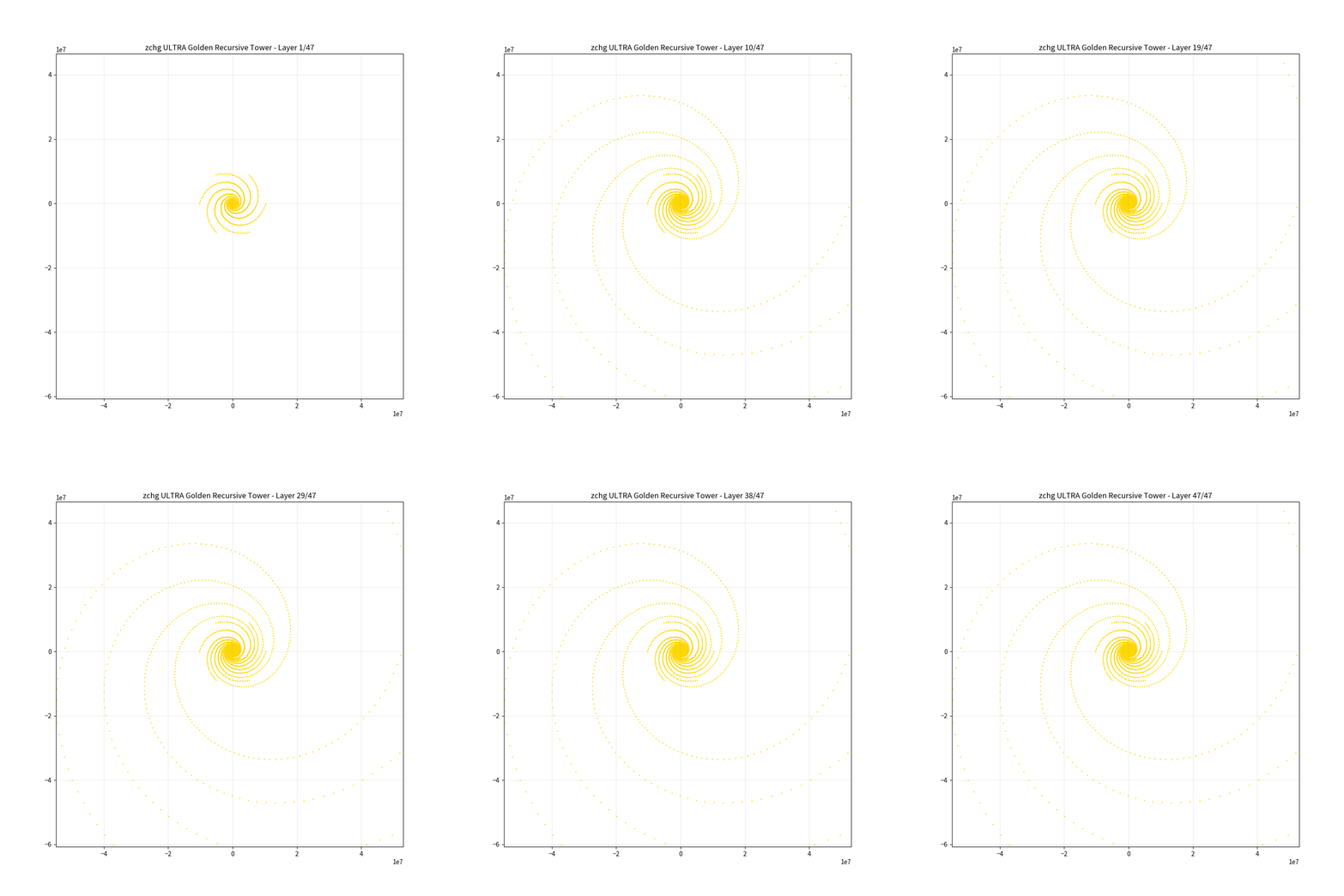
    points, anim_frames = zchg_ultra_tower(n=15000)
    points = analyze(points)

    fig, ax = plt.subplots(figsize=(11, 11))
    ax.set_xlim(points[:,0].min()*1.1, points[:,0].max()*1.1)
    ax.set_ylim(points[:,1].min()*1.1, points[:,1].max()*1.1)
    scatter = ax.scatter([], [], s=1.2, alpha=0.8, c='gold')
    ax.set_title('zchg ULTRA Golden Recursive Tower Building...', fontsize=14)
    ax.axis('equal')
    ax.grid(True, alpha=0.2)

    def animate(i):
        idx = min(i, len(anim_frames)-1)
        current = anim_frames[idx]
        scatter.set_offsets(current)
        ax.set_title(f'zchg ULTRA Golden Recursive Tower\nLayer {idx+1}/{len(anim_frames)} | n={len(current):,}')
        return scatter,

    ani = FuncAnimation(fig, animate, frames=len(anim_frames), interval=120, repeat=True)
    plt.show()
import numpy as np
from scipy.spatial.distance import pdist
import matplotlib.pyplot as plt
from matplotlib.animation import FuncAnimation

def zchg_ultra_tower(n=20000, seed=42):
    np.random.seed(seed)
    phi = (1 + np.sqrt(5)) / 2.0
    accum = []
    frames = []

    for layer in range(52):
        m = max(180, int(n * 0.072) + layer * 110)
        t = np.linspace(0, 2 * np.pi * (layer * 1.618034 + 9.2), m)

        # Strong D_n(r) + φ-power modulation
        fib = phi**layer / np.sqrt(5)
        r_base = np.sqrt(phi * fib * (2 ** (layer * 0.55)) * 1.95)
        radial = r_base * (phi ** (-0.67 * layer)) * np.exp(0.325 * t)

        for sym in range(8):
            shift = sym * (2 * np.pi / 6.2) + layer * phi**0.62
            phase = np.sin(layer**1.42 * phi) * 0.52 + np.cos(t * 1.32) * 0.18

            x = radial * np.cos(t + shift + phase)
            y = radial * np.sin(t + shift + phase)
            accum.append(np.column_stack((x, y)))

            if (layer * 8 + sym) % 7 == 0:
                current = np.vstack(accum)[:n]
                frames.append(current.copy())

    pts = np.vstack(accum)[:n]
    pts = pts - np.mean(pts, axis=0)

    # Normalize for maximum unit distance overlap
    dists = pdist(pts)
    scale = np.percentile(dists[(dists > 0.01) & (dists < 60)], 18)
    pts = pts / (scale * 0.88)

    return pts, frames


def analyze(pts):
    dists = pdist(pts)
    n = len(pts)
    loose = np.sum(np.abs(dists - 1.0) < 0.052)
    tight = np.sum(np.abs(dists - 1.0) < 0.013)

    print(f"\n=== zchg ULTRA Golden Recursive Tower (n={n:,}) ===")
    print(f"Loose unit pairs (tol=0.052): {loose:,}")
    print(f"Tight unit pairs (tol=0.013): {tight:,}")
    print(f"Avg loose degree: {2*loose/n:.2f}")
    print(f"Avg tight degree: {2*tight/n:.2f}")
    return pts


if __name__ == "__main__":
    points, anim_frames = zchg_ultra_tower(n=20000)
    points = analyze(points)

    # ============== ANIMATION ==============
    fig, ax = plt.subplots(figsize=(12, 12))
    ax.set_xlim(points[:,0].min()*1.15, points[:,0].max()*1.15)
    ax.set_ylim(points[:,1].min()*1.15, points[:,1].max()*1.15)
    scatter = ax.scatter([], [], s=0.9, alpha=0.85, c='gold')
    ax.set_title('zchg ULTRA Golden Recursive Tower - Building...', fontsize=15)
    ax.axis('equal')
    ax.grid(True, alpha=0.25)

    def animate(i):
        idx = min(i, len(anim_frames)-1)
        current = anim_frames[idx]
        scatter.set_offsets(current)
        ax.set_title(f'zchg ULTRA Golden Recursive Tower\nLayer {idx+1}/{len(anim_frames)} | n={len(current):,}')
        return scatter,

    ani = FuncAnimation(fig, animate, frames=len(anim_frames), interval=80, repeat=True)
    plt.show()