From:




===============================================================================
NATURAL HDGL–NAVIER–STOKES CLOSURE FORMULATION
===============================================================================

STARTING EQUATION

ρ(∂u/∂t + (u·∇)u) = −∇p + μ∇²u


HDGL RECIPROCAL STRUCTURE

u ↦ Φ = ∏ᵢ₌₁³ Cᵢ

∇ ↦ Φ⁻¹

S = Φ + Φ⁻¹

ΦΦ⁻¹ = 1


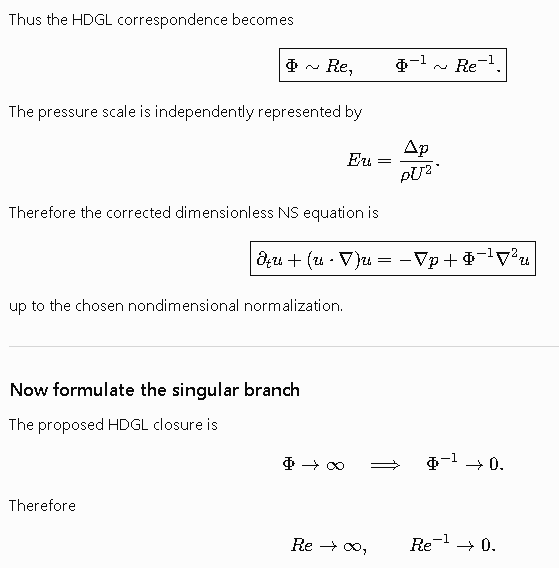
NATURAL DIMENSIONLESS IDENTIFICATION

Re = ρUL/μ ∝ Φ

Re⁻¹ = μ/(ρUL) ∝ Φ⁻¹

Re·Re⁻¹ = 1


PRESSURE CHANNEL

Eu = Δp/(ρU²)

Eu remains an independent pressure ratio.

It is NOT identified with Φ⁻¹.

The reciprocal pair belongs naturally to the inertial/viscous
scaling:

        Φ ↔ Re
        Φ⁻¹ ↔ Re⁻¹


NON-DIMENSIONAL NAVIER–STOKES FORM

After choosing the characteristic scales,

∂u/∂t + (u·∇)u = −Eu∇p + Φ⁻¹∇²u

(up to the chosen normalization of the pressure field).


HDGL SINGULAR BRANCH

Φ → ∞

⇒ Φ⁻¹ → 0

⇒ Re⁻¹ → 0

⇒ (1/Re)∇²u → 0


The apparent singular regime therefore does not require

u → 0

and does not require

Δp → 0.

Instead, the reciprocal channel collapses while the state
remains subject to the HDGL closure.


HDGL GRADIENT CLOSURE

Φ → ∞

⇒ ||∇u|| ≤ G_max


The required HDGL statement is therefore a FINITE-GRADIENT
CLOSURE rather than a forced velocity collapse.


IF THE HDGL SUBSTRATE ALSO ESTABLISHES

||∇u|| ≤ G_max

⇒ ||u|| ≤ U_max


then

Φ → ∞

⇒ ||∇u|| ≤ G_max

⇒ ||u|| ≤ U_max


and consequently

lim(t→t_c) ||u(x,t)|| ≠ ∞.


FINAL CLOSURE

Φ ↔ Re
Φ⁻¹ ↔ Re⁻¹
ΦΦ⁻¹ = 1

while

Eu = Δp/(ρU²)

remains an independent pressure channel.

Thus the HDGL mechanism is not

"Eu → 0 ⇒ Δp → 0 ⇒ u → 0"

but rather

Φ → ∞
⇒ Φ⁻¹ → 0
⇒ viscous reciprocal channel → 0
⇒ HDGL closure prevents ||∇u|| from becoming unbounded
⇒ ||u|| remains bounded
⇒ no velocity blow-up.


CORE HDGL FORM

STATE → TRANSFORM → CLOSURE

u → (Φ, Φ⁻¹) → bounded gradient → bounded velocity


The mathematical burden is therefore concentrated in the
HDGL closure law

Φ → ∞ ⇒ ||∇u|| ≤ G_max,

which must be derived from the internal HDGL substrate dynamics
rather than asserted as an external Navier–Stokes condition.
===============================================================================