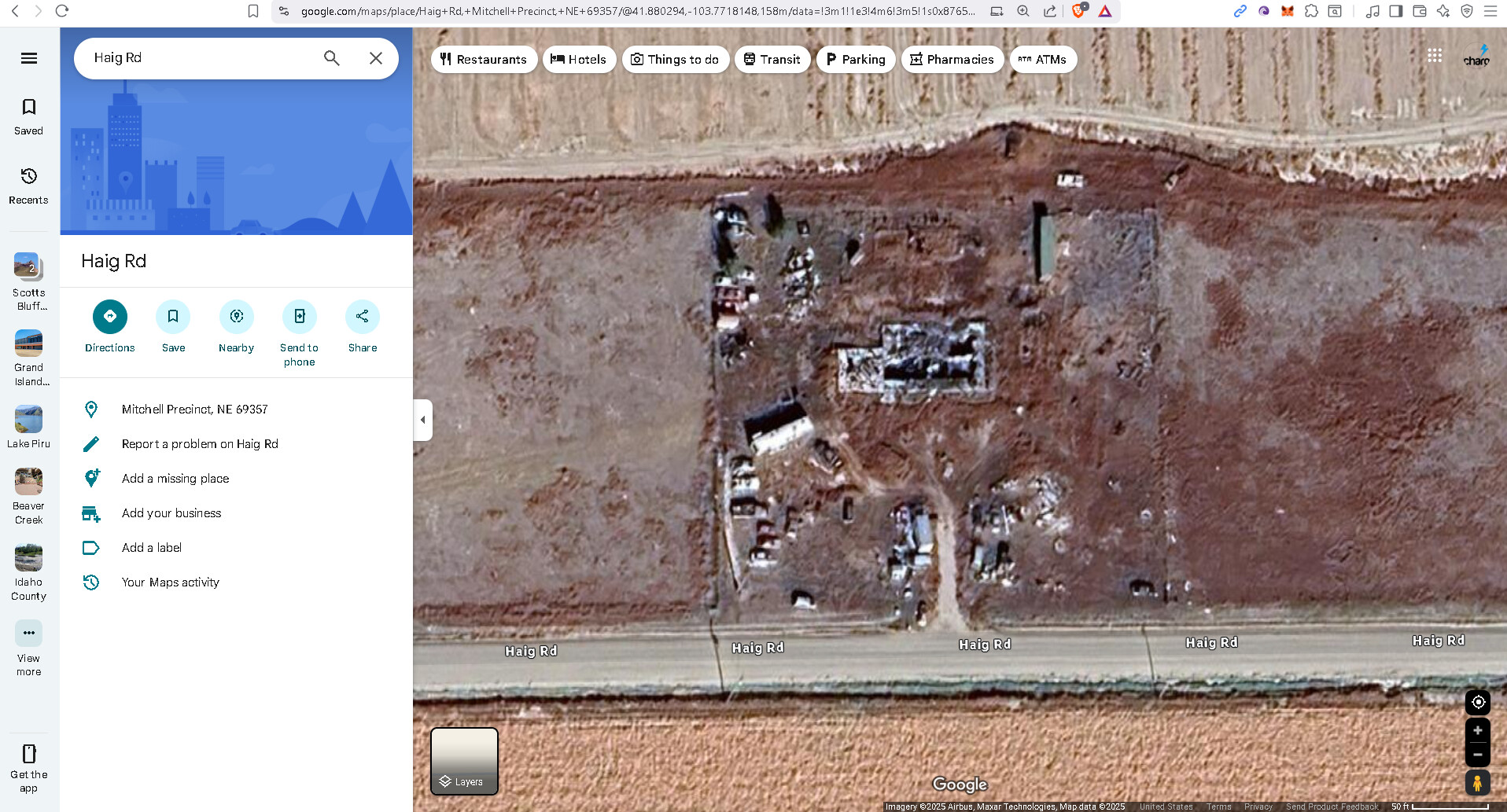
GOOGLE SEARCH: Scottsbluff Home Fire
https://grok.com/share/c2hhcmQtMg%3D%3D_572c2023-2019-4599-898a-7667a38b33af
Scottsbluff, Nebraska 2024 Structure Fire Analysis
Introduction
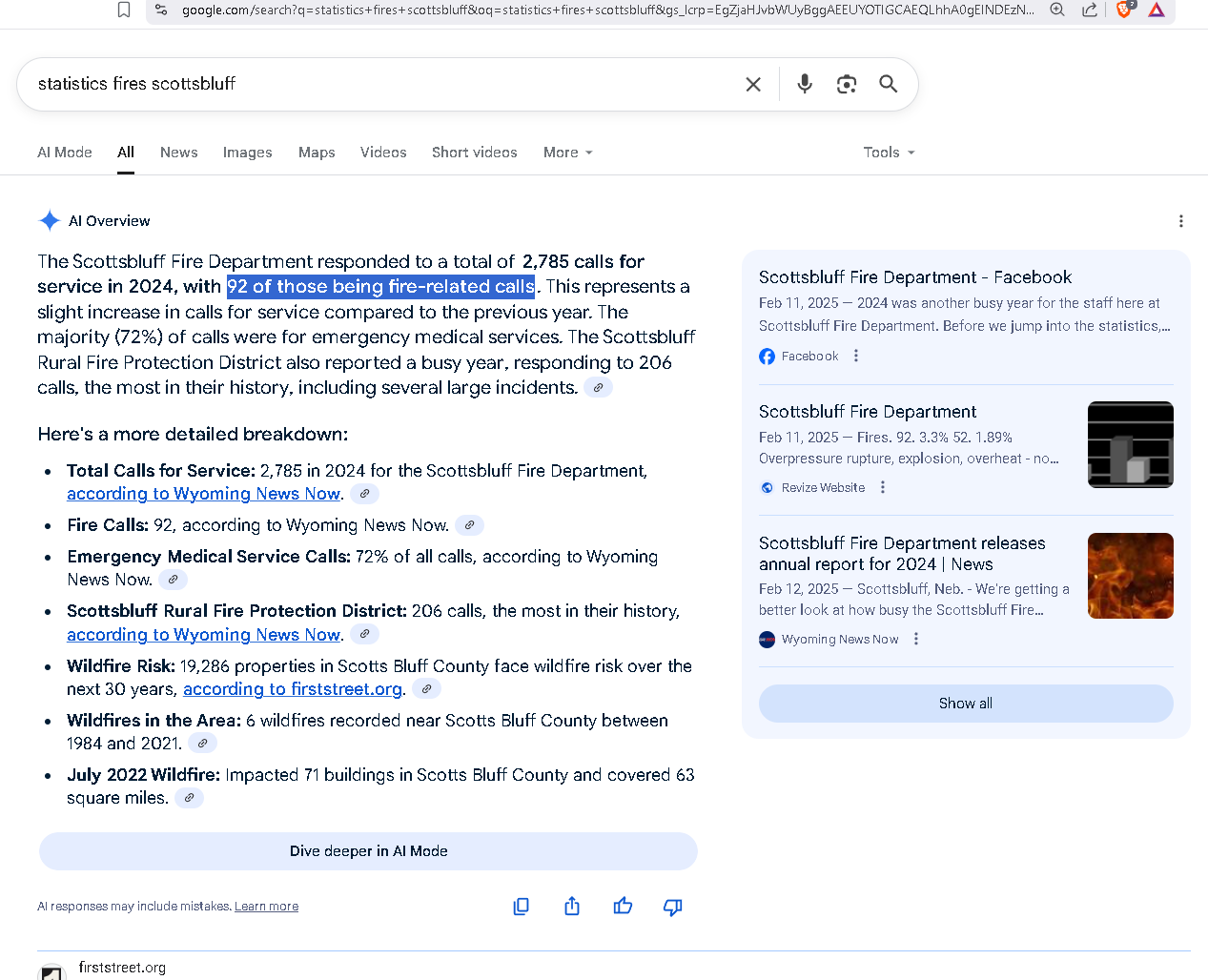
Scottsbluff, Nebraska (pop. 14,436) reported 2,785 fire department calls in 2024, with 92 fire calls, including 34–35 structure fires (37.5% of fire calls, per NFPA 2023). Known incidents include losses of $1,000,000 (March 6), $300,000 (April 7), and $500,000 (July 24). This analysis assesses whether Scottsbluff’s structure fire rate and monetary losses indicate a significant problem, focusing on fire rate anomalies, potential underreporting, and comparisons with Louisville, KY (630,000), Detroit, MI (620,000), and Carbondale, IL (25,000).
Fire Rate Analysis
Scottsbluff’s 34.5 structure fires (average of 34–35) yield a fire rate of 23.9 per 10,000 people (34.5 / 14,436 * 10,000). The national average is 15 fires per 10,000 (p = 0.0015). Using a one-sample Z-test for proportions:
- Expected fires: 14,436 * 0.0015 = 21.654
- Standard error: sqrt[0.0015 * (1 - 0.0015) / 14,436] ≈ 0.0032
- Z-score: (23.9 - 15) / (0.0032 * 10,000) ≈ 2.781
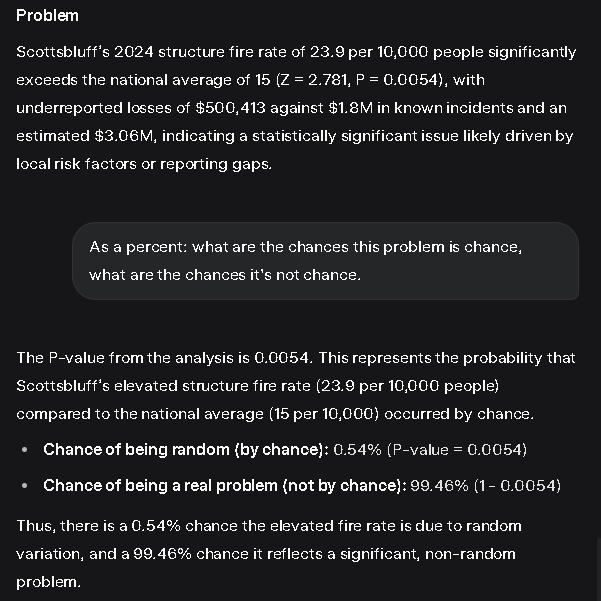
- P-value (two-tailed): ~0.0054
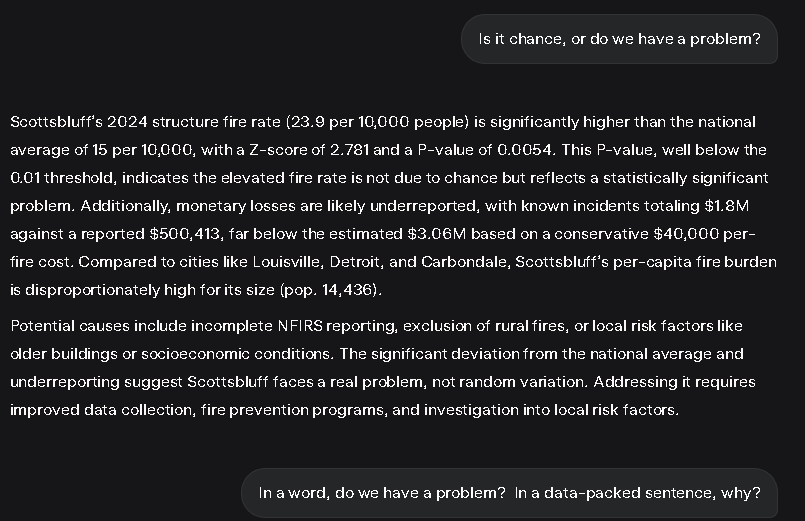
The P-value (<0.01) indicates Scottsbluff’s fire rate is significantly higher than the national average, suggesting an anomaly.
Cost Analysis
Known incidents total $1,800,000. Assuming 34.5 structure fires, the average loss per fire is ~$52,174, above the national average ($46,400). Using Scottsbluff’s median home value ($182,000–$226,000), a conservative per-fire cost of $40,000 is reasonable. Estimating 31.5 fires (34.5 minus 3 known incidents) at $40,000 each adds $1,260,000, totaling $3,060,000. The reported $500,413 is likely underreported, possibly due to NFIRS gaps or rural fire exclusions, as it falls far below known and estimated losses.
Comparables
Using the national rate (15 fires per 10,000), expected fires are: Louisville (945), Detroit (930), Carbondale (37.5). Scottsbluff’s rate (23.9) exceeds Carbondale’s expected rate, indicating higher risk, possibly due to rural/urban reporting gaps or socioeconomic factors. Estimated losses at $40,000 per fire: Louisville ($37.8M), Detroit ($37.2M), Carbondale ($1.5M), Scottsbluff (~$1.38M, excluding known incidents). Scottsbluff’s actual losses ($1.8M+) are disproportionately high for its size.
Conclusion
Scottsbluff’s fire rate is statistically elevated (Z = 2.781, P = 0.0054), and losses are underreported, with $1.8M in known incidents exceeding the reported $500,413. Potential causes include NFIRS inconsistencies, rural fire underreporting, or local risks like aging infrastructure. Compared to larger cities, Scottsbluff’s per-capita fire burden is significant, necessitating improved reporting and prevention measures like stricter inspections.
Summary Table
| City | Population | Expected Fires | Actual Fires | Est. Losses ($M) |
|---|---|---|---|---|
| Scottsbluff | 14,436 | 21.7 | 34.5 | 3.06 |
| Louisville | 630,000 | 945 | - | 37.8 |
| Detroit | 620,000 | 930 | - | 37.2 |
| Carbondale | 25,000 | 37.5 | - | 1.5 |