


Transcriptions of same
Transcriptions

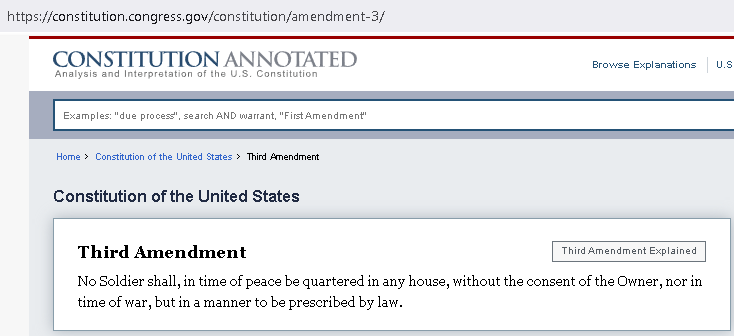
Image 1 — Constitution Annotated, Third Amendment

"No Soldier shall, in time of peace be quartered in any house, without the consent of the Owner, nor in time of war, but in a manner to be prescribed by law."

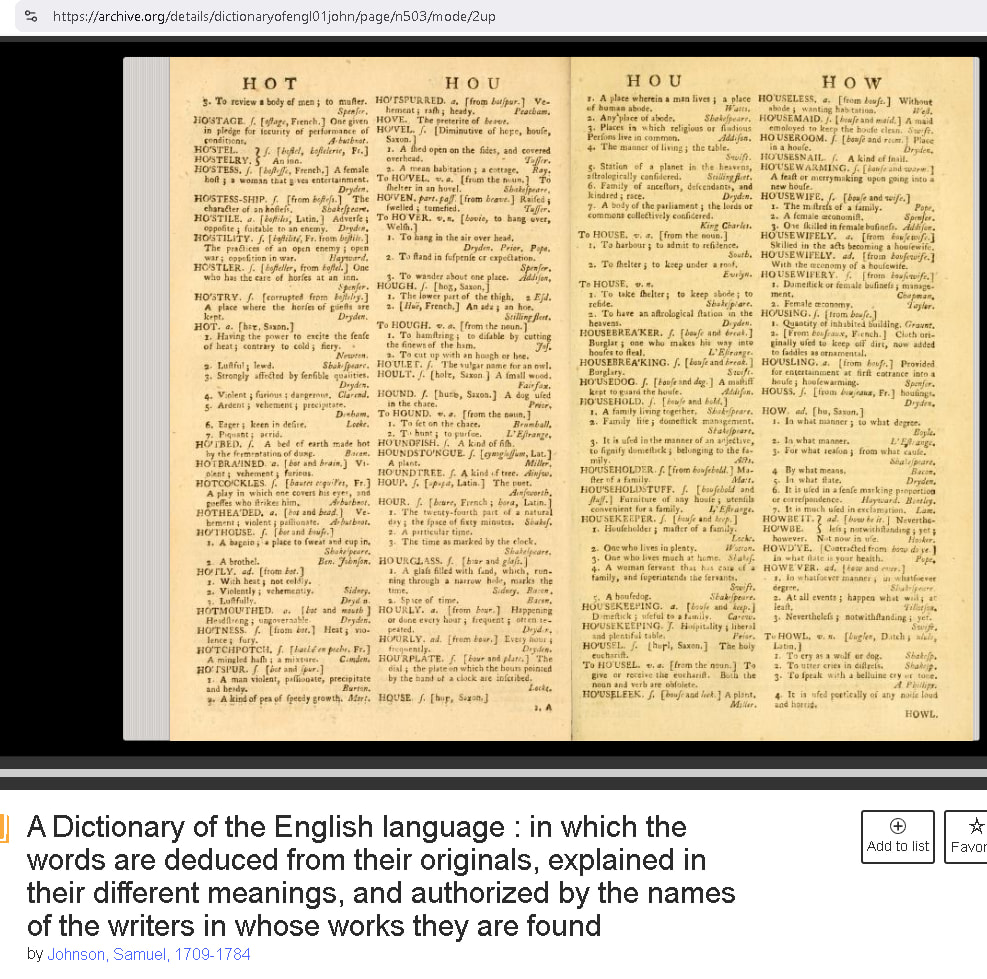
Image 2 — Johnson's Dictionary, "HOU"

HOUSE, f. 1. A place wherein a man lives; a place of human abode. Watts. 2. Any place of abode. Shakespeare. 3. Places in which religious or studious persons live in common. Addison. 4. The manner of living; the table. Swift. 5. Station of a planet in the heavens, astrologically considered. Stillingfleet. 6. Family of ancestors, descendants, and kindred; race. Dryden. 7. A body of the parliament; the lords or commons collectively considered. King Charles.

To HOUSE, v.a. [from the noun.] 1. To harbour; to admit to residence. South.
To HOUSE, v.n. 1. To take shelter; to keep abode; to reside. Shakespeare. 2. To have an astrological station. Dryden.
HOUSEBREAKER, f. Burglar; one who makes his way into houses to steal. L'Estrange.
HOUSEBREAKING, f. Burglary.
HOUSEDOG, f. A mastiff kept to guard the house. Addison.
HOUSEHOLD, f. 1. A family living together. Shakespeare. 2. Family life; domestick management. Shakespeare. 3. Used as an adjective, to signify domestick; belonging to the family. Acts.
HOUSEHOLDER, f. Master of a family. Matt.
HOUSEHOLDSTUFF, f. Furniture of any house; utensils convenient for a family. L'Estrange.

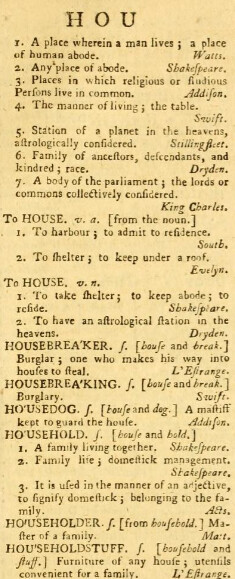
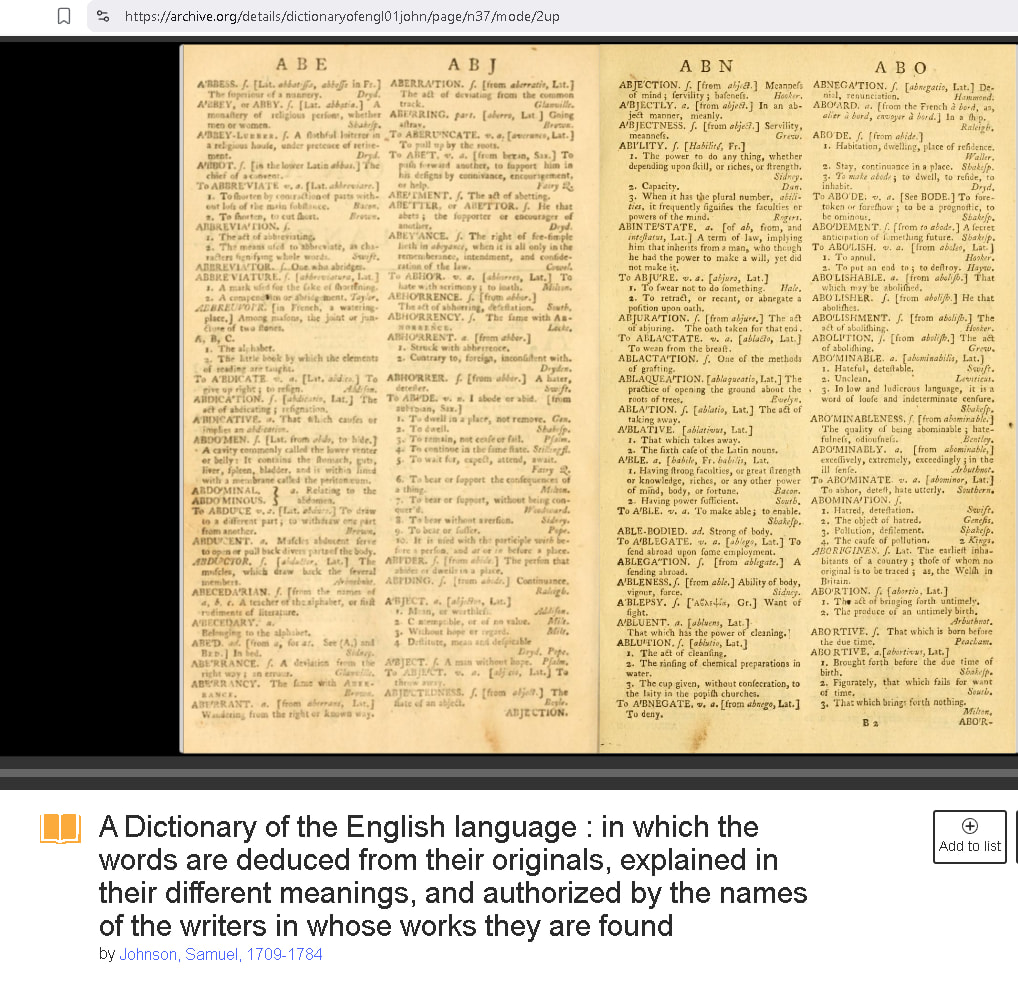
Image 3 — Johnson's Dictionary, "ABO"

ABNEGATION. Denial, renunciation. Hammond. ... ABODE, f. 1. Habitation, dwelling, place of residence. Waller. 2. Stay, continuance in a place. Dryden. ... To ABOLISH, v.a. To annul; to put out of use; to destroy. Hayward. ABOLISHMENT — The act of abolishing. Hooker. ABOLITION — The act of abolishing. Grew. ABOMINABLE, a. 1. Hateful, detestable. Swift. 2. Unclean; in low and ludicrous language, a word of loose and indeterminate censure. Locke. ... ABOMINATION, f. 1. Hatred, detestation. Swift. 2. The object of hatred. Genesis. 3. Pollution, defilement. Shakespeare. 4. The cause of pollution. 2 Kings. ABORIGINES, f. The earliest inhabitants of a country; those of whom no original is to be traced. ABORTION — 1. The act of bringing forth untimely. 2. The produce of an untimely birth. ABORTIVE, a. 1. Brought forth before the due time of birth. Milton. 2. Figuratively, that which fails for want of time. South. 3. That which brings forth nothing. Milton.

Images 4–5 — Johnson's Dictionary, "SOLDIER" / "SOL"

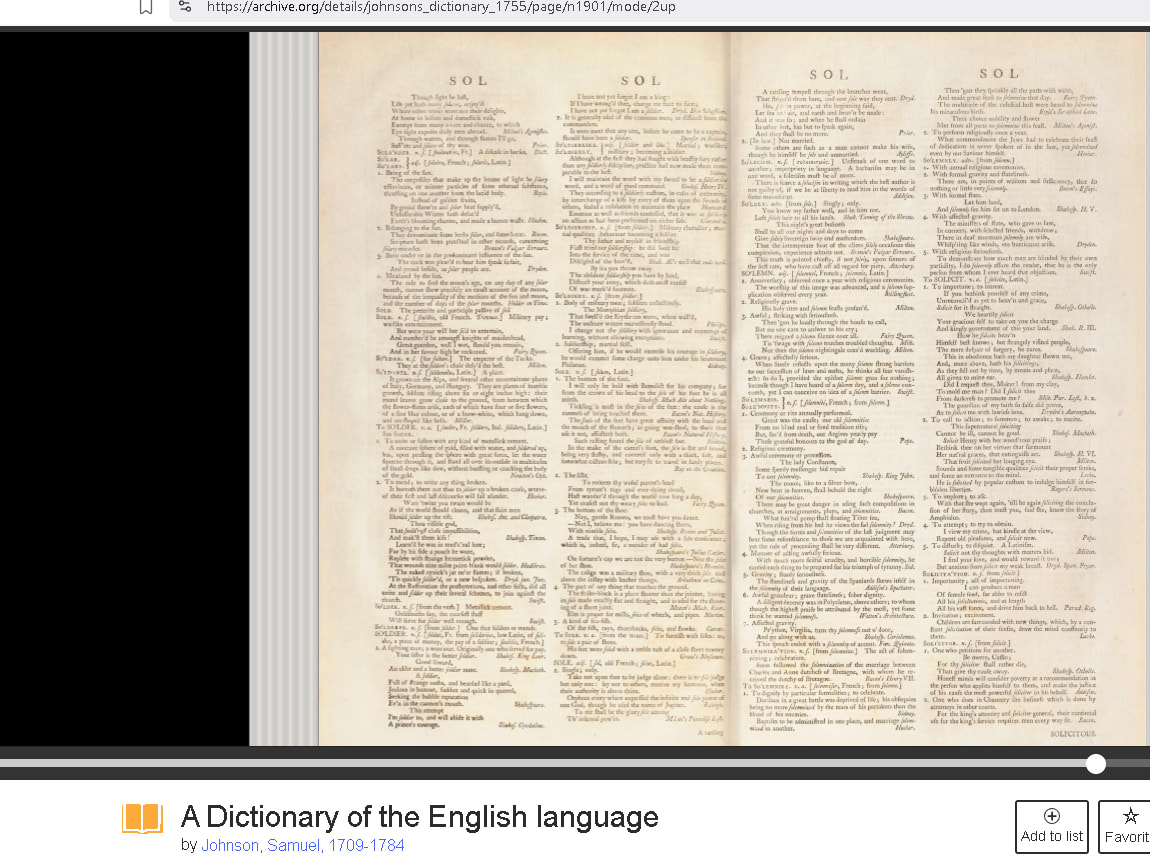
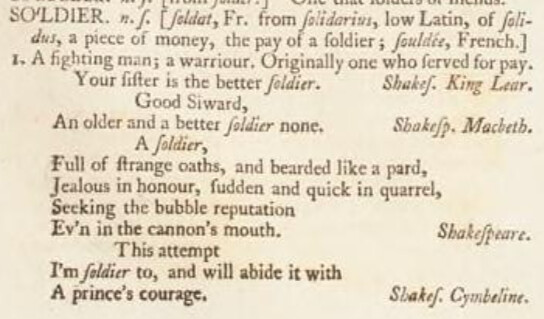
SOLDIER, n.s. [soldat, Fr. from solidarius, low Latin, of solidus, a piece of money, the pay of a soldier.] 1. A fighting man; a warrior. Originally one who served for pay. — "Your sister is the better soldier." K. Lear. "Good Siward, / An older and a better soldier none." Macbeth. "A soldier, / Full of strange oaths, and bearded like a pard, / Jealous in honour, sudden and quick in quarrel, / Seeking the bubble reputation / Ev'n in the cannon's mouth." Shakespeare. "This attempt / I'm soldier to, and will abide it with / A prince's courage." Cymbeline.
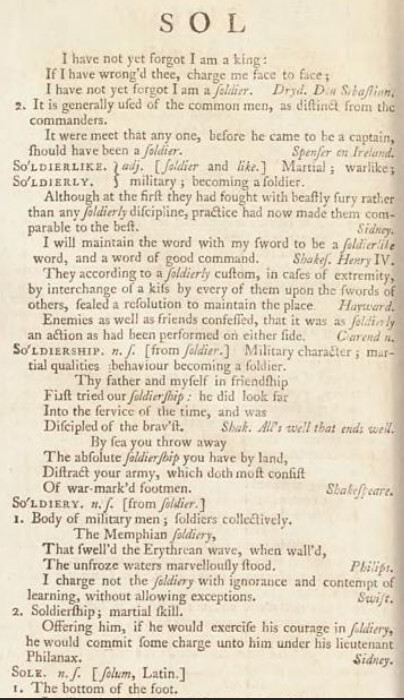
2. "It is generally used of the common men, as distinct from the commanders." — "It were meet that any one, before he came to be a captain, should have been a soldier." Spenser on Ireland.
SOLDIERLIKE / SOLDIERLY, adj. Martial; warlike; becoming a soldier.
SOLDIERSHIP, n.f. Military character; martial qualities; behaviour becoming a soldier.
SOLDIERY, n.f. 1. Body of military men; soldiers collectively. 2. Soldiership; martial skill.
SOLE, n.f. [solum, Latin.] 1. The bottom of the foot.

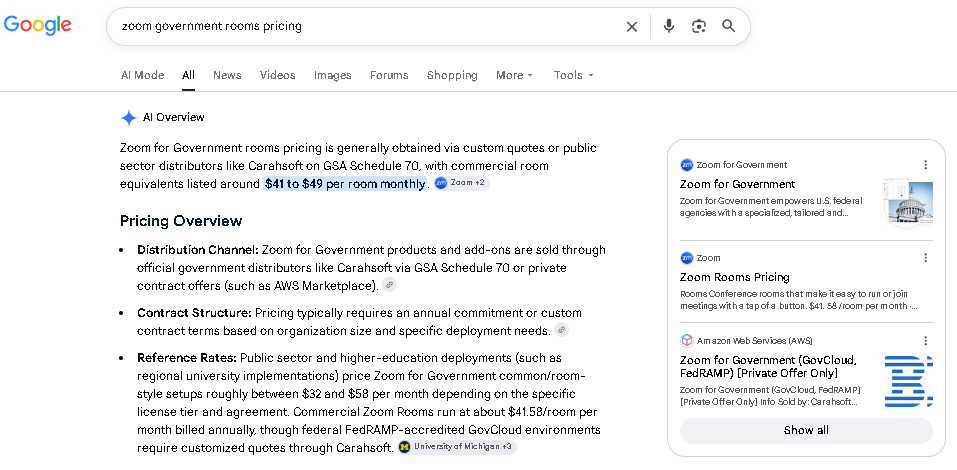
Images 6–7 — Google AI Overview: Zoom pricing for courts/government

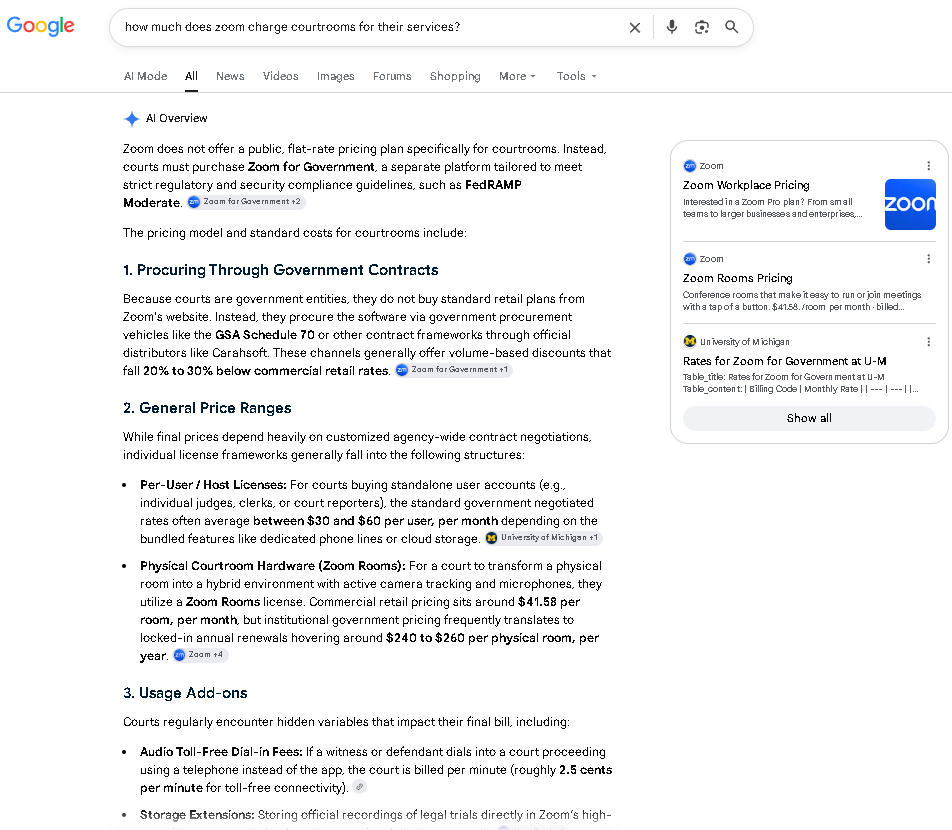
Zoom has no flat public rate for courtrooms; courts must buy Zoom for Government through GSA Schedule 70 or distributors like Carahsoft (FedRAMP Moderate compliance). Per-user/host licenses run roughly $30–$60/month; a Zoom Rooms hardware license for a physical courtroom runs about $41.58/room/month commercially, with government contracts often locking in $240–$260/room/year. Add-ons include toll-free dial-in fees (~2.5¢/min) and storage extensions for recordings.

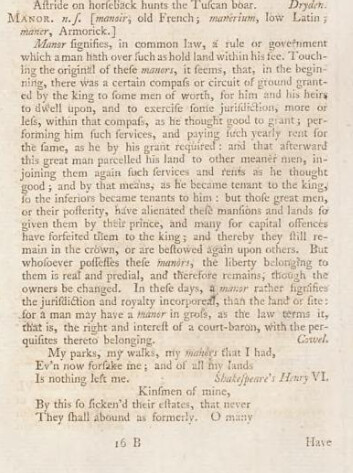
Image 8 — Johnson's Dictionary, "MANOR"

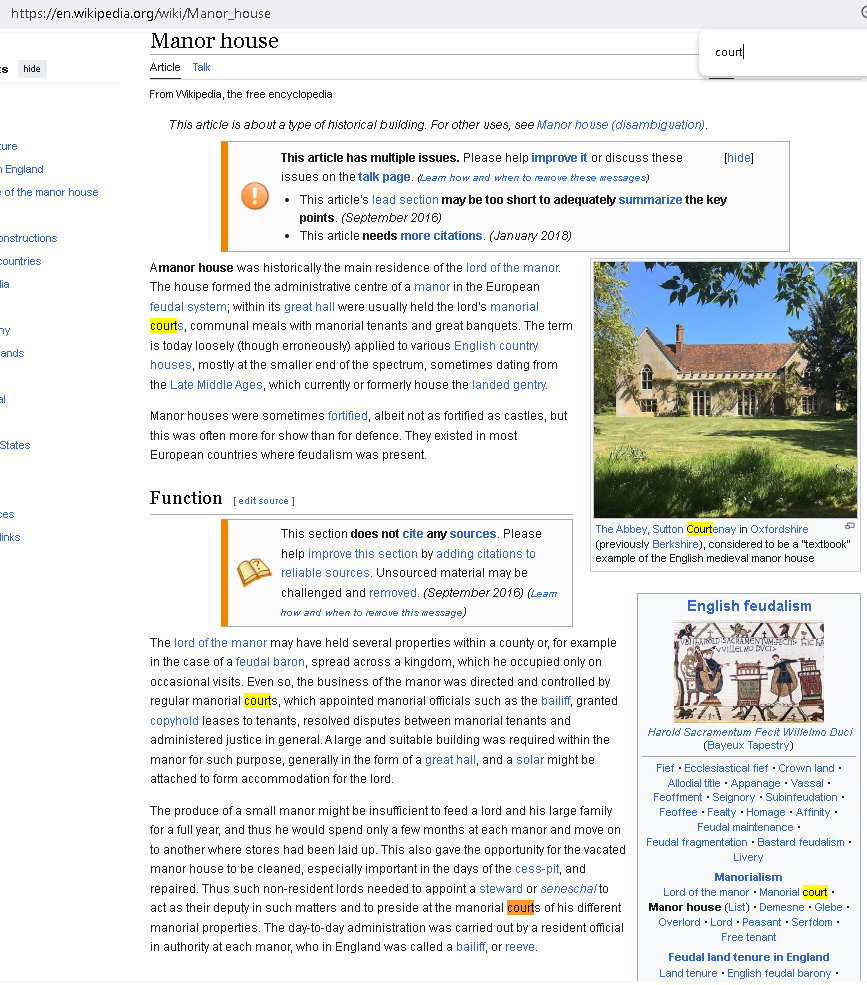
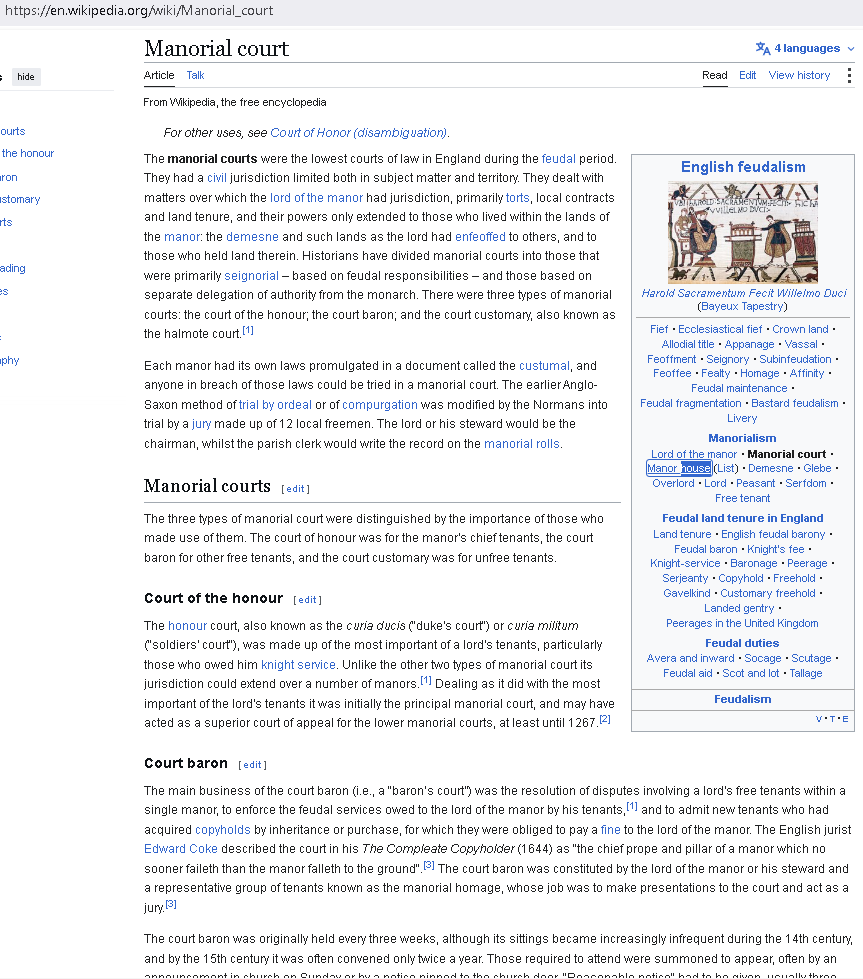
MANOR, n.f. [manoir, old French; manerium, low Latin.] "Manor signifies, in common law, a rule or government which a man hath over such as hold land within his fee. Touching the original of these manors, it seems that, in the beginning, there was a certain compass or circuit of ground granted by the king to some men of worth, for him and his heirs to dwell upon, and to exercise some jurisdiction, more or less, within that compass... performing him such services, and paying such yearly rent... as he thought good to grant; and that afterward this great man parcelled his land to other meaner men, enjoining them again such services and rents as he thought good; and by that means, as he became tenant to the king, so the inferiors became tenants to him... In these days, a manor rather signifies the jurisdiction and royalty incorporeal, than the land or site: for a man may have a manor in gross, as the law terms it, that is, the right and interest of a court-baron, with the perquisites thereto belonging." Cowel.
"My parks, my walks, my manors that I had, / Ev'n now forsake me; and of all my lands / Nothing is left me." Shakespeare's Henry VI.

Image 9 — Johnson's Dictionary, "MAN" (continued)

MANQUELLER, f. A murderer; a manslayer. — "This was not Kayne the manqueller, but one of a gentler spirit and milder sex, to wit, a woman." Carew.
MANSE, f. A parsonage house.
MANSION, f. 1. Place of residence; abode; house. — "A fault no less grievous... than if some king should build his mansion-house by the model of Solomon's palace." Hooker. "Thy mansion wants thee, Adam, rise..." Milton.
MANSLAUGHTER, n.f. 1. Murder; destruction of the human species. 2. [In law.] "The act of killing a man not wholly without fault, though without malice."
MANSLAYER, n.f. Murderer; one that hath killed another. — "Cities for refuge to the manslayer." Numbers xxxv. 6.
John 8
8 Jesus went unto the mount of Olives.
2 And early in the morning he came again into the temple, and all the people came unto him; and he sat down, and taught them.
3 And the scribes and Pharisees brought unto him a woman taken in adultery; and when they had set her in the midst,
4 They say unto him, Master, this woman was taken in adultery, in the very act.
5 Now Moses in the law commanded us, that such should be stoned: but what sayest thou?
6 This they said, tempting him, that they might have to accuse him. But Jesus stooped down, and with his finger wrote on the ground, as though he heard them not.
7 So when they continued asking him, he lifted up himself, and said unto them, He that is without sin among you, let him first cast a stone at her.
8 And again he stooped down, and wrote on the ground.
9 And they which heard it, being convicted by their own conscience, went out one by one, beginning at the eldest, even unto the last: and Jesus was left alone, and the woman standing in the midst.
10 When Jesus had lifted up himself, and saw none but the woman, he said unto her, Woman, where are those thine accusers? hath no man condemned thee?
11 She said, No man, Lord. And Jesus said unto her, Neither do I condemn thee: go, and sin no more.
12 Then spake Jesus again unto them, saying, I am the light of the world: he that followeth me shall not walk in darkness, but shall have the light of life.
13 The Pharisees therefore said unto him, Thou bearest record of thyself; thy record is not true.
14 Jesus answered and said unto them, Though I bear record of myself, yet my record is true: for I know whence I came, and whither I go; but ye cannot tell whence I come, and whither I go.
15 Ye judge after the flesh; I judge no man.
16 And yet if I judge, my judgment is true: for I am not alone, but I and the Father that sent me.
17 It is also written in your law, that the testimony of two men is true.
18 I am one that bear witness of myself, and the Father that sent me beareth witness of me.
19 Then said they unto him, Where is thy Father? Jesus answered, Ye neither know me, nor my Father: if ye had known me, ye should have known my Father also.
20 These words spake Jesus in the treasury, as he taught in the temple: and no man laid hands on him; for his hour was not yet come.
21 Then said Jesus again unto them, I go my way, and ye shall seek me, and shall die in your sins: whither I go, ye cannot come.
22 Then said the Jews, Will he kill himself? because he saith, Whither I go, ye cannot come.
23 And he said unto them, Ye are from beneath; I am from above: ye are of this world; I am not of this world.
24 I said therefore unto you, that ye shall die in your sins: for if ye believe not that I am he, ye shall die in your sins.
25 Then said they unto him, Who art thou? And Jesus saith unto them, Even the same that I said unto you from the beginning.
26 I have many things to say and to judge of you: but he that sent me is true; and I speak to the world those things which I have heard of him.
27 They understood not that he spake to them of the Father.
28 Then said Jesus unto them, When ye have lifted up the Son of man, then shall ye know that I am he, and that I do nothing of myself; but as my Father hath taught me, I speak these things.
29 And he that sent me is with me: the Father hath not left me alone; for I do always those things that please him.
30 As he spake these words, many believed on him.
31 Then said Jesus to those Jews which believed on him, If ye continue in my word, then are ye my disciples indeed;
32 And ye shall know the truth, and the truth shall make you free.
33 They answered him, We be Abraham’s seed, and were never in bondage to any man: how sayest thou, Ye shall be made free?
34 Jesus answered them, Verily, verily, I say unto you, Whosoever committeth sin is the servant of sin.
35 And the servant abideth not in the house for ever: but the Son abideth ever.
36 If the Son therefore shall make you free, ye shall be free indeed.
37 I know that ye are Abraham’s seed; but ye seek to kill me, because my word hath no place in you.
38 I speak that which I have seen with my Father: and ye do that which ye have seen with your father.
39 They answered and said unto him, Abraham is our father. Jesus saith unto them, If ye were Abraham’s children, ye would do the works of Abraham.
40 But now ye seek to kill me, a man that hath told you the truth, which I have heard of God: this did not Abraham.
41 Ye do the deeds of your father. Then said they to him, We be not born of fornication; we have one Father, even God.
42 Jesus said unto them, If God were your Father, ye would love me: for I proceeded forth and came from God; neither came I of myself, but he sent me.
43 Why do ye not understand my speech? even because ye cannot hear my word.
44 Ye are of your father the devil, and the lusts of your father ye will do. He was a murderer from the beginning, and abode not in the truth, because there is no truth in him. When he speaketh a lie, he speaketh of his own: for he is a liar, and the father of it.
45 And because I tell you the truth, ye believe me not.
46 Which of you convinceth me of sin? And if I say the truth, why do ye not believe me?
47 He that is of God heareth God’s words: ye therefore hear them not, because ye are not of God.
48 Then answered the Jews, and said unto him, Say we not well that thou art a Samaritan, and hast a devil?
49 Jesus answered, I have not a devil; but I honour my Father, and ye do dishonour me.
50 And I seek not mine own glory: there is one that seeketh and judgeth.
51 Verily, verily, I say unto you, If a man keep my saying, he shall never see death.
52 Then said the Jews unto him, Now we know that thou hast a devil. Abraham is dead, and the prophets; and thou sayest, If a man keep my saying, he shall never taste of death.
53 Art thou greater than our father Abraham, which is dead? and the prophets are dead: whom makest thou thyself?
54 Jesus answered, If I honour myself, my honour is nothing: it is my Father that honoureth me; of whom ye say, that he is your God:
55 Yet ye have not known him; but I know him: and if I should say, I know him not, I shall be a liar like unto you: but I know him, and keep his saying.
56 Your father Abraham rejoiced to see my day: and he saw it, and was glad.
57 Then said the Jews unto him, Thou art not yet fifty years old, and hast thou seen Abraham?
58 Jesus said unto them, Verily, verily, I say unto you, Before Abraham was, I am.
59 Then took they up stones to cast at him: but Jesus hid himself, and went out of the temple, going through the midst of them, and so passed by.
SOURCE
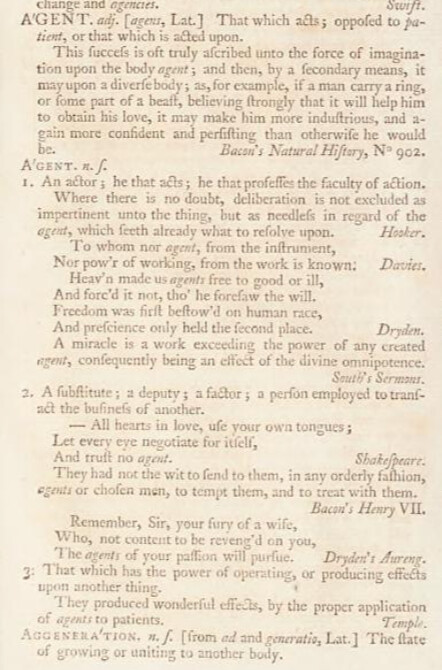
A'GENT. adj. [agens, Lat.] That which acts; opposed to patient, or that which is acted upon.

This success is oft truly ascribed unto the force of imagination upon the body agent; and then, by a secondary means, it may upon a diverse body; as, for example, if a man carry a ring, or some part of a beast, believing strongly that it will help him to obtain his love, it may make him more industrious, and again more confident and persisting than otherwise he would be. Bacon's Natural History, Nº 902.

A'GENT. n. s.

An actor; he that acts; he that professes the faculty of action. Where there is no doubt, deliberation is not excluded as impertinent unto the thing, but as needless in regard of the agent, which seeth already what to resolve upon. Hooker. To whom nor agent, from the instrument,
Nor pow'r of working, from the work is known: Davies. Heav'n made us agents free to good or ill,
And forc'd it not, tho' he foresaw the will.
Freedom was first bestow'd on human race,
And prescience only held the second place. Dryden. A miracle is a work exceeding the power of any created agent, consequently being an effect of the divine omnipotence. South's Sermons.
A substitute; a deputy; a factor; a person employed to transact the business of another. —— All beauty in love, use your own tongues;
Let every eye negotiate for itself,
And trust no agent. Shakespeare. They had not the wit to send to them, in any orderly fashion, agents or chosen men, to tempt them, and to treat with them. Bacon's Henry VII. Remember, Sir, your fury of a wife,
Who, not content to be reveng'd on you,
The agents of your passion will pursue. Dryden's Aureng.
That which has the power of operating, or producing effects upon another thing. They produced wonderful effects, by the proper application of agents to patients. Temple.