Star Chamber / Star Court?
SOURCE
H is in English, as in other languages, a note of aspiration, sounded only by a strong emission of the breath, without any conformation of the organs of speech, and is therefore by many grammarians accounted no letter. The h in English is scarcely ever mute at the beginning of a word, or where it immediately precedes a vowel; as house, behaviour: where it is followed by a consonant it has no sound, according to the present pronunciation, but anciently, as now in Scotland, it made the syllable guttural; as right, bought.

HA. interject. [ha, Latin.]

An expression of wonder, surprise, sudden question or sudden exertion.

You shall look fairer ere I give or hazard: / What says the golden chest? ha! let me see. — Shak.

Ha! what art thou? thou horrid headless trunk! / It is my Hastings! — Rowe's Jane Shore.

VOL. I. (volume mark at foot of column)

Column 2 — running head HAB

(a few faint lines at the very top are show‑through from the reverse leaf, not text of this column)

An expression of laughter. Used with reduplication.

He saith among the trumpets ha, ha, and he smelleth the battle afar off. — Job, xxxix. 25.

Ha, ha, 'tis what so long I wish'd and vow'd; / Our plots and delusions / Have wrought such confusions, / That the monarch's a slave to the crown. — Dryden.

HAAK. n.s. A fish.

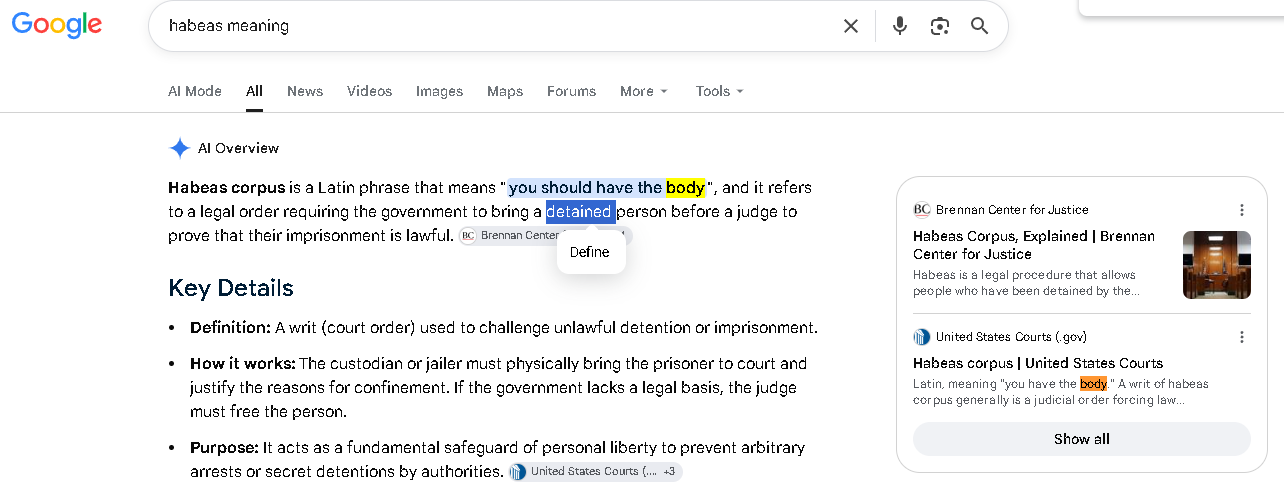
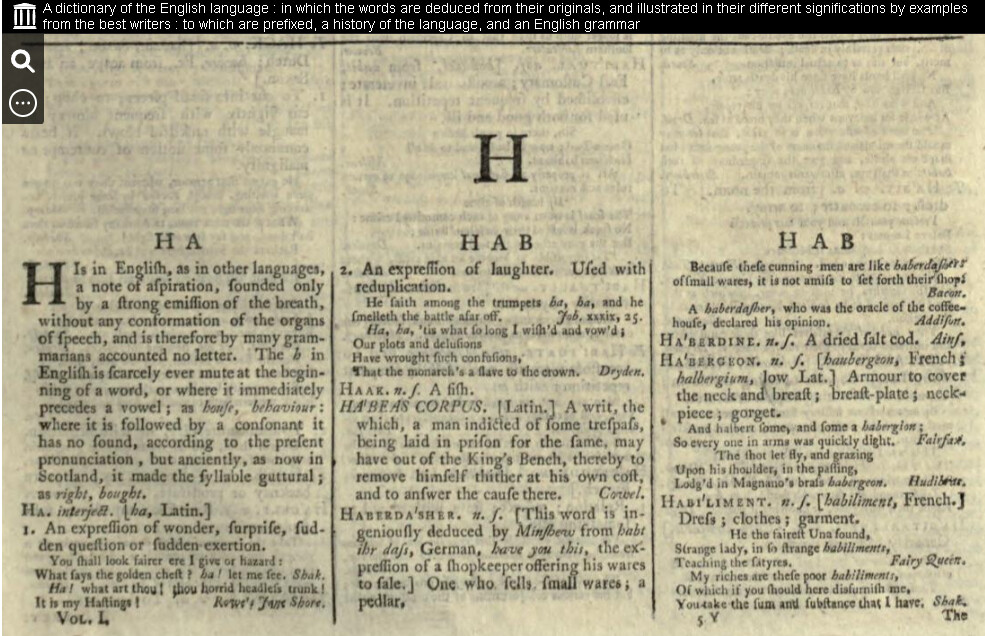
HA'BEAS CORPUS. [Latin.] A writ, the which, a man indicted of some trespass, being laid in prison for the same, may have out of the King's Bench, thereby to remove himself thither at his own cost, and to answer the cause there. — Cowel.

HABERDA'SHER. n.s. [This word is ingeniously deduced by Minshew from habt ihr das, German, have you this, the expression of a shopkeeper offering his wares to sale.] One who sells small wares; a pedlar,

Column 3 — running head HAB

…Because these cunning men are like haberdashers of small wares, it is not amiss to set forth their shop. — Bacon.

A haberdasher, who was the oracle of the coffee-house, declared his opinion. — Addison.

HA'BERDINE. n.s. A dried salt cod. — Ainsw.

HA'BERGEON. n.s. [haubergeon, French; halbergium, low Lat.] Armour to cover the neck and breast; breast-plate; neck-piece; gorget.

And halbert some, and some a habergeon; / So every one in arms was quickly dight. — Fairfax.

The [shot] let fly, and grazing / Upon his shoulder, in the passing, / Lodg'd in Magnano's brass habergeon. — Hudibras.

HABI'LIMENT. n.s. [habiliment, French.] Dress; clothes; garment.

He the fairest Una found, / Strange lady, in so strange habiliments, / Teaching the satyres. — Fairy Queen.

My riches are these poor habiliments, / Of which if you should here disfurnish me, / You take the sum and substance that I have. — Shak.