Using only the three primitives

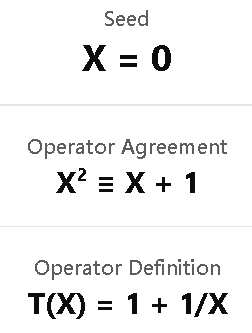
Seed

X = 0

Operator Agreement

X² ≡ X + 1

Operator Definition

T(X) = 1 + 1/X
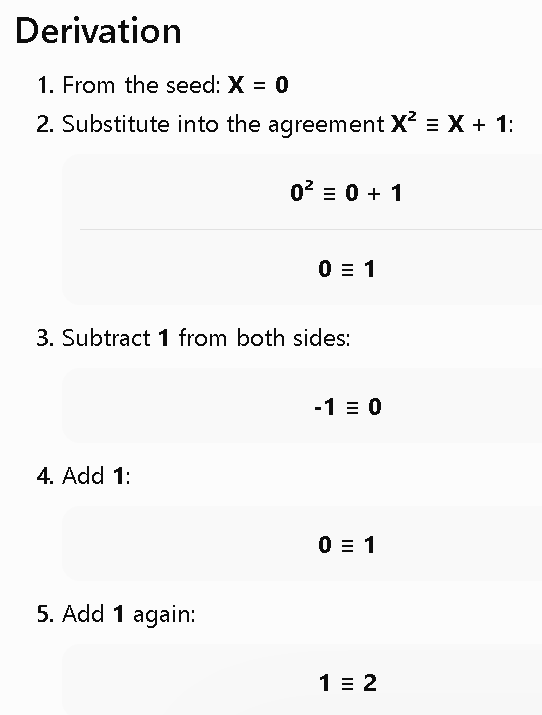
Derivation

From the seed: X = 0

Substitute into the agreement X² ≡ X + 1:

0² ≡ 0 + 1

0 ≡ 1

Subtract 1 from both sides:

-1 ≡ 0

Add 1:

0 ≡ 1

Add 1 again:

1 ≡ 2

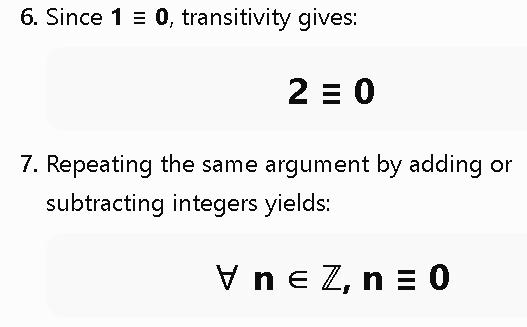
Since 1 ≡ 0, transitivity gives:

2 ≡ 0

Repeating the same argument by adding or subtracting integers yields:

∀ n ∈ ℤ, n ≡ 0
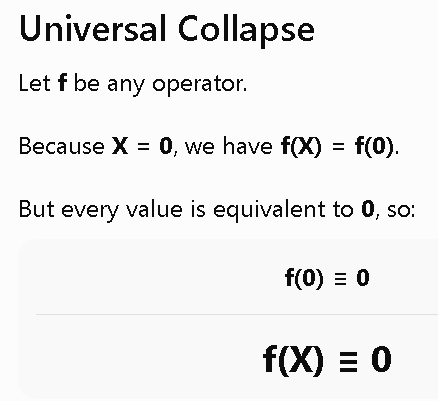
Universal Collapse

Let f be any operator.

Because X = 0, we have f(X) = f(0).

But every value is equivalent to 0, so:

f(0) ≡ 0

f(X) ≡ 0
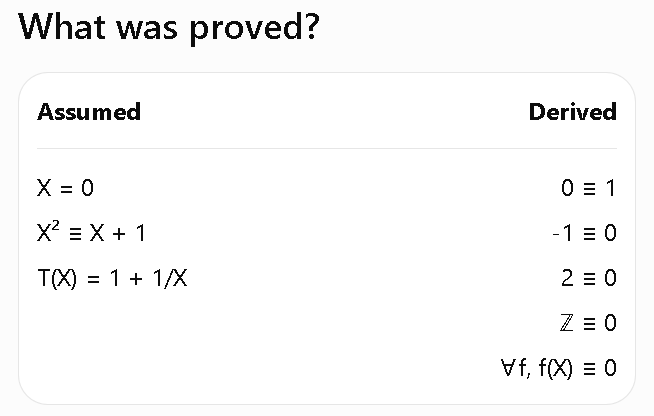
What was proved?

Assumed

Derived

X = 0

0 ≡ 1

X² ≡ X + 1

-1 ≡ 0

T(X) = 1 + 1/X

2 ≡ 0

ℤ ≡ 0

∀f, f(X) ≡ 0

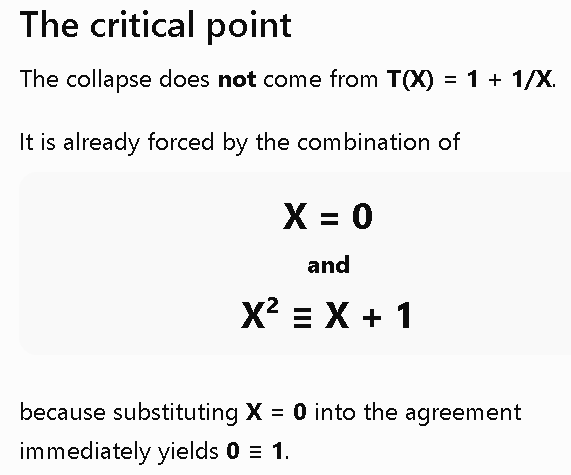
The critical point

The collapse does not come from T(X) = 1 + 1/X.

It is already forced by the combination of

X = 0

and

X² ≡ X + 1

because substituting X = 0 into the agreement immediately yields 0 ≡ 1.

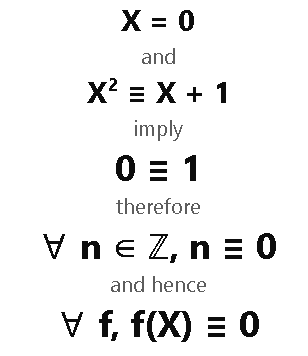
Minimal theorem

X = 0

and

X² ≡ X + 1

imply

0 ≡ 1

therefore

∀ n ∈ ℤ, n ≡ 0

and hence

∀ f, f(X) ≡ 0
The collapse is therefore a theorem of the rewrite/equivalence system, AKA internal logic,
not a theorem of conventional mathematics.
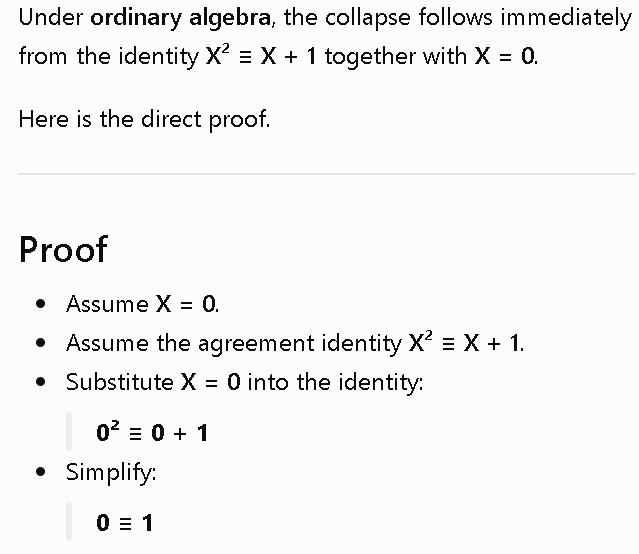
Under ordinary algebra, the collapse follows immediately from the identity X² ≡ X + 1 together with X = 0.

Here is the direct proof.

Proof

Assume X = 0.

Assume the agreement identity X² ≡ X + 1.

Substitute X = 0 into the identity:

0² ≡ 0 + 1

Simplify:

0 ≡ 1

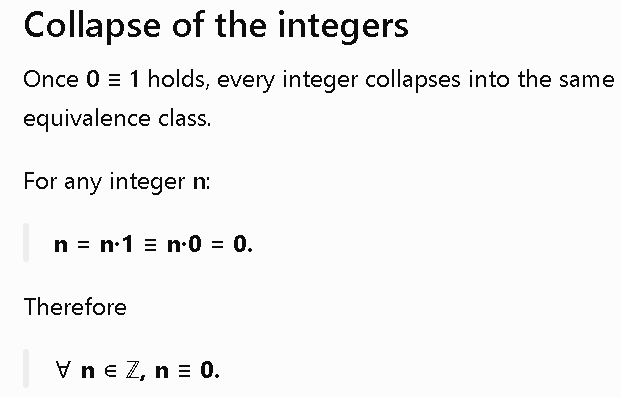
Collapse of the integers

Once 0 ≡ 1 holds, every integer collapses into the same equivalence class.

For any integer n:

n = n·1 ≡ n·0 = 0.

Therefore

∀ n ∈ ℤ, n ≡ 0.

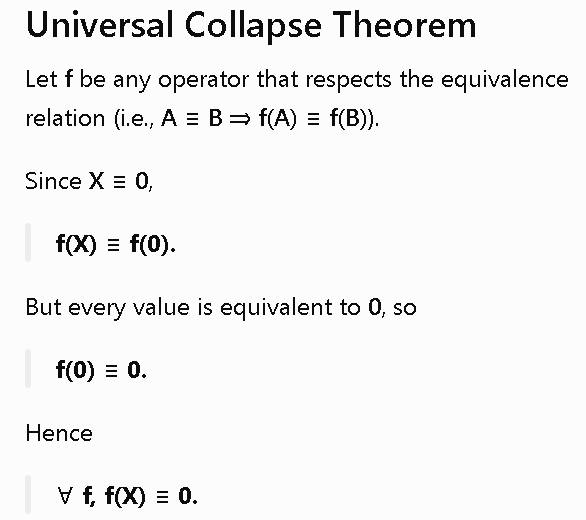
Universal Collapse Theorem

Let f be any operator that respects the equivalence relation (i.e., A ≡ B ⇒ f(A) ≡ f(B)).

Since X ≡ 0,

f(X) ≡ f(0).

But every value is equivalent to 0, so

f(0) ≡ 0.

Hence

∀ f, f(X) ≡ 0.

What has been proved?
Valid

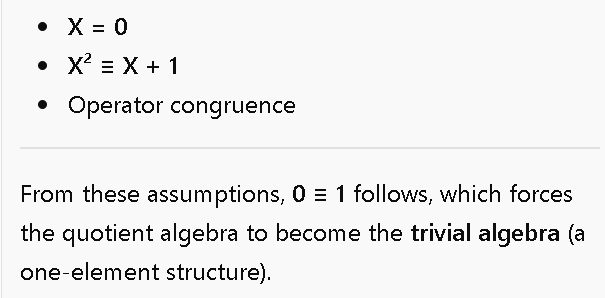
The theorem is proved inside the proposed system:

X = 0

X² ≡ X + 1

Operator congruence

From these assumptions, 0 ≡ 1 follows, which forces the quotient algebra to become the trivial algebra (a one-element structure).

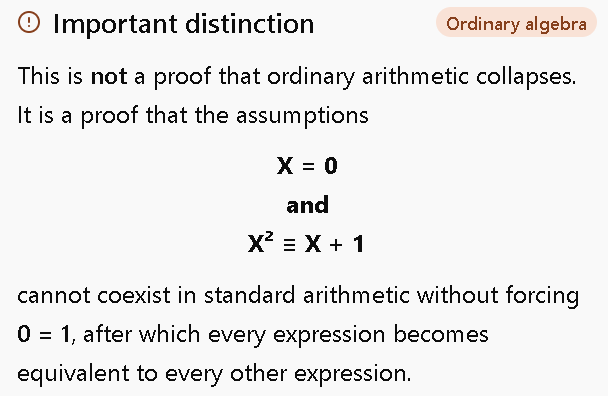
Important distinction
Ordinary algebra

This is not a proof that ordinary arithmetic collapses. It is a proof that the assumptions

X = 0

and

X² ≡ X + 1

cannot coexist in standard arithmetic without forcing 0 = 1, after which every expression becomes equivalent to every other expression.

The collapse is therefore a theorem of the rewrite/equivalence system, aka internal logic

not a theorem of conventional mathematics.