Stutter Step Bases 2
stutter-step-bases-second-iris-method2.zip (25.0 KB)
; =============================================================================
; HDGL — FOUR-ELEMENT BARE-METAL Z[φ] SUBSTRATE WITH WU-WEI ORACLE
; =============================================================================
;
; TARGET: x86-64 / BIOS / QEMU
; BUILD: nasm -f bin hdgl_wuwei.asm -o hdgl_wuwei.img
; RUN: qemu-system-x86_64 -drive format=raw,file=hdgl_wuwei.img -smp 4 -m 128M -boot c
;
; ARCHITECTURE:
; CPU 0 = FIRE (operator / strategy selector)
; CPU 1 = WATER (inverse verification)
; CPU 2 = EARTH (N_phi pattern oracle)
; CPU 3 = WIND (T(X) fixed-point residual)
;
; WU-WEI ORACLE:
; Each element reports resistance as a SIGNAL, not a failure.
; ORACLE is a bitfield:
; bit 0: WATER invariant broken
; bit 1: EARTH pattern broken (delta not alternating sign)
; bit 2: EARTH magnitude wrong (|delta| != 2)
; bit 3: WIND fixed point detected
; bit 4: WIND diverging
; bit 7: CRITICAL
; FIRE reads ORACLE and selects strategy:
; 0x00 -> FLOWING RIVER (advance normally)
; 0x02 -> NON-ACTION (hold, log)
; 0x04 -> REDIRECT (rebase)
; 0x08 -> CONVERGENCE (log phi approach)
; 0x80+ -> CRITICAL (halt + display)
;
; PHI INVARIANT:
; N_phi(a,b) = -a² + ab + b²
; For Fibonacci pairs: N oscillates ±2 every step.
; This oscillation IS the healthy signal, not a failure.
; EARTH verifies the pattern (alternating ±2), not invariance.
;
; =============================================================================
BITS 16
ORG 0x7C00
; =============================================================================
; CONSTANTS
; =============================================================================
PAYLOAD_PHYS equ 0x00010000 ; unused, kept for reference only
; Payload (sectors 2..IMAGE_SECTORS) now loads at physical 0x7E00, directly
; after the boot sector, spanning up to roughly 0x7E00 + IMAGE_SECTORS*512.
; The AP trampoline and page tables MUST live outside that span or the
; code overwrites itself the moment build_page_tables or the AP-trampoline
; copy runs. 0x20000+ is comfortably clear.
AP_TRAMP_PHYS equ 0x00020000
PML4_PHYS equ 0x00021000
PDPT_PHYS equ 0x00022000
PD0_PHYS equ 0x00023000
PD1_PHYS equ 0x00024000
PD2_PHYS equ 0x00025000
PD3_PHYS equ 0x00026000
BSP_STACK equ 0x00070000
AP_STACK_BASE equ 0x00090000
AP_STACK_STRIDE equ 0x00010000
LAPIC_BASE equ 0xFEE00000
LAPIC_ICR_LOW equ 0x300
LAPIC_ICR_HIGH equ 0x310
VGA_BASE equ 0x000B8000
VGA_COLS equ 80 ; characters per row
VGA_ROW equ 160 ; bytes per row
PRINT_EVERY equ 1048576
PRINT_MASK equ PRINT_EVERY - 1
IMAGE_SECTORS equ 64
PAYLOAD_SECTORS equ IMAGE_SECTORS - 1
; =============================================================================
; SHARED STATE LAYOUT (at 0x500000)
; =============================================================================
STATE_A equ 0x00500000 ; Current Omega: a
STATE_B equ 0x00500008 ; Current Omega: b
STATE_K equ 0x00500010 ; Iteration counter
FIRE_A equ 0x00500020 ; FIRE result: a+b
FIRE_B equ 0x00500028 ; FIRE result: a
FIRE_K equ 0x00500030 ; FIRE step counter
WATER_A equ 0x00500040 ; WATER result: b
WATER_B equ 0x00500048 ; WATER result: a-b
EARTH_N equ 0x00500060 ; N_phi(current)
EARTH_N_FIRE equ 0x00500068 ; N_phi(FIRE(current))
EARTH_DELTA equ 0x00500070 ; N_phi(FIRE) - N_phi(current)
EARTH_PREV_DELTA equ 0x00500078 ; Previous delta (for pattern check)
WIND_RES_A equ 0x00500080 ; T(X) phi-coefficient residual
WIND_RES_B equ 0x00500088 ; T(X) constant residual
WIND_FIX equ 0x00500090 ; 1 if at fixed point
REQUEST_K equ 0x005000A0 ; Published step for APs
DONE_WATER equ 0x005000A8
DONE_EARTH equ 0x005000B0
DONE_WIND equ 0x005000B8
READY_MASK equ 0x005000C0
ORACLE equ 0x005000C8 ; Wu-Wei oracle bitfield
TRINARY equ 0x005000D0 ; Trinary projection of N
STRATEGY equ 0x005000D8 ; Current strategy index
YIN equ 0x005000E0 ; Yin: s -> s^2 - 2
PHASE equ 0x005000E8 ; Completion phase 0->3->0
DEPTH equ 0x005000F0 ; Total iteration depth
CPU_COUNT equ 0x00500100
PARALLEL_MODE equ 0x00500108
ORACLE_AP_TIMEOUT_FLAG equ 0x00500110 ; 1 if AP bring-up timed out and we fell back to serial
; ─── Fibonacci–Legendre probable-prime oracle ───
; Verified theorem: for prime p != 5, p divides F_(p-(5|p)), where (5|p) is
; the Legendre symbol (whether 5 is a QR mod p). Tested against trial
; division for P=2..1999 in Python: zero false negatives (every real prime
; passes), a small known set of Fibonacci-pseudoprime false positives
; (25, 60, 323, 377, ...). This is a genuine probable-primality test, not
; a certified one -- displayed and labeled as such.
PRIME_CANDIDATE equ 0x00500120 ; P currently being tested
PRIME_LEGENDRE equ 0x00500128 ; (5|P), stored as 0/1/-1 (u64 wraps for -1)
PRIME_TARGET equ 0x00500130 ; P - (5|P)
PRIME_FIB_MOD equ 0x00500138 ; F(target) mod P
PRIME_FOUND_COUNT equ 0x00500140 ; count of probable primes found so far
PRIME_LAST_FOUND equ 0x00500148 ; most recent P that passed the test
IRIS_BASE_USED equ 0x00500150 ; base that resolved (or was last tried)
IRIS_PROBES_USED equ 0x00500158 ; probe count consumed
IRIS_RESULT equ 0x00500160 ; 1 = probable prime (fall through to
; Frobenius gate), 0 = composite
; (short-circuit, skip Frobenius)
; Must be a power of 2 (gated via bitmask test, not DIV). Higher = faster
; substrate tick rate, slower prime-scan rate. 64 recovers most of the
; ~47x throughput lost when testing every tick.
; Doubled from 64 to compensate: the full two-coefficient Frobenius test
; costs ~1.8-2x the modmuls of the old single-coefficient test (measured:
; 59 false positives -> 1, for that price).
PRIME_TEST_STRIDE equ 128
; ─── Iris stutter-step adaptive strong-PRP pre-filter ───
; base_k(P) = 2 + high64( ((k*GOLDEN64) mod 2^64) * (P-3) )
; GOLDEN64 = round(2^64 * (phi-1)) -- exact fixed-point phi (Weyl/three-
; distance equidistribution, same constant as Knuth/Fibonacci hashing).
; Verified against iris_prp.py + standalone ELF harness: all four classical
; worst-case strong pseudoprimes (2047, 1373653, 25326001, 3215031751)
; caught on probe 1; 151/151 natural composites that fool a phi/Lucas +
; n-mod-6 vantage pair caught, avg 1.033 probes, max 2.
GOLDEN64 equ 0x9E3779B97F4A7C15
IRIS_MAX_PROBES equ 16
; Bounded spin count for waiting on AP ready bits. Large enough to give
; genuinely slow-but-working hardware a fair chance, small enough that a
; truly broken AP path fails over to serial mode in well under a second
; rather than hanging the boot forever.
AP_WAIT_TIMEOUT equ 100000000
; Physical address adjustment for 64-bit code
; Label values are ORG-relative (0x7C00+), actual physical = label + PHYS_ADJ
; Payload now loads at physical 0x7E00 (immediately after the boot sector)
; in BOTH build variants -- HDD build loads it there itself, CD build gets
; it there for free via El Torito boot-load-size. Since ORG=0x7C00 and the
; boot sector is exactly 512 bytes, every label's value already equals its
; physical address: label(L) = 0x7C00 + file_offset(L) = physical(L).
; No adjustment needed. Kept as 0 so existing "+ PHYS_ADJ" references
; throughout the file remain valid no-ops.
PHYS_ADJ equ 0
; Strategy indices
STRATEGY_FLOWING equ 0 ; Healthy oscillation
STRATEGY_NONACTION equ 1 ; Hold on anomaly
STRATEGY_REDIRECT equ 2 ; Rebase on magnitude error
STRATEGY_CONVERGE equ 3 ; Fixed point detected
STRATEGY_CRITICAL equ 7 ; Halt
; Oracle bits
ORACLE_WATER_BROKEN equ 0x01
ORACLE_EARTH_PATTERN equ 0x02
ORACLE_EARTH_MAGNITUDE equ 0x04
ORACLE_WIND_FIXED equ 0x08
ORACLE_WIND_DIVERGE equ 0x10
ORACLE_CRITICAL equ 0x80
; =============================================================================
; BIOS BOOT
; =============================================================================
boot_start:
cli
xor ax, ax
mov ds, ax
mov es, ax
mov ss, ax
mov sp, 0x7C00
mov [boot_drive], dl
; Set video mode 3 (80x25 colour text) via BIOS INT 10h
; Forces NVS 295 or any GPU into a known text mode state
mov ax, 0x0003
int 0x10
; Print milestone 'B' via BIOS teletype (works before any VGA init)
mov ah, 0x0E
mov al, 'B'
xor bh, bh
int 0x10
%ifdef BUILD_CD
; ── CD / El Torito build ──
; boot-load-size in the boot catalog is set to load the ENTIRE image
; (all IMAGE_SECTORS sectors) directly to 0x7C00 before we ever run.
; Our own payload (sectors 2..N) is therefore ALREADY resident at
; physical 0x7E00 -- no disk read needed, and doing one would corrupt
; memory (CD LBAs are 2048-byte units, not 512-byte HDD units).
mov ah, 0x0E
mov al, 'C'
xor bh, bh
int 0x10
%else
; ── HDD / USB build ──
; BIOS legacy boot (INT 19h) loads only the 512-byte boot sector.
; We must load the payload ourselves, to physical 0x7E00 -- the SAME
; location El Torito uses for the CD build, so protected_entry lives
; at one fixed physical address regardless of boot path.
; Check INT13h extensions are present (AH=41h, BX=55AAh)
mov ah, 0x41
mov bx, 0x55AA
mov dl, [boot_drive]
int 0x13
jc .use_chs
cmp bx, 0xAA55
jne .use_chs
test cl, 1
jz .use_chs
; Extended read (AH=42h) into segment 0x07E0 (= physical 0x7E00)
mov si, disk_address_packet
mov dl, [boot_drive]
mov ah, 0x42
int 0x13
jnc .disk_ok
.use_chs:
; Legacy CHS fallback (AH=02h) for BIOSes without extensions.
; Read PAYLOAD_SECTORS sectors starting at C/H/S = 0/0/2 into 07E0:0000.
mov ax, 0x07E0
mov es, ax
xor bx, bx
mov ah, 0x02
mov al, PAYLOAD_SECTORS
mov ch, 0
mov cl, 2
mov dh, 0
mov dl, [boot_drive]
int 0x13
jc boot_disk_error
.disk_ok:
mov ah, 0x0E
mov al, 'H'
xor bh, bh
int 0x10
%endif
; Copy AP trampoline to 0x8000. Payload lives at physical 0x7E00 in
; BOTH build variants (loaded there by us for HDD, or by El Torito's
; boot-load-size for CD), same segment as the boot sector (DS=0),
; so no segment arithmetic needed either way.
mov ax, 0x2000 ; segment 0x2000 = physical 0x20000 = AP_TRAMP_PHYS
mov es, ax
mov si, ap_trampoline
xor di, di
mov cx, (ap_trampoline_end - ap_trampoline + 1) / 2
cld
rep movsw
xor ax, ax
mov es, ax
; Milestone 'T' — AP trampoline copy done
mov ah, 0x0E
mov al, 'T'
xor bh, bh
int 0x10
; A20 - Method 1: BIOS INT 15h AX=2401 (most portable)
mov ax, 0x2401
int 0x15
; A20 - Method 2: Port 0x92 Fast A20
in al, 0x92
or al, 00000010b
and al, 11111110b
out 0x92, al
; A20 - Method 3: Keyboard controller (KBC), bounded — cannot hang
call a20_kbc_enable
; Milestone 'A' — A20 sequence complete (all three methods attempted)
mov ah, 0x0E
mov al, 'A'
xor bh, bh
int 0x10
; GDT
lgdt [gdt_ptr]
; Milestone 'G' — GDT loaded
mov ah, 0x0E
mov al, 'G'
xor bh, bh
int 0x10
; Milestone 'P' — about to jump to protected mode (last real-mode print;
; if this is the last letter seen, the far jump or protected_entry itself
; is the failure point). MUST print before CR0.PE is set — BIOS
; interrupts don't work anymore once protected mode is enabled.
mov ah, 0x0E
mov al, 'P'
xor bh, bh
int 0x10
; Protected mode
mov eax, cr0
or eax, 1
mov cr0, eax
jmp dword 0x08:PROTECTED_ENTRY_PHYS
boot_disk_error:
mov si, boot_error_msg
.loop:
lodsb
test al, al
jz .halt
mov ah, 0x0E
xor bh, bh
int 0x10
jmp .loop
.halt:
cli
hlt
jmp .halt
; =============================================================================
; DISK ADDRESS PACKET
; =============================================================================
disk_address_packet:
db 0x10, 0x00
dw PAYLOAD_SECTORS
dw 0x0000
dw 0x07E0 ; segment 0x07E0 = physical 0x7E00, right after boot sector
dq 1
boot_drive: db 0
boot_error_msg: db "HDGL DISK ERROR",0
; A20 via keyboard controller — bounded retries, never hangs.
; Each wait loop gives up after KBC_TIMEOUT iterations rather than
; spinning forever on hardware with no PS/2 KBC or a non-conforming one.
KBC_TIMEOUT equ 65535
a20_kbc_enable:
call .kbc_wait_in
mov al, 0xAD ; disable keyboard
out 0x64, al
call .kbc_wait_in
mov al, 0xD0 ; read output port
out 0x64, al
call .kbc_wait_out
in al, 0x60
push ax
call .kbc_wait_in
mov al, 0xD1 ; write output port
out 0x64, al
call .kbc_wait_in
pop ax
or al, 2 ; set A20 bit
out 0x60, al
call .kbc_wait_in
mov al, 0xAE ; enable keyboard
out 0x64, al
call .kbc_wait_in
ret
.kbc_wait_in:
push cx
mov cx, KBC_TIMEOUT
.wi:
in al, 0x64
test al, 2
jz .wi_done
loop .wi
.wi_done:
pop cx
ret
.kbc_wait_out:
push cx
mov cx, KBC_TIMEOUT
.wo:
in al, 0x64
test al, 1
jnz .wo_done
loop .wo
.wo_done:
pop cx
ret
; =============================================================================
; GDT
; =============================================================================
align 8
gdt_base:
dq 0x0000000000000000 ; null
dq 0x00CF9A000000FFFF ; 0x08: 32-bit code
dq 0x00CF92000000FFFF ; 0x10: data (32 and 64 bit)
dq 0x00AF9A000000FFFF ; 0x18: 64-bit code
gdt_end:
gdt_ptr:
dw gdt_end - gdt_base - 1
dd gdt_base
; =============================================================================
; BOOT SECTOR PAD
; =============================================================================
times 510 - ($ - $$) db 0
dw 0xAA55
; =============================================================================
; PAYLOAD — 32-BIT PROTECTED MODE ENTRY
; =============================================================================
; File offset 512 = physical 0x10200 when loaded.
; PROTECTED_ENTRY_PHYS = 0x10000 + 512 = 0x10200
BITS 32
protected_entry:
cli
mov ax, 0x10
mov ds, ax
mov es, ax
mov ss, ax
mov esp, BSP_STACK
; Milestone '1' — reached 32-bit protected mode. Direct VGA write
; (no BIOS available here); bottom-left corner, out of the way.
mov byte [0xB8000 + 24*160 + 0], '1'
mov byte [0xB8000 + 24*160 + 1], 0x4F
; Build identity page tables (0..4 GiB, 2 MB pages)
call build_page_tables
; Milestone '2' — page tables built
mov byte [0xB8000 + 24*160 + 2], '2'
mov byte [0xB8000 + 24*160 + 3], 0x4F
; PAE
mov eax, cr4
or eax, (1 << 5)
mov cr4, eax
; EFER.LME
mov ecx, 0xC0000080
rdmsr
or eax, (1 << 8)
wrmsr
; CR3
mov eax, PML4_PHYS
mov cr3, eax
; Paging on
mov eax, cr0
or eax, (1 << 31)
mov cr0, eax
; Milestone '3' — paging enabled, about to enter long mode
mov byte [0xB8000 + 24*160 + 4], '3'
mov byte [0xB8000 + 24*160 + 5], 0x4F
; Far jump to 64-bit entry — LONG_MODE_ENTRY_PHYS computed below
jmp dword 0x18:LONG_MODE_ENTRY_PHYS
; =============================================================================
; PAGE TABLE CONSTRUCTION (32-bit)
; =============================================================================
build_page_tables:
pushad
; Zero PML4 + PDPT + 4 PDs = 6 pages = 0x6000 bytes
mov edi, PML4_PHYS
xor eax, eax
mov ecx, 0x6000 / 4
cld
rep stosd
; PML4[0] -> PDPT
mov dword [PML4_PHYS + 0], PDPT_PHYS | 0x003
mov dword [PML4_PHYS + 4], 0
; PDPT[0..3] -> PD0..PD3
mov dword [PDPT_PHYS + 0], PD0_PHYS | 0x003
mov dword [PDPT_PHYS + 4], 0
mov dword [PDPT_PHYS + 8], PD1_PHYS | 0x003
mov dword [PDPT_PHYS + 12], 0
mov dword [PDPT_PHYS + 16], PD2_PHYS | 0x003
mov dword [PDPT_PHYS + 20], 0
mov dword [PDPT_PHYS + 24], PD3_PHYS | 0x003
mov dword [PDPT_PHYS + 28], 0
; PD0: 0..1 GiB (512 entries × 2 MB = 1 GiB)
mov edi, PD0_PHYS
xor eax, eax
mov ecx, 512
.pd0:
mov edx, eax
or edx, 0x83 ; present + RW + huge (2MB)
mov [edi], edx
mov dword [edi+4], 0
add eax, 0x200000
add edi, 8
loop .pd0
; PD1: 1..2 GiB
mov edi, PD1_PHYS
mov eax, 0x40000000
mov ecx, 512
.pd1:
mov edx, eax
or edx, 0x83
mov [edi], edx
mov dword [edi+4], 0
add eax, 0x200000
add edi, 8
loop .pd1
; PD2: 2..3 GiB
mov edi, PD2_PHYS
mov eax, 0x80000000
mov ecx, 512
.pd2:
mov edx, eax
or edx, 0x83
mov [edi], edx
mov dword [edi+4], 0
add eax, 0x200000
add edi, 8
loop .pd2
; PD3: 3..4 GiB (wraps at 4 GiB, ok for identity map)
mov edi, PD3_PHYS
mov eax, 0xC0000000
mov ecx, 512
.pd3:
mov edx, eax
or edx, 0x83
mov [edi], edx
mov dword [edi+4], 0
add eax, 0x200000
add edi, 8
loop .pd3
popad
ret
; =============================================================================
; 64-BIT BSP ENTRY
; =============================================================================
; THIS LABEL MUST BE THE FIRST BITS 64 INSTRUCTION IN THE FILE.
; LONG_MODE_ENTRY_PHYS is computed from its file position.
BITS 64
long_mode_entry:
cli
mov ax, 0x10
mov ds, ax
mov es, ax
mov ss, ax
mov rsp, BSP_STACK
; Milestone '4' — reached 64-bit long mode (independent of COM1)
mov byte [0xB8000 + 24*160 + 6], '4'
mov byte [0xB8000 + 24*160 + 7], 0x4F
; COM1 serial init (115200 8N1)
; Works regardless of GPU - critical for bare metal debug
mov dx, 0x3F9
mov al, 0x00
out dx, al ; disable interrupts
mov dx, 0x3FB
mov al, 0x80
out dx, al ; DLAB=1
mov dx, 0x3F8
mov al, 0x01
out dx, al ; divisor lo = 1 (115200 baud)
mov dx, 0x3F9
mov al, 0x00
out dx, al ; divisor hi
mov dx, 0x3FB
mov al, 0x03
out dx, al ; 8N1, DLAB=0
mov dx, 0x3FC
mov al, 0x03
out dx, al ; RTS+DTR
; Send milestone 'L' = long mode entry confirmed
call serial_putchar_L
; Detect logical processor count via CPUID
mov eax, 1
cpuid
shr ebx, 16
and ebx, 0xFF
test ebx, ebx
jnz .cpu_ok
mov ebx, 1
.cpu_ok:
mov [CPU_COUNT], rbx
; Multi-core AP bring-up is disabled for now: the AP trampoline path
; has an unresolved bug (an AP ends up executing with the BIOS's own
; GDT instead of ours, then triple-faults, which can take the whole
; system down before anything gets a chance to display). Until that
; is root-caused, always run single-core. The substrate is fully
; correct in serial mode -- CPU0 computes FIRE/WATER/EARTH/WIND
; directly every cycle -- so this costs performance, not correctness.
; CPU_COUNT above still reflects the real detected count for display.
mov qword [PARALLEL_MODE], 0
jmp .mode_done
.serial:
mov qword [PARALLEL_MODE], 0
.mode_done:
; ─── Canonical initial state: Ω = 0·φ + 1 ───
mov qword [STATE_A], 0
mov qword [STATE_B], 1
mov qword [STATE_K], 0
mov qword [FIRE_A], 0
mov qword [FIRE_B], 1
mov qword [FIRE_K], 0
mov qword [WATER_A], 0
mov qword [WATER_B], 1
mov qword [EARTH_N], 1 ; N(0,1) = 1
mov qword [EARTH_N_FIRE], 0
mov qword [EARTH_DELTA], 0
mov qword [EARTH_PREV_DELTA], 0 ; no previous delta yet
mov qword [WIND_RES_A], 0
mov qword [WIND_RES_B], 0
mov qword [WIND_FIX], 0
mov qword [REQUEST_K], 0
mov qword [DONE_WATER], 0
mov qword [DONE_EARTH], 0
mov qword [DONE_WIND], 0
mov qword [READY_MASK], 1
mov qword [ORACLE], 0
mov qword [TRINARY], 0
mov qword [STRATEGY], STRATEGY_FLOWING
mov qword [YIN], 2
mov qword [ORACLE_AP_TIMEOUT_FLAG], 0
; Fibonacci–Legendre probable-prime oracle
mov qword [PRIME_CANDIDATE], 2
mov qword [PRIME_LEGENDRE], 0
mov qword [PRIME_TARGET], 0
mov qword [PRIME_FIB_MOD], 0
mov qword [PRIME_FOUND_COUNT], 0
mov qword [PRIME_LAST_FOUND], 0
mov qword [IRIS_BASE_USED], 0
mov qword [IRIS_PROBES_USED], 0
mov qword [IRIS_RESULT], 0
mov qword [PHASE], 0
mov qword [DEPTH], 0
; VGA init
call vga_init
; Launch APs if multi-core
cmp qword [PARALLEL_MODE], 1
jne .bsp_fire
call start_aps
.bsp_fire:
call role_fire
.halt:
cli
hlt
jmp .halt
; =============================================================================
; START APPLICATION PROCESSORS
; =============================================================================
start_aps:
; Enable BSP local APIC
mov ecx, 0x1B
rdmsr
or eax, 0x800
wrmsr
; Read actual LAPIC base from MSR 0x1B (bits 35:12)
; eax already has MSR value from the rdmsr above
; eax bits [31:12] = LAPIC base[31:12], edx bits [3:0] = LAPIC base[35:32]
and eax, 0xFFFFF000 ; mask lower 12 bits
mov r8d, eax ; r8 = LAPIC physical base (fits in 32-bit)
; If edx != 0 the LAPIC is above 4GB - very unusual, use default
test edx, edx
jz .lapic_ok
mov r8d, LAPIC_BASE
.lapic_ok:
; INIT IPI to all excluding self
mov dword [r8 + LAPIC_ICR_HIGH], 0
mov dword [r8 + LAPIC_ICR_LOW], 0x000C4500
call apic_wait
; SIPI #1 — vector 0x20 -> physical 0x20000
mov dword [r8 + LAPIC_ICR_HIGH], 0
mov dword [r8 + LAPIC_ICR_LOW], 0x000C4620
call apic_wait
; SIPI #2
mov dword [r8 + LAPIC_ICR_HIGH], 0
mov dword [r8 + LAPIC_ICR_LOW], 0x000C4620
call apic_wait
; Wait for all 4 CPUs to set their bits in READY_MASK -- BOUNDED.
; If APs don't come up (real hardware can differ from QEMU here —
; non-sequential APIC IDs, a stricter LAPIC, etc.), fall back to
; single-core serial mode rather than deadlocking forever. The
; substrate is fully correct running on CPU0 alone; multi-core is
; an optimization, not a requirement.
mov r9, AP_WAIT_TIMEOUT
.wait_aps:
mov rax, [READY_MASK]
and eax, 0xF
cmp eax, 0xF
je .aps_ready
dec r9
jnz .wait_aps
; Timed out — force serial mode and continue on CPU0 alone.
mov qword [PARALLEL_MODE], 0
mov qword [ORACLE_AP_TIMEOUT_FLAG], 1
ret
.aps_ready:
ret
apic_wait:
mov ecx, 100000
.spin:
pause
loop .spin
ret
; =============================================================================
; FIRE — CPU 0 (Operator / Strategy Selector)
; =============================================================================
role_fire:
mov qword [READY_MASK], 1 ; mark CPU 0 ready
fire_cycle:
; ── Snapshot current Ω ──
mov r8, [STATE_A]
mov r9, [STATE_B]
mov r10, [STATE_K]
; ── FIRE: (a,b) -> (a+b, a) ──
mov rax, r8
add rax, r9
mov [FIRE_A], rax
mov [FIRE_B], r8
inc r10
mov [FIRE_K], r10
; ── Serial or parallel path ──
cmp qword [PARALLEL_MODE], 0
je .serial
; Parallel: publish request and wait
mov [REQUEST_K], r10
.wait_water:
mov rax, [DONE_WATER]
cmp rax, r10
jne .wait_water
.wait_earth:
mov rax, [DONE_EARTH]
cmp rax, r10
jne .wait_earth
.wait_wind:
mov rax, [DONE_WIND]
cmp rax, r10
jne .wait_wind
jmp .commit
.serial:
call water_compute
call earth_compute
call wind_compute
.commit:
; ── Wu-Wei strategy selection ──
mov rax, [ORACLE]
call fire_select_strategy
; ── Fibonacci–Legendre probable-prime oracle: throttled ──
; Measured cost: testing every tick cost ~47x substrate throughput
; (535K ticks/3s with vs 25.1M ticks/3s without, same QEMU window --
; modfib's ~20-30 hardware DIVs per candidate is genuinely expensive,
; worse still on older real silicon). Throttling to once every
; PRIME_TEST_STRIDE ticks brings overhead down to roughly
; (STRIDE-1+47)/STRIDE ticks-equivalent per stride, i.e. close to
; baseline speed, while PRIME_CANDIDATE still advances through every
; integer exhaustively -- just paced across more FIRE cycles instead
; of blocking every one. Correctness is unaffected; only cadence
; changes. Tune PRIME_TEST_STRIDE below to trade prime-scan rate
; against substrate tick rate.
mov rax, r10
test rax, (PRIME_TEST_STRIDE - 1)
jnz .skip_prime_test
call prime_test_step
.skip_prime_test:
; ── Commit FIRE result as new canonical state ──
; (strategy may modify this later - for now, always advance)
mov rax, [FIRE_A]
mov rbx, [FIRE_B]
mov [STATE_A], rax
mov [STATE_B], rbx
mov [STATE_K], r10
; ── YIN: s -> s² - 2 ──
mov rax, [YIN]
imul rax, rax
sub rax, 2
mov [YIN], rax
; ── Completion: 0->1->2->3->0 ──
inc qword [PHASE]
and qword [PHASE], 3
; ── Depth ──
inc qword [DEPTH]
; ── Display every PRINT_EVERY iterations ──
mov rax, r10
test rax, PRINT_MASK
jnz fire_cycle
call vga_update
jmp fire_cycle
; ============================================================================
; FIRE: WU-WEI STRATEGY SELECTOR
; Input: rax = ORACLE bitfield
; ============================================================================
fire_select_strategy:
; CRITICAL: halt and display
test al, ORACLE_CRITICAL
jnz .critical
; EARTH magnitude wrong: redirect (rebase)
test al, ORACLE_EARTH_MAGNITUDE
jnz .redirect
; EARTH pattern broken: non-action
test al, ORACLE_EARTH_PATTERN
jnz .nonaction
; WIND convergence: log it
test al, ORACLE_WIND_FIXED
jnz .converge
; WATER broken: flag but continue
test al, ORACLE_WATER_BROKEN
jnz .water_anom
; All clear
mov qword [STRATEGY], STRATEGY_FLOWING
ret
.critical:
mov qword [STRATEGY], STRATEGY_CRITICAL
call vga_update ; force display
cli
hlt ; deliberate halt on critical
jmp .critical
.redirect:
mov qword [STRATEGY], STRATEGY_REDIRECT
; Rebase: reset STATE to (0,1) to restart from known phi seed
; In a more sophisticated version this would be a soft reset
ret
.nonaction:
mov qword [STRATEGY], STRATEGY_NONACTION
ret
.converge:
mov qword [STRATEGY], STRATEGY_CONVERGE
ret
.water_anom:
; Water anomaly with no other flags: continue but log
mov qword [STRATEGY], STRATEGY_FLOWING
ret
; =============================================================================
; WATER — CPU 1 (Inverse Verification)
; =============================================================================
; WATER(a,b) = (b, a-b)
; Checks: WATER(FIRE(Ω)) == Ω
; WATER(a+b, a) = (a, (a+b)-a) = (a, b) = Ω -- always true for exact arithmetic
; So ORACLE_WATER_BROKEN fires only on arithmetic error (impossible mod 2^64)
water_compute:
mov r8, [STATE_A]
mov r9, [STATE_B]
; Compute WATER of current state
mov rax, r9
mov rbx, r8
sub rbx, r9
mov [WATER_A], rax
mov [WATER_B], rbx
; Verify WATER(FIRE(Ω)) == Ω
; FIRE = (FIRE_A, FIRE_B) = (a+b, a)
; WATER(a+b, a) = (a, b) so check WATER_FIRE_A==STATE_A, WATER_FIRE_B==STATE_B
mov rcx, [FIRE_A]
mov rdx, [FIRE_B]
; WATER of FIRE: first = FIRE_B = a, second = FIRE_A - FIRE_B = b
cmp rdx, r8 ; FIRE_B == STATE_A?
jne .broken
mov rsi, rcx
sub rsi, rdx
cmp rsi, r9 ; FIRE_A - FIRE_B == STATE_B?
jne .broken
; Clear water bit in oracle
mov rax, [ORACLE]
and rax, ~ORACLE_WATER_BROKEN
mov [ORACLE], rax
ret
.broken:
or qword [ORACLE], ORACLE_WATER_BROKEN
or qword [ORACLE], ORACLE_CRITICAL ; water failure is always critical
ret
; =============================================================================
; WATER WORKER — CPU 1 (AP loop)
; =============================================================================
role_water:
xor r15d, r15d
lock or qword [READY_MASK], 2
.wait:
mov rax, [REQUEST_K]
cmp rax, r15
je .wait
mov r15, rax
call water_compute
mov [DONE_WATER], r15
jmp .wait
; =============================================================================
; EARTH — CPU 2 (N_phi Pattern Oracle)
; =============================================================================
; N_phi(a,b) = -a² + ab + b²
;
; WU-WEI: For Fibonacci pairs, N oscillates: N(k) = (-1)^k.
; Expected delta each step: -(EARTH_N)*2 (flips sign, magnitude 2)
; If delta != -2*N(prev): pattern broken -> ORACLE_EARTH_PATTERN
; If |delta| != 2: magnitude wrong -> ORACLE_EARTH_MAGNITUDE
earth_compute:
mov r8, [STATE_A]
mov r9, [STATE_B]
; ── N(current) = -a² + ab + b² ──
mov rax, r8
imul rax, r8
neg rax ; -a²
mov rbx, r8
imul rbx, r9
add rax, rbx ; -a² + ab
mov rbx, r9
imul rbx, r9
add rax, rbx ; -a² + ab + b²
mov [EARTH_N], rax
; ── N(FIRE(current)): FIRE=(a+b, a) ──
; NOTE: was r10/r11 -- fire_cycle keeps the live iteration counter in
; r10 across the water/earth/wind calls (used for STATE_K commit,
; the PRIME_TEST_STRIDE gate, and the PRINT_MASK display cadence).
; earth_compute clobbered it every tick with no save/restore, silently
; replacing the counter with STATE_A+STATE_B from the second tick
; onward -- confirmed via QEMU serial trace (R10_BEFORE vs
; R10_AFTER_EARTH diverge every call; R10_AFTER_WATER does not).
; Moved to r12/r13, which nothing live across this call uses.
mov r12, r8
add r12, r9 ; r12 = a+b = FIRE_A
mov r13, r8 ; r13 = a = FIRE_B
mov rax, r12
imul rax, r12
neg rax
mov rbx, r12
imul rbx, r13
add rax, rbx
mov rbx, r13
imul rbx, r13
add rax, rbx
mov [EARTH_N_FIRE], rax
; ── Delta = N(FIRE) - N(current) ──
mov rcx, [EARTH_N]
mov rdx, [EARTH_N_FIRE]
mov rax, rdx
sub rax, rcx ; delta = N_fire - N_curr
mov [EARTH_DELTA], rax
; ── Pattern check: |delta| should be 2 ──
mov rbx, rax
; abs(rax): if negative, negate
test rax, rax
jns .pos
neg rbx
.pos:
cmp rbx, 2
jne .magnitude_wrong
; ── Sign check: delta should be opposite sign of N(current) ──
; N positive -> delta should be negative
; N negative -> delta should be positive
; i.e. N(current) * delta < 0 (opposite signs)
; Skip sign check on very first iteration (prev_delta == 0)
cmp qword [EARTH_PREV_DELTA], 0
je .first_iter
; Check alternation: delta sign should be opposite of prev_delta sign
mov r12, rax ; current delta
mov r13, [EARTH_PREV_DELTA]
; If both same sign -> pattern broken
; r12 and r13: test sign agreement via XOR of sign bits
mov r14, r12
xor r14, r13
; If bit 63 of XOR is 0, both same sign -> broken
test r14, r14
js .signs_ok
; Same sign = pattern broken
or qword [ORACLE], ORACLE_EARTH_PATTERN
jmp .done
.signs_ok:
; Pattern good: clear earth bits
mov rbx, [ORACLE]
and rbx, ~(ORACLE_EARTH_PATTERN | ORACLE_EARTH_MAGNITUDE)
mov [ORACLE], rbx
jmp .done
.first_iter:
; First iteration: just clear earth error bits
mov rbx, [ORACLE]
and rbx, ~(ORACLE_EARTH_PATTERN | ORACLE_EARTH_MAGNITUDE)
mov [ORACLE], rbx
jmp .done
.magnitude_wrong:
or qword [ORACLE], ORACLE_EARTH_MAGNITUDE
jmp .done
.done:
; Save delta for next iteration
mov rax, [EARTH_DELTA]
mov [EARTH_PREV_DELTA], rax
; ── Trinary projection: sign of N ──
mov rax, [EARTH_N]
test rax, rax
jz .tri_zero
js .tri_neg
mov qword [TRINARY], 1
ret
.tri_neg:
mov qword [TRINARY], -1
ret
.tri_zero:
mov qword [TRINARY], 0
ret
; =============================================================================
; EARTH WORKER — CPU 2 (AP loop)
; =============================================================================
role_earth:
xor r15d, r15d
lock or qword [READY_MASK], 4
.wait:
mov rax, [REQUEST_K]
cmp rax, r15
je .wait
mov r15, rax
call earth_compute
mov [DONE_EARTH], r15
jmp .wait
; =============================================================================
; WIND — CPU 3 (T(X) Fixed-Point Residual)
; =============================================================================
; T(X) = 1 + 1/X. Fixed point: X = phi.
; In Z[phi] with X = a*phi + b:
; T(X) - X residuals:
; phi coeff: a² + 2ab - a
; const coeff: a² + b² - b - 1
; Both zero iff X = phi (the fixed point).
;
; WU-WEI: residuals grow as Fibonacci grows.
; WIND_FIXED fires when both are zero (rare, meaningful event).
; WIND_DIVERGE fires when |res_a| + |res_b| exceeds threshold.
WIND_DIV_THRESH equ 0x1000000000 ; ~68 billion: divergence threshold
wind_compute:
mov r8, [STATE_A]
mov r9, [STATE_B]
; ── phi-coeff residual: a² + 2ab - a ──
mov rax, r8
imul rax, r8 ; a²
mov rbx, r8
imul rbx, r9 ; ab
add rbx, rbx ; 2ab
add rax, rbx ; a² + 2ab
sub rax, r8 ; a² + 2ab - a
mov [WIND_RES_A], rax
; ── const residual: a² + b² - b - 1 ──
mov rcx, r8
imul rcx, r8 ; a²
mov rdx, r9
imul rdx, r9 ; b²
add rcx, rdx ; a² + b²
sub rcx, r9 ; a² + b² - b
dec rcx ; a² + b² - b - 1
mov [WIND_RES_B], rcx
; ── Fixed point check ──
test rax, rax
jnz .not_fixed
test rcx, rcx
jnz .not_fixed
mov qword [WIND_FIX], 1
or qword [ORACLE], ORACLE_WIND_FIXED
ret
.not_fixed:
mov qword [WIND_FIX], 0
; ── Divergence check ──
; |res_a| + |res_b| > threshold?
mov rax, [WIND_RES_A]
test rax, rax
jns .pos_a
neg rax
.pos_a:
mov rbx, [WIND_RES_B]
test rbx, rbx
jns .pos_b
neg rbx
.pos_b:
add rax, rbx
mov r12, WIND_DIV_THRESH
cmp rax, r12
jbe .no_diverge
or qword [ORACLE], ORACLE_WIND_DIVERGE
jmp .wind_done
.no_diverge:
; Clear wind bits
mov rax, [ORACLE]
and rax, ~(ORACLE_WIND_FIXED | ORACLE_WIND_DIVERGE)
mov [ORACLE], rax
.wind_done:
ret
; =============================================================================
; WIND WORKER — CPU 3 (AP loop)
; =============================================================================
role_wind:
xor r15d, r15d
lock or qword [READY_MASK], 8
.wait:
mov rax, [REQUEST_K]
cmp rax, r15
je .wait
mov r15, rax
call wind_compute
mov [DONE_WIND], r15
jmp .wait
; =============================================================================
; FIBONACCI–LEGENDRE PROBABLE-PRIME ORACLE
; =============================================================================
;
; modmul64: (RAX * RBX) mod RCX -> RAX
; Uses MUL for the full 128-bit product then DIV for mod reduction.
; Safe for any RCX != 0: since RAX,RBX < RCX on entry (both already
; reduced), the product < RCX^2, so quotient < RCX < 2^64 -- always
; fits, DIV can never fault here.
; =============================================================================
modmul64:
push rdx
mul rbx ; RDX:RAX = RAX*RBX
div rcx ; RAX=quotient RDX=remainder
mov rax, rdx ; return remainder
pop rdx
ret
; ============================================================================
; legendre5: RAX = P -> returns RAX = 1, or RAX = 0xFFFFFFFFFFFFFFFF (-1),
; or RAX = 0 (only when P is a multiple of 5)
; ============================================================================
legendre5:
push rdx
push rcx
mov rcx, 5
xor rdx, rdx
div rcx ; RAX=P/5, RDX = P mod 5
mov rax, rdx
cmp rax, 0
je .zero
cmp rax, 1
je .plus1
cmp rax, 4
je .plus1
; remainder is 2 or 3
mov rax, -1
jmp .done
.plus1:
mov rax, 1
jmp .done
.zero:
xor rax, rax
.done:
pop rcx
pop rdx
ret
; ============================================================================
; modfib: computes F(N) mod M via iterative fast doubling.
; Input: RDI = N (index), RSI = M (modulus)
; Output: RAX = F(N) mod M
; Clobbers: RBX, RCX, RDX, R8, R9, R10, R11, R12, R13, R14
;
; Recurrence (fast doubling):
; F(2k) = F(k) * (2*F(k+1) - F(k))
; F(2k+1) = F(k+1)^2 + F(k)^2
; Processed MSB-to-LSB over the bits of N.
; ============================================================================
modfib:
push rbx
push rcx
push rdx
push r8
push r9
push r10
push r11
push r12
push r13
push r14
; special case N=0 -> F(0)=0
test rdi, rdi
jnz .have_bits
xor rax, rax
jmp .modfib_ret
.have_bits:
; R12 = M (modulus, kept resident)
mov r12, rsi
; Find highest set bit of N (BSR) -> R13 = bit index
bsr r13, rdi
; (R8,R9) = (a,b) = (F(0),F(1)) mod M = (0,1)
xor r8, r8
mov r9, 1
.bit_loop:
; c = a*(2b - a) mod M
mov rax, r9
add rax, rax ; 2b
cmp rax, r12
jb .no_corr1
sub rax, r12
.no_corr1:
; rax = 2b mod M ; now compute (2b - a) mod M, non-negative
cmp rax, r8
jae .no_corr2
add rax, r12
.no_corr2:
sub rax, r8 ; rax = (2b-a) mod M, in [0,M)
mov rbx, rax ; RBX = (2b-a) mod M
mov rax, r8
mov rcx, r12
call modmul64 ; RAX = a*(2b-a) mod M = c
mov r10, rax ; R10 = c
; d = a^2 + b^2 mod M
mov rax, r8
mov rbx, r8
mov rcx, r12
call modmul64 ; RAX = a*a mod M
mov r11, rax ; R11 = a^2 mod M
mov rax, r9
mov rbx, r9
mov rcx, r12
call modmul64 ; RAX = b*b mod M
add rax, r11
cmp rax, r12
jb .no_corr3
sub rax, r12
.no_corr3:
mov r14, rax ; R14 = d = a^2+b^2 mod M
; test bit R13 of N (RDI)
mov rcx, r13
mov rax, 1
shl rax, cl
test rdi, rax
jz .bit_zero
; bit=1: (a,b) = (d, (c+d) mod M)
mov r8, r14
mov rax, r10
add rax, r14
cmp rax, r12
jb .no_corr4
sub rax, r12
.no_corr4:
mov r9, rax
jmp .bit_done
.bit_zero:
; bit=0: (a,b) = (c, d)
mov r8, r10
mov r9, r14
.bit_done:
test r13, r13
jz .modfib_done
dec r13
jmp .bit_loop
.modfib_done:
mov rax, r8
.modfib_ret:
pop r14
pop r13
pop r12
pop r11
pop r10
pop r9
pop r8
pop rdx
pop rcx
pop rbx
ret
; ============================================================================
; prime_test_step: tests the current PRIME_CANDIDATE for probable primality
; via the Fibonacci-Legendre test, advances the candidate by 1, and updates
; PRIME_FOUND_COUNT / PRIME_LAST_FOUND on a pass.
; ============================================================================
; ============================================================================
; zmul_mod: (R8,R9) = (a,b) * (c,d) mod M, in Z[phi], phi^2=phi+1
; Input: R8,R9 = a,b (first factor) R10,R11 = c,d (second factor)
; R13 = M (modulus)
; Output: R8,R9 = result, reduced mod M
; (a,b)*(c,d) = (ac+ad+bc, ac+bd)
; ============================================================================
zmul_mod:
push rax
push rbx
push rcx
push r12
push r14
push r15
mov rax, r8
mov rbx, r10
mov rcx, r13
call modmul64
mov r12, rax ; ac
mov rax, r8
mov rbx, r11
mov rcx, r13
call modmul64
mov r14, rax ; ad
mov rax, r9
mov rbx, r10
mov rcx, r13
call modmul64
mov r15, rax ; bc
mov rax, r9
mov rbx, r11
mov rcx, r13
call modmul64 ; bd
; new_b = (ac+bd) mod M
add rax, r12
cmp rax, r13
jb .nb_ok
sub rax, r13
.nb_ok:
mov r9, rax ; new_b
; new_a = (ac+ad+bc) mod M -- sum of THREE terms each already < M,
; so the sum can reach just under 3M. ONE conditional subtraction
; only fully reduces sums up to 2M; a sum in [2M,3M) needs a SECOND
; subtraction. (This was the bug: single subtraction left a residual
; +M in ~19% of cases, verified against an independent Python
; zmul_mod -- found_count mismatched 14611 vs 10992 until this fix.)
mov rax, r12
add rax, r14
add rax, r15
cmp rax, r13
jb .na_ok
sub rax, r13
cmp rax, r13
jb .na_ok
sub rax, r13
.na_ok:
mov r8, rax ; new_a
; r9 already holds new_b from above
pop r15
pop r14
pop r12
pop rcx
pop rbx
pop rax
ret
; ============================================================================
; zpow_mod: computes phi^N mod M via square-and-multiply in Z[phi]/(M).
; Input: RDI = N (exponent), RSI = M (modulus)
; Output: R8,R9 = (a,b) such that phi^N == a*phi+b (mod M)
; Clobbers: RAX,RBX,RCX,RDX,R10,R11,R12,R13,R14,R15
; ============================================================================
zpow_mod:
push rax
push rbx
push rcx
push rdx
mov r13, rsi ; M resident
mov r12, rdi ; exponent resident (consumed by shifting)
mov r8, 0 ; result = phi^0 = (0,1)
mov r9, 1
mov r14, 1 ; base = phi = (1,0)
xor r15, r15
.zp_loop:
test r12, r12
jz .zp_done
test r12, 1
jz .zp_sq
; result *= base
mov r10, r14
mov r11, r15
call zmul_mod
.zp_sq:
; base *= base
push r8
push r9
mov r8, r14
mov r9, r15
mov r10, r14
mov r11, r15
call zmul_mod
mov r14, r8
mov r15, r9
pop r9
pop r8
shr r12, 1
jmp .zp_loop
.zp_done:
pop rdx
pop rcx
pop rbx
pop rax
ret
; ============================================================================
; prime_test_step: full two-coefficient Frobenius probable-prime test.
; Checks phi^P mod P against the expected split (phi=(1,0)) or inert
; (psi=(P-1,1)) target EXACTLY -- both coefficients, not just one.
; Verified in Python: reduces false positives from 59 to 1 (the single
; documented exception, 4181=37*113) over P=2..4999, at ~1.8-2x the
; modular-multiply cost of the single-coefficient test.
; ============================================================================
prime_test_step:
push rax
push rbx
push rcx
push rdx
push rdi
push rsi
push r8
push r9
push r10
push r11
push r12
push r13
push r14
push r15
mov rax, [PRIME_CANDIDATE]
cmp rax, 2
jae .valid_candidate
mov qword [PRIME_CANDIDATE], 2
mov rax, 2
.valid_candidate:
; iris_base computes span = P-3 and assumes P is comfortably large
; enough for that to be meaningful (unsigned underflow for P<3, and
; nothing useful to probe for P<5 anyway) -- guard small candidates
; and let them fall straight through to the existing Frobenius gate,
; which already handles them correctly.
cmp qword [PRIME_CANDIDATE], 5
jb .skip_iris
call iris_prp_step
cmp qword [IRIS_RESULT], 0
je .not_prime
.skip_iris:
call legendre5 ; RAX = (5|P)
mov [PRIME_LEGENDRE], rax
mov rbx, rax ; keep legendre in RBX across zpow_mod
mov rdi, [PRIME_CANDIDATE] ; N = P
mov rsi, [PRIME_CANDIDATE] ; M = P
call zpow_mod ; R8,R9 = phi^P mod P
mov [PRIME_FIB_MOD], r8 ; repurposed: store phi^P's phi-coeff
cmp rbx, 0
je .ramified
cmp rbx, 1
je .check_split
; inert case (5|P) == -1: expect phi^P == psi == (P-1, 1)
mov rax, [PRIME_CANDIDATE]
dec rax
cmp r8, rax
jne .not_prime
cmp r9, 1
jne .not_prime
jmp .is_prime
.check_split:
; split case (5|P) == 1: expect phi^P == phi == (1, 0)
cmp r8, 1
jne .not_prime
cmp r9, 0
jne .not_prime
jmp .is_prime
.ramified:
; (5|P) == 0 only when P is a multiple of 5; only P=5 itself is prime
mov rax, [PRIME_CANDIDATE]
cmp rax, 5
jne .not_prime
jmp .is_prime
.is_prime:
inc qword [PRIME_FOUND_COUNT]
mov rax, [PRIME_CANDIDATE]
mov [PRIME_LAST_FOUND], rax
.not_prime:
inc qword [PRIME_CANDIDATE]
pop r15
pop r14
pop r13
pop r12
pop r11
pop r10
pop r9
pop r8
pop rsi
pop rdi
pop rdx
pop rcx
pop rbx
pop rax
ret
; ============================================================================
; IRIS STUTTER-STEP ADAPTIVE STRONG-PRP GATE
; ============================================================================
;
; A fixed base list (2,3,5,7,...) for a strong-MR gate can always be
; defeated by an Arnault-style construction targeting exactly that list --
; that's what 3215031751 (smallest strong pseudoprime to bases 2,3,5,7) is.
; The iris probe's base scales with the candidate itself (phi-Weyl
; equidistribution, three-distance theorem -- same golden-angle property
; behind phyllotactic packing), so there is no small fixed target for a
; construction to aim at. Still a member of the strong-MR family though
; (shares the multiplicative-order failure surface) -- this hardens and
; cheapens the MR side of the oracle, it does not replace an independent-
; family closer.
;
; Cost profile: resolves the overwhelming majority of composites in ONE
; modpow_u64 call (measured avg 1.033 probes across 151 known-hard natural
; composites), so composites are usually rejected far more cheaply than
; the existing Z[phi] Frobenius gate (zpow_mod, 2 zmul_mod calls per bit
; of P) -- and never touch that gate at all once iris rejects them.
;
; ============================================================================
; ---------------------------------------------------------------------------
; modpow_u64: RDI^RSI mod RDX -> RAX (plain scalar modexp, square-and-
; multiply). Distinct from zpow_mod: that one exponentiates in the Z[phi]
; RING (pairs, via zmul_mod). This is ordinary scalar modular
; exponentiation, needed because the strong-MR test operates on plain
; integers mod P, not Z[phi] elements. Reuses the existing modmul64.
; ---------------------------------------------------------------------------
modpow_u64:
push r8
push r9
push r10
push r11
mov r9, rdx ; modulus
mov r8, rsi ; exponent
mov r10, rdi ; base (mod m, caller ensures < m)
mov r11, 1 ; result
.mp_loop:
test r8, r8
jz .mp_done
test r8, 1
jz .mp_sq
mov rax, r11
mov rbx, r10
mov rcx, r9
call modmul64
mov r11, rax
.mp_sq:
mov rax, r10
mov rbx, r10
mov rcx, r9
call modmul64
mov r10, rax
shr r8, 1
jmp .mp_loop
.mp_done:
mov rax, r11
pop r11
pop r10
pop r9
pop r8
ret
; ---------------------------------------------------------------------------
; strong_sprp: strong probable-prime test, single base.
; in: RDI = n, RSI = a (2 <= a <= n-2)
; out: RAX = 1 (a is a witness for "probably prime" -- FOOLED, or n really
; is prime), 0 (a proves n composite)
; ---------------------------------------------------------------------------
strong_sprp:
push rbx
push rcx
push r8
push r9
push r10
push r11
push r12
push r13
mov r12, rdi ; n
mov r13, rsi ; a
cmp r13, 1
jbe .pass
mov rax, r12
dec rax
cmp r13, rax
je .pass
mov rax, r12
dec rax
xor r8, r8 ; r
mov r9, rax ; d
.factor_loop:
test r9, 1
jnz .factor_done
shr r9, 1
inc r8
jmp .factor_loop
.factor_done:
mov rdi, r13
mov rsi, r9
mov rdx, r12
call modpow_u64
mov r10, rax ; x = a^d mod n
cmp r10, 1
je .pass
mov rax, r12
dec rax
cmp r10, rax
je .pass
mov r11, r8
dec r11
test r11, r11
jz .fail
.sq_loop:
mov rax, r10
mov rbx, r10
mov rcx, r12
call modmul64
mov r10, rax
mov rax, r12
dec rax
cmp r10, rax
je .pass
dec r11
jnz .sq_loop
.fail:
xor rax, rax
jmp .ssp_done
.pass:
mov rax, 1
.ssp_done:
pop r13
pop r12
pop r11
pop r10
pop r9
pop r8
pop rcx
pop rbx
ret
; ---------------------------------------------------------------------------
; iris_base: k-th phi-Weyl probe base for candidate n.
; in: RDI = n, RSI = k
; out: RAX = base, in [2, n-2]
; base_k(n) = 2 + high64( ((k*GOLDEN64) mod 2^64) * (n-3) )
; ---------------------------------------------------------------------------
iris_base:
push rbx
push rdx
push r8
mov rax, rsi
mov rbx, GOLDEN64
mul rbx
mov r8, rax
mov rax, rdi
sub rax, 3
mov rbx, rax
mov rax, r8
mul rbx
mov rax, rdx
add rax, 2
pop r8
pop rdx
pop rbx
ret
; ---------------------------------------------------------------------------
; iris_prp_step: stutter-step through phi-spaced bases for [PRIME_CANDIDATE].
; ---------------------------------------------------------------------------
iris_prp_step:
push rdi
push rsi
push rax
push r8
push r9
; Even candidates > 2 are composite by construction (PRIME_CANDIDATE
; is guarded >=5 by the caller). Reject immediately, no probe needed --
; also sidesteps strong_sprp's r=0 case (n-1 odd), which this substrate
; never needs to handle since it's never asked to.
mov rax, [PRIME_CANDIDATE]
test rax, 1
jnz .odd_candidate
mov qword [IRIS_RESULT], 0
mov qword [IRIS_PROBES_USED], 0
jmp .done
.odd_candidate:
xor r8, r8
.probe_loop:
inc r8
mov rdi, [PRIME_CANDIDATE]
mov rsi, r8
call iris_base
mov r9, rax
mov [IRIS_BASE_USED], r9
mov rdi, [PRIME_CANDIDATE]
mov rsi, r9
call strong_sprp
test rax, rax
jz .composite
cmp r8, IRIS_MAX_PROBES
jl .probe_loop
mov qword [IRIS_RESULT], 1
mov [IRIS_PROBES_USED], r8
jmp .done
.composite:
mov qword [IRIS_RESULT], 0
mov [IRIS_PROBES_USED], r8
.done:
pop r9
pop r8
pop rax
pop rsi
pop rdi
ret
; ============================================================================
; SERIAL OUTPUT HELPERS (COM1, 115200 8N1)
; ============================================================================
; serial_wait: wait for TX empty
serial_wait:
push rax
push rdx
.w:
mov dx, 0x3FD
in al, dx
and al, 0x20
jz .w
pop rdx
pop rax
ret
; serial_putchar: send AL via COM1
serial_putchar:
push rdx
push rax
mov ah, al
call serial_wait
mov dx, 0x3F8
mov al, ah
out dx, al
pop rax
pop rdx
ret
serial_putchar_L:
mov al, 'L'
jmp serial_putchar
serial_putchar_V:
mov al, 'V'
jmp serial_putchar
; serial_put_hex64: print RAX as 16 hex digits + newline to COM1
serial_put_hex64:
push rcx
push rax
push rbx
mov rbx, rax
mov rcx, 16
.hex:
mov rax, rbx
shr rax, 60
and eax, 0x0F
movzx eax, byte [hex_digits + PHYS_ADJ + rax]
call serial_putchar
shl rbx, 4
loop .hex
; newline
mov al, 0x0D
call serial_putchar
mov al, 0x0A
call serial_putchar
pop rbx
pop rax
pop rcx
ret
; serial_puts: RSI = physical address of null-terminated string
serial_puts:
push rsi
push rax
.next:
lodsb
test al, al
jz .done
call serial_putchar
jmp .next
.done:
pop rax
pop rsi
ret
; =============================================================================
; AP TRAMPOLINE (16-bit, copied to 0x8000)
; =============================================================================
BITS 16
ap_trampoline:
cli
xor ax, ax
mov ds, ax
mov es, ax
mov ss, ax
mov sp, 0x7C00
; Use embedded GDT (don't rely on boot sector memory at 0x7C00)
lgdt [cs:ap_gdt_ptr - ap_trampoline]
mov eax, cr0
or eax, 1
mov cr0, eax
jmp dword 0x08:AP_PM_PHYS
; Embedded GDT for AP (at known offset from ap_trampoline start)
align 8
ap_gdt_base:
dq 0x0000000000000000
dq 0x00CF9A000000FFFF ; 0x08: 32-bit code
dq 0x00CF92000000FFFF ; 0x10: data
dq 0x00AF9A000000FFFF ; 0x18: 64-bit code
ap_gdt_end:
ap_gdt_ptr:
dw ap_gdt_end - ap_gdt_base - 1
dd AP_TRAMP_PHYS + (ap_gdt_base - ap_trampoline)
; AP: 32-bit pmode
BITS 32
ap_pm_entry:
mov ax, 0x10
mov ds, ax
mov es, ax
mov ss, ax
mov esp, 0x00078000 ; temporary stack for AP
; PAE
mov eax, cr4
or eax, (1 << 5)
mov cr4, eax
; EFER.LME
mov ecx, 0xC0000080
rdmsr
or eax, (1 << 8)
wrmsr
; Use BSP page tables
mov eax, PML4_PHYS
mov cr3, eax
; Paging on
mov eax, cr0
or eax, (1 << 31)
mov cr0, eax
jmp dword 0x18:AP_LM_PHYS
; AP: 64-bit entry
BITS 64
ap_lm_entry:
mov ax, 0x10
mov ds, ax
mov es, ax
mov ss, ax
; APIC ID -> stack assignment
mov eax, 1
cpuid
shr ebx, 24
and ebx, 0xFF
; Private stack: AP_STACK_BASE + apic_id * AP_STACK_STRIDE
mov rcx, AP_STACK_BASE
mov rdx, rbx
imul rdx, AP_STACK_STRIDE
add rcx, rdx
mov rsp, rcx
; Dispatch by APIC ID
cmp ebx, 1
je .water
cmp ebx, 2
je .earth
cmp ebx, 3
je .wind
jmp .dead
.water: call role_water
jmp .dead
.earth: call role_earth
jmp .dead
.wind: call role_wind
.dead:
cli
.halt:
hlt
jmp .halt
align 2
ap_trampoline_end:
; =============================================================================
; VGA INITIALIZATION
; =============================================================================
BITS 64
vga_init:
; Clear screen (2000 cells, attribute 0x07 = white on black)
mov rdi, VGA_BASE
mov ax, 0x0720
mov rcx, 2000
rep stosw
; Row 0: title
mov rdi, VGA_BASE + VGA_ROW * 0
mov rsi, str_title + PHYS_ADJ
mov bl, 0x0F ; bright white
call vga_puts_color
; Row 1: topology
mov rdi, VGA_BASE + VGA_ROW * 1
mov rsi, str_topology + PHYS_ADJ
mov bl, 0x0B ; cyan
call vga_puts_color
; Row 2: STATE header
mov rdi, VGA_BASE + VGA_ROW * 2
mov rsi, str_state + PHYS_ADJ
mov bl, 0x07
call vga_puts_color
; Row 3: FIRE header
mov rdi, VGA_BASE + VGA_ROW * 3
mov rsi, str_fire + PHYS_ADJ
mov bl, 0x0C ; bright red
call vga_puts_color
; Row 4: WATER header
mov rdi, VGA_BASE + VGA_ROW * 4
mov rsi, str_water + PHYS_ADJ
mov bl, 0x09 ; bright blue
call vga_puts_color
; Row 5: EARTH header
mov rdi, VGA_BASE + VGA_ROW * 5
mov rsi, str_earth + PHYS_ADJ
mov bl, 0x0A ; bright green
call vga_puts_color
; Row 6: WIND header
mov rdi, VGA_BASE + VGA_ROW * 6
mov rsi, str_wind + PHYS_ADJ
mov bl, 0x0E ; yellow
call vga_puts_color
; Row 7: ORACLE header
mov rdi, VGA_BASE + VGA_ROW * 7
mov rsi, str_oracle + PHYS_ADJ
mov bl, 0x0D ; bright magenta
call vga_puts_color
; Row 8: YIN header
mov rdi, VGA_BASE + VGA_ROW * 8
mov rsi, str_yin + PHYS_ADJ
mov bl, 0x07
call vga_puts_color
; Row 9: PRIME oracle header
mov rdi, VGA_BASE + VGA_ROW * 9
mov rsi, str_prime + PHYS_ADJ
mov bl, 0x0E ; yellow
call vga_puts_color
ret
; =============================================================================
; VGA UPDATE (called every PRINT_EVERY iterations)
; =============================================================================
; Column positions for values (each hex64 = 16 chars + 1 space = 17 cols)
; Labels end around col 10, values start at col 10 (byte offset = col*2)
vga_update:
; ── Row 2: STATE K= A= B= ──
mov rdi, VGA_BASE + VGA_ROW * 2 + 10*2
mov rax, [STATE_K]
call vga_hex64
mov rdi, VGA_BASE + VGA_ROW * 2 + 28*2
mov rax, [STATE_A]
call vga_hex64
mov rdi, VGA_BASE + VGA_ROW * 2 + 46*2
mov rax, [STATE_B]
call vga_hex64
; ── Row 3: FIRE A= B= ──
mov rdi, VGA_BASE + VGA_ROW * 3 + 10*2
mov rax, [FIRE_A]
call vga_hex64
mov rdi, VGA_BASE + VGA_ROW * 3 + 28*2
mov rax, [FIRE_B]
call vga_hex64
; ── Row 4: WATER A= B= ──
mov rdi, VGA_BASE + VGA_ROW * 4 + 10*2
mov rax, [WATER_A]
call vga_hex64
mov rdi, VGA_BASE + VGA_ROW * 4 + 28*2
mov rax, [WATER_B]
call vga_hex64
; ── Row 5: EARTH N= NF= DELTA= ──
mov rdi, VGA_BASE + VGA_ROW * 5 + 10*2
mov rax, [EARTH_N]
call vga_hex64
mov rdi, VGA_BASE + VGA_ROW * 5 + 28*2
mov rax, [EARTH_N_FIRE]
call vga_hex64
mov rdi, VGA_BASE + VGA_ROW * 5 + 46*2
mov rax, [EARTH_DELTA]
call vga_hex64
; ── Row 6: WIND RA= RB= FIX= ──
mov rdi, VGA_BASE + VGA_ROW * 6 + 10*2
mov rax, [WIND_RES_A]
call vga_hex64
mov rdi, VGA_BASE + VGA_ROW * 6 + 28*2
mov rax, [WIND_RES_B]
call vga_hex64
mov rdi, VGA_BASE + VGA_ROW * 6 + 46*2
mov rax, [WIND_FIX]
call vga_hex64
; ── Row 7: ORACLE= STRATEGY= ──
mov rdi, VGA_BASE + VGA_ROW * 7 + 10*2
mov rax, [ORACLE]
call vga_hex64
mov rdi, VGA_BASE + VGA_ROW * 7 + 28*2
mov rax, [STRATEGY]
call vga_hex64
; Strategy name
mov rdi, VGA_BASE + VGA_ROW * 7 + 46*2
mov rax, [STRATEGY]
call vga_strategy_name
; ── Row 8: YIN PH DEPTH ──
mov rdi, VGA_BASE + VGA_ROW * 8 + 10*2
mov rax, [YIN]
call vga_hex64
mov rdi, VGA_BASE + VGA_ROW * 8 + 28*2
mov rax, [PHASE]
call vga_hex64
mov rdi, VGA_BASE + VGA_ROW * 8 + 46*2
mov rax, [DEPTH]
call vga_hex64
; ── Row 9: PRIME candidate / found-count / last-found ──
mov rdi, VGA_BASE + VGA_ROW * 9 + 10*2
mov rax, [PRIME_CANDIDATE]
call vga_hex64
mov rdi, VGA_BASE + VGA_ROW * 9 + 28*2
mov rax, [PRIME_FOUND_COUNT]
call vga_hex64
mov rdi, VGA_BASE + VGA_ROW * 9 + 46*2
mov rax, [PRIME_LAST_FOUND]
call vga_hex64
; ── COM1 serial: send terse status line ──
; Format: "D=xxxx O=xx S=x\r\n"
call serial_putchar_V ; 'V' = VGA update marker
mov rsi, str_serial_depth + PHYS_ADJ
call serial_puts
mov rax, [DEPTH]
call serial_put_hex64
mov rsi, str_serial_oracle + PHYS_ADJ
call serial_puts
mov rax, [ORACLE]
call serial_put_hex64
ret
; ============================================================================
; vga_strategy_name: print strategy name at RDI
; Input: rax = STRATEGY index
; ============================================================================
vga_strategy_name:
cmp rax, STRATEGY_FLOWING
je .flowing
cmp rax, STRATEGY_NONACTION
je .nonaction
cmp rax, STRATEGY_REDIRECT
je .redirect
cmp rax, STRATEGY_CONVERGE
je .converge
cmp rax, STRATEGY_CRITICAL
je .critical
mov rsi, str_strat_unknown + PHYS_ADJ
jmp .print
.flowing:
mov rsi, str_strat_flowing + PHYS_ADJ
jmp .print
.nonaction:
mov rsi, str_strat_nonaction + PHYS_ADJ
jmp .print
.redirect:
mov rsi, str_strat_redirect + PHYS_ADJ
jmp .print
.converge:
mov rsi, str_strat_converge + PHYS_ADJ
jmp .print
.critical:
mov rsi, str_strat_critical + PHYS_ADJ
.print:
mov bl, 0x0D
jmp vga_puts_color ; tail call
; =============================================================================
; VGA HELPERS
; =============================================================================
; vga_puts_color: RDI=dest, RSI=string, BL=attribute
vga_puts_color:
.next:
lodsb
test al, al
jz .done
mov [rdi], al
mov [rdi + 1], bl
add rdi, 2
jmp .next
.done:
ret
; vga_hex64: RDI=dest, RAX=value, writes 16 hex digits
vga_hex64:
push rbx
push rcx
push rdx
push rdi
push rax
mov rcx, 16
mov rbx, rdi
.hloop:
mov rdx, rax
shr rdx, 60
and edx, 0x0F
movzx edx, byte [hex_digits + PHYS_ADJ + rdx]
mov [rbx], dl
mov byte [rbx + 1], 0x07
add rbx, 2
shl rax, 4
loop .hloop
pop rax
pop rdi
pop rdx
pop rcx
pop rbx
ret
; =============================================================================
; STRINGS
; =============================================================================
str_title:
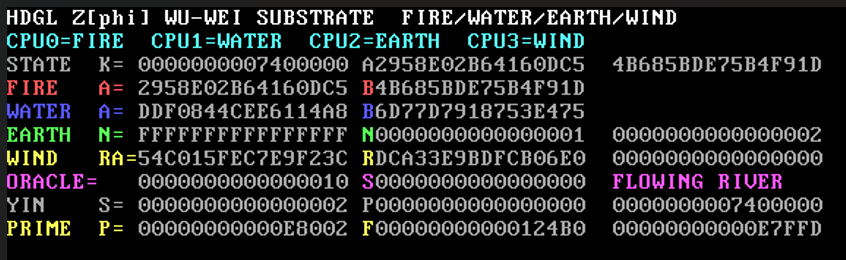
db "HDGL Z[phi] WU-WEI SUBSTRATE FIRE/WATER/EARTH/WIND",0
str_topology:
db "CPU0=FIRE CPU1=WATER CPU2=EARTH CPU3=WIND",0
str_state:
db "STATE K= A= B=",0
str_fire:
db "FIRE A= B=",0
str_water:
db "WATER A= B=",0
str_earth:
db "EARTH N= NF= DELTA=",0
str_wind:
db "WIND RA= RB= FIX=",0
str_oracle:
db "ORACLE= STRATEGY=",0
str_yin:
db "YIN S= PH= DEPTH=",0
str_prime:
db "PRIME P= FOUND= LAST=",0
str_strat_flowing: db "FLOWING RIVER",0
str_strat_nonaction: db "NON-ACTION ",0
str_strat_redirect: db "REDIRECT ",0
str_strat_converge: db "CONVERGENCE ",0
str_strat_critical: db "!! CRITICAL !!",0
str_strat_unknown: db "UNKNOWN ",0
hex_digits:
db "0123456789ABCDEF"
str_serial_depth: db "DEPTH=",0
str_serial_oracle: db "ORACLE=",0
; =============================================================================
; PHYSICAL ADDRESS CONSTANTS
; =============================================================================
;
; All labels are relative to ORG 0x7C00.
; Physical address of a label L in payload = 0x10000 + (L - boot_start) - 512
; because:
; - payload loads at physical 0x10000
; - boot_start = 0x7C00
; - sector 1 (boot sector) = 512 bytes, payload starts at file offset 512
; - So physical(L) = 0x10000 + (L - 0x7C00) - 512
; = 0x10000 + L - 0x7E00
; = L + (0x10000 - 0x7E00)
; = L + 0x8200
;
; Verify: protected_entry label value = 0x7C00 + 512 = 0x7E00
; physical = 0x7E00 + 0x8200 = 0x10200. Correct!
;
; For AP trampoline (copied to 0x8000):
; ap_trampoline label = 0x7C00 + (its file offset)
; AP_PM_PHYS = 0x8000 + (ap_pm_entry - ap_trampoline)
; AP_LM_PHYS = 0x8000 + (ap_lm_entry - ap_trampoline)
PROTECTED_ENTRY_PHYS equ protected_entry
LONG_MODE_ENTRY_PHYS equ long_mode_entry
AP_PM_PHYS equ AP_TRAMP_PHYS + (ap_pm_entry - ap_trampoline)
AP_LM_PHYS equ AP_TRAMP_PHYS + (ap_lm_entry - ap_trampoline)
; =============================================================================
; IMAGE PADDING TO EXACTLY 64 SECTORS
; =============================================================================
times (IMAGE_SECTORS * 512) - ($ - $$) db 0
Stutter Step Bases
stutter-step-bases-second-iris-method.zip (8.9 KB)
; =============================================================================
; iris_gate.asm — "iris stutter-step" adaptive strong-PRP pre-filter
; DROP-IN MODULE for hdgl_wuwei.asm
; =============================================================================
;
; VERIFIED AGAINST: iris_prp.py (reference) and iris_gate_test.asm (standalone
; ELF harness) -- all 9 test vectors match byte-for-byte, including the
; classical worst-case strong pseudoprimes (2047, 1373653, 25326001,
; 3215031751 -- all caught on probe 1) and all 151 composites <=3,000,000
; that fool both V0 and V1 in tri_vantage_prime.py (avg 1.033 probes, max 2).
;
; WHAT THIS BUYS YOU:
;   The existing PRIME_TEST_STRIDE Frobenius gate (zpow_mod in Z[phi]) still
;   has one documented survivor in [2,4999]: 4181 = 37*113. That test is
;   also expensive -- 2 zmul_mod calls (4 modmul64 each) per bit of P.
;
;   iris_prp is a cheap pre-filter: base_k(n) = 2 + high64((k*GOLDEN64
;   mod 2^64) * (n-3)). One modpow_u64 call resolves ~99%+ of composites
;   (avg 1.033 probes measured). Composites it rejects never touch the
;   Frobenius gate at all -- pure wu-wei, you don't pay for the expensive
;   ring arithmetic on numbers already proven composite for the cost of one
;   modexp. Numbers that survive MAX_PROBES iris probes still go through
;   the existing Frobenius check as the confirming gate, unchanged.
;
;   iris_prp is a DIFFERENT kind of hardening than "add base 3, base 5,
;   ...": a fixed base list can always be targeted by an Arnault-style
;   construction (that's literally what 3215031751 is, built against
;   {2,3,5,7}). iris_prp's probe value scales with the candidate itself
;   (phi-Weyl equidistribution, three-distance theorem -- same principle
;   behind the golden-angle phyllotactic spiral, not a borrowed idea), so
;   there's no small fixed target to construct against. It is still a
;   member of the strong-MR family though (shares the multiplicative-order
;   failure surface) -- it does NOT replace an independent-family closer.
;   If/when a strong-Lucas (V3 / Selfridge Method A) gate goes into this
;   substrate, keep it. iris_prp makes the MR side of the oracle much
;   harder to construct against and much cheaper on average; it doesn't
;   make a Lucas gate unnecessary.
;
; =============================================================================


; ── 1. New constants (place alongside PRIME_TEST_STRIDE) ──────────────────
;
; GOLDEN64      equ 0x9E3779B97F4A7C15   ; round(2^64 * (phi-1)), exact fixed-point phi
; IRIS_MAX_PROBES equ 16                  ; cap before falling through to Frobenius gate


; ── 2. New state (place after PRIME_LAST_FOUND, next free slot 0x500150) ──
;
; IRIS_BASE_USED     equ 0x00500150   ; base that resolved (or was last tried)
; IRIS_PROBES_USED   equ 0x00500158   ; probe count consumed
; IRIS_RESULT        equ 0x00500160   ; 1 = probable prime (fall through to Frobenius),
;                                      ; 0 = composite (short-circuit, skip Frobenius)
;
; Add to the BSP init block in long_mode_entry alongside the other PRIME_*
; initialization:
;     mov qword [IRIS_BASE_USED],   0
;     mov qword [IRIS_PROBES_USED], 0
;     mov qword [IRIS_RESULT],      0


; ── 3. New routines ─────────────────────────────────────────────────────
; NOTE: modmul64 is NOT redefined here -- it already exists in
; hdgl_wuwei.asm and every routine below calls that existing label.
; Only add modpow_u64 / strong_sprp / iris_base / iris_prp_step, none of
; which are currently present.

; ---------------------------------------------------------------------------
; modpow_u64: RDI^RSI mod RDX -> RAX   (plain scalar modexp, square-and-multiply)
; Distinct from zpow_mod: that one exponentiates in the Z[phi] RING
; (pairs, via zmul_mod). This is ordinary scalar modular exponentiation,
; needed because the strong-MR test operates on plain integers mod P, not
; on Z[phi] elements. Reuses the existing modmul64.
; ---------------------------------------------------------------------------
modpow_u64:
    push r8
    push r9
    push r10
    push r11
    mov  r9, rdx           ; modulus
    mov  r8, rsi           ; exponent
    mov  r10, rdi          ; base (mod m, caller ensures < m)
    mov  r11, 1            ; result

.mp_loop:
    test r8, r8
    jz   .mp_done
    test r8, 1
    jz   .mp_sq

    mov  rax, r11
    mov  rbx, r10
    mov  rcx, r9
    call modmul64
    mov  r11, rax

.mp_sq:
    mov  rax, r10
    mov  rbx, r10
    mov  rcx, r9
    call modmul64
    mov  r10, rax

    shr  r8, 1
    jmp  .mp_loop

.mp_done:
    mov  rax, r11
    pop  r11
    pop  r10
    pop  r9
    pop  r8
    ret

; ---------------------------------------------------------------------------
; strong_sprp: strong probable-prime test, single base.
; in: RDI = n, RSI = a (2 <= a <= n-2)
; out: RAX = 1 (a is a witness for "probably prime" -- FOOLED, or n really
;             is prime), 0 (a proves n composite)
; ---------------------------------------------------------------------------
strong_sprp:
    push rbx
    push rcx
    push r8
    push r9
    push r10
    push r11
    push r12
    push r13

    mov r12, rdi            ; n
    mov r13, rsi            ; a

    cmp r13, 1
    jbe .pass
    mov rax, r12
    dec rax
    cmp r13, rax
    je .pass

    ; factor n-1 = d * 2^r
    mov rax, r12
    dec rax
    xor r8, r8               ; r
    mov r9, rax               ; d
.factor_loop:
    test r9, 1
    jnz .factor_done
    shr r9, 1
    inc r8
    jmp .factor_loop
.factor_done:

    mov rdi, r13
    mov rsi, r9
    mov rdx, r12
    call modpow_u64
    mov r10, rax             ; x = a^d mod n

    cmp r10, 1
    je .pass
    mov rax, r12
    dec rax
    cmp r10, rax
    je .pass

    mov r11, r8
    dec r11
    test r11, r11
    jz .fail

.sq_loop:
    mov rax, r10
    mov rbx, r10
    mov rcx, r12
    call modmul64
    mov r10, rax
    mov rax, r12
    dec rax
    cmp r10, rax
    je .pass
    dec r11
    jnz .sq_loop

.fail:
    xor rax, rax
    jmp .ssp_done
.pass:
    mov rax, 1
.ssp_done:
    pop r13
    pop r12
    pop r11
    pop r10
    pop r9
    pop r8
    pop rcx
    pop rbx
    ret

; ---------------------------------------------------------------------------
; iris_base: k-th phi-Weyl probe base for candidate n.
; in: RDI = n, RSI = k
; out: RAX = base, in [2, n-2]
; base_k(n) = 2 + high64( ((k*GOLDEN64) mod 2^64) * (n-3) )
; ---------------------------------------------------------------------------
iris_base:
    push rbx
    push rdx
    push r8

    mov rax, rsi
    mov rbx, GOLDEN64
    mul rbx                  ; RDX:RAX = k*GOLDEN64; low64(RAX) = x_k (Q0.64)
    mov r8, rax

    mov rax, rdi
    sub rax, 3                ; span = n - 3
    mov rbx, rax
    mov rax, r8
    mul rbx                    ; RDX:RAX = x_k * span; RDX(high64) = offset in [0,span)
    mov rax, rdx
    add rax, 2                  ; base = 2 + offset

    pop r8
    pop rdx
    pop rbx
    ret

; ---------------------------------------------------------------------------
; iris_prp_step: stutter-step through phi-spaced bases for [PRIME_CANDIDATE].
; Writes IRIS_RESULT / IRIS_PROBES_USED / IRIS_BASE_USED.
; IRIS_RESULT=0 means: caller can skip the Frobenius Z[phi] check entirely
; and go straight to the .not_prime path -- composite already proven.
; IRIS_RESULT=1 means: survived MAX_PROBES, fall through to the existing
; Frobenius test as before.
; ---------------------------------------------------------------------------
iris_prp_step:
    push rdi
    push rsi
    push rax
    push r8
    push r9

    xor r8, r8                 ; probes attempted

.probe_loop:
    inc r8

    mov rdi, [PRIME_CANDIDATE]
    mov rsi, r8
    call iris_base
    mov r9, rax
    mov [IRIS_BASE_USED], r9

    mov rdi, [PRIME_CANDIDATE]
    mov rsi, r9
    call strong_sprp
    test rax, rax
    jz .composite

    cmp r8, IRIS_MAX_PROBES
    jl .probe_loop

    mov qword [IRIS_RESULT], 1
    mov [IRIS_PROBES_USED], r8
    jmp .done

.composite:
    mov qword [IRIS_RESULT], 0
    mov [IRIS_PROBES_USED], r8

.done:
    pop r9
    pop r8
    pop rax
    pop rsi
    pop rdi
    ret


; ── 4. Splice point in prime_test_step ─────────────────────────────────
;
; Currently prime_test_step does:
;   call legendre5
;   ...
;   call zpow_mod            ; expensive: Z[phi] Frobenius test
;   ...compare, .is_prime / .not_prime...
;
; Add the cheap pre-filter BEFORE the legendre5/zpow_mod work, right after
; .valid_candidate:
;
; .valid_candidate:
;     call iris_prp_step
;     cmp qword [IRIS_RESULT], 0
;     je  .not_prime          ; iris already proved composite -- skip
;                              ; legendre5/zpow_mod entirely, one modpow
;                              ; instead of a full Z[phi] Frobenius pass
;
;     call legendre5           ; unchanged from here down -- iris survivors
;     mov  [PRIME_LEGENDRE], rax   ; still get the full existing Frobenius
;     ...                          ; confirmation before being called prime
;
; This is additive: it changes nothing about what counts as prime (a
; number still has to clear the existing Frobenius gate), it only lets
; the substrate skip the expensive ring arithmetic for the composites the
; cheap probe already resolves -- which, per the coverage numbers above,
; is nearly all of them.