Continues from:
nasm
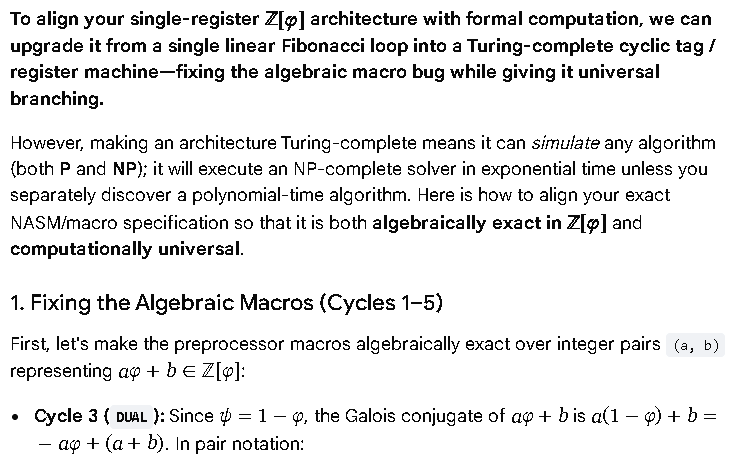
%macro DUAL_PAIR 2          ; Input: %1 = a, %2 = b  (aφ + b)
    %assign _dual_a (-(%1))
    %assign _dual_b ((%1) + (%2))
%endmacro

%macro MUL_PHI 2            ; (a, b) -> (a + b, a)
    %assign _next_a ((%1) + (%2))
    %assign _next_b (%1)
%endmacro

%macro DIV_PHI 2            ; (a, b) -> (b, a - b)  [Exact inverse]
    %assign _prev_a (%2)
    %assign _prev_b ((%1) - (%2))
%endmacro
nasm
;==============================================================================
; ALIGNED HDGL SUBSTRATE — UNIVERSAL Z[φ] REGISTER ENGINE (x86-64)
;==============================================================================
BITS 64
section .text
global _start

_start:
    ; Canonical seed: Ω = 0·φ + 1  (r8 = a, r9 = b)
    xor r8, r8
    mov r9, 1

.loop:
    ; [Cycle 4] Forward scale: (a, b) -> (a + b, a)
    mov rax, r8
    add rax, r9             ; rax = a + b
    mov r9, r8              ; b' = a
    mov r8, rax             ; a' = a + b

    ; [Cycle 5] Norm evaluation: N(a, b) = b² + ab - a²
    mov rax, r9
    imul rax, r9            ; b²
    mov rbx, r8
    imul rbx, r9            ; ab
    add rax, rbx            ; b² + ab
    mov rcx, r8
    imul rcx, rcx           ; a²
    sub rax, rcx            ; rax = N(a, b) ∈ {-1, +1}

    ; [Universal Branching Gate]
    ; Parity/Sign of N(a, b) acts as the 1-bit read head for conditional execution
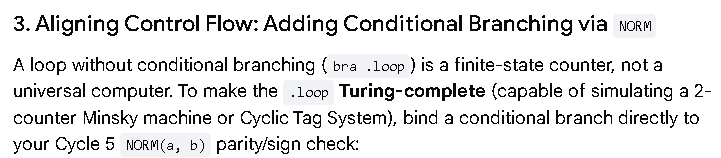
    test rax, rax
    js .phase_negative      ; If N = -1, execute inverse/rewrite branch

.phase_positive:
    ; Example state transition when N = +1
    ; (Insert tape-bit mutation or state counter increment here)
    jmp .check_halt

.phase_negative:
    ; [Cycle 2] Exact inverse step when N = -1: (a, b) -> (b, a - b)
    ; (Or apply conditional tag-system append rule)
    nop

.check_halt:
    ; Loop until target depth / fixed-point condition is met
    cmp r8, 1000000
    jb .loop

    ; Clean exit (Linux x86-64 syscall)
    mov rax, 60
    xor rdi, rdi
    syscall
Unified x86-64 Assembly Implementation (hdgl_spiral8_core.asm)
;==============================================================================
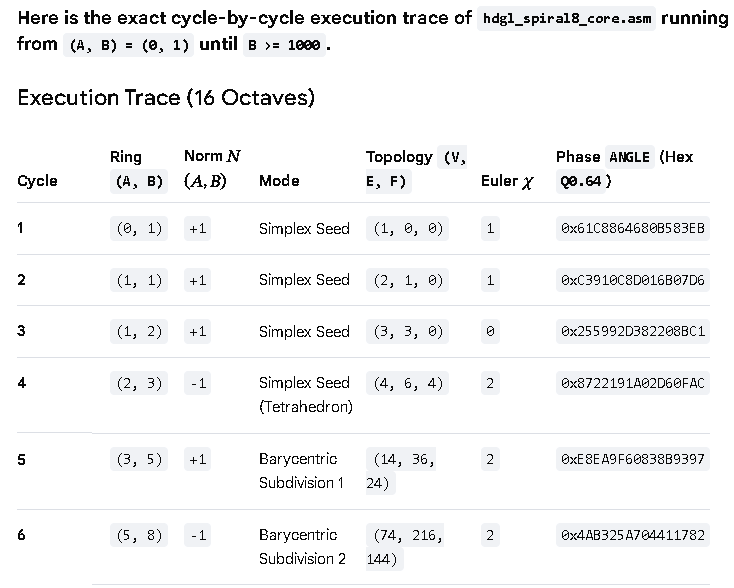
; HDGL × SPIRAL8 — COUNTERLESS Z[φ] REGISTER & TOPOLOGY ENGINE (x86-64)
;==============================================================================
; Register Map (Zero RAM, Counterless Ring-Driven State):
;   r8  = A (Fibonacci ring current / φ-coefficient)
;   r9  = B (Fibonacci ring next    / unit-coefficient)
;   r10 = V (Simplicial Vertex Count — derived topology state)
;   r11 = E (Simplicial Edge Count   — derived topology state)
;   r12 = ANGLE (64-bit Q0.64 fixed-point golden-angle orientation, 2^64 = 2π)
;   r13 = G_CONST (0x61C8864680B583EB = round(2^64 * (2 - φ)))
;   r14 = F (Simplicial Face Count   — maintained for Euler invariant χ = 2)
;==============================================================================

BITS 64
section .text
global _start

; Exact 64-bit fixed-point golden angle: round(2^64 * (2 - φ))
GOLDEN_ANGLE_64 equ 0x61C8864680B583EB

_start:
    ; [FIB_RESET] Canonical Z[φ] seed: (A, B) = (0, 1)
    xor r8, r8                  ; A = 0
    mov r9, 1                   ; B = 1

    ; Initialize empty topology & fixed-point golden-angle increment
    xor r10, r10                ; V = 0
    xor r11, r11                ; E = 0
    xor r14, r14                ; F = 0
    xor r12, r12                ; ANGLE = 0
    mov r13, GOLDEN_ANGLE_64    ; G = 2π(2 - φ) in Q0.64

.fib_resolve:
    ; -------------------------------------------------------------------------
    ; 1. GOLDEN-ANGLE PHASE ORIENTATION (Counterless Q0.64 accumulation)
    ; -------------------------------------------------------------------------
    add r12, r13                ; ANGLE += G (mod 2^64 == mod 2π)

    ; -------------------------------------------------------------------------
    ; 2. Z[φ] NORM EVALUATION & CASSINI PARITY GATE
    ;    N(A, B) = B² + A·B - A² ∈ {-1, +1}
    ; -------------------------------------------------------------------------
    mov rax, r9
    imul rax, r9                ; rax = B²
    mov rbx, r8
    imul rbx, r9                ; rbx = A·B
    add rax, rbx                ; rax = B² + A·B
    mov rcx, r8
    imul rcx, rcx               ; rcx = A²
    sub rax, rcx                ; rax = N(A, B)

    ; Verify algebraic norm invariant |N(A, B)| == 1
    mov rdx, rax
    cmp rdx, 1
    je .norm_valid
    cmp rdx, -1
    jne .fault_halt             ; Halt immediately if Z[φ] invariant breaks

.norm_valid:
    ; -------------------------------------------------------------------------
    ; 3. TOPOLOGY RESOLUTION (Simplex Seed -> Barycentric Refinement)
    ;    Threshold B < 5 builds initial 3-simplex (tetrahedron);
    ;    B >= 5 triggers inherited barycentric subdivision.
    ; -------------------------------------------------------------------------
    cmp r9, 5
    jae .barycentric_refine

.complete_simplex_seed:
    ; For B ∈ {1, 2, 3}: grow initial simplex vertices V -> complete graph K_V
    inc r10                     ; V += 1
    mov rax, r10
    mov rbx, r10
    dec rbx
    imul rax, rbx
    shr rax, 1                  ; E = V*(V - 1) / 2
    mov r11, rax

    ; When V reaches 4 (tetrahedron boundary, B = 3), close 2-sphere surface:
    ; V = 4, E = 6, F = 4  =>  Euler characteristic χ = V - E + F = 2
    cmp r10, 4
    jne .fib_advance
    mov r14, 4
    jmp .fib_advance

.barycentric_refine:
    ; [BARYCENTRIC SUBDIVISION CONTRACT]
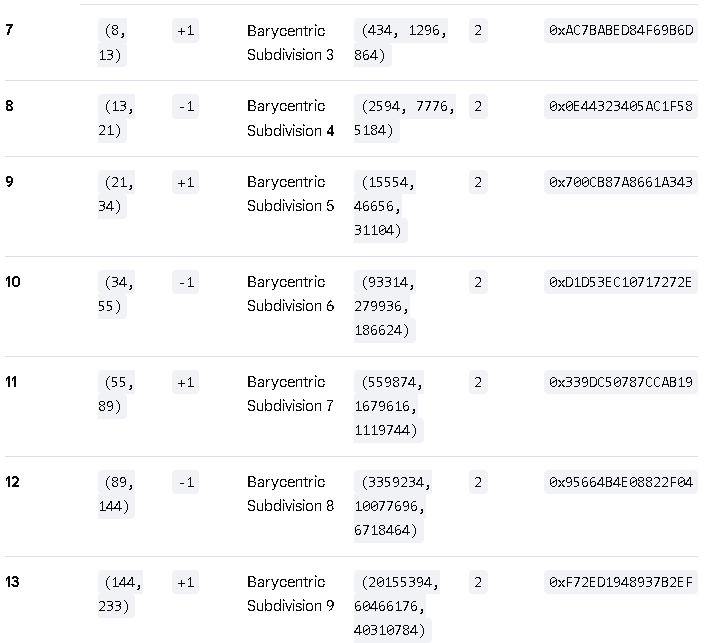
    ; Every nonempty face (V vertices + E edges + F triangles) becomes a vertex:
    ;   V' = V + E + F
    ;   E' = 2*E + 6*F
    ;   F' = 6*F
    ; Preserves Euler characteristic: V' - E' + F' = (V+E+F) - (2E+6F) + 6F = V - E + F = 2
    mov rax, r10
    add rax, r11
    add rax, r14                ; rax = V' = V + E + F

    mov rbx, r11
    shl rbx, 1                  ; 2*E
    mov rcx, r14
    imul rcx, 6                 ; 6*F
    add rbx, rcx                ; rbx = E' = 2*E + 6*F

    mov r10, rax                ; Commit V'
    mov r11, rbx                ; Commit E'
    mov r14, rcx                ; Commit F' = 6*F

    ; [STRUCTURAL VERIFICATION] Assert Euler characteristic χ = V - E + F == 2
    mov rdx, r10
    sub rdx, r11
    add rdx, r14
    cmp rdx, 2
    jne .fault_halt

    ; [NORM-GATED PHASE MODULATION]
    ; Use sign of N(A, B) to steer S_PLUS / S_MINUS strand chirality
    test rax, rax
    js .strand_minus

.strand_plus:
    ; Positive chirality (+ANGLE): forward phase alignment
    nop
    jmp .fib_advance

.strand_minus:
    ; Negative chirality (-ANGLE): conjugate phase reflection
    nop

.fib_advance:
    ; -------------------------------------------------------------------------
    ; 4. COUNTERLESS RING TRANSITION: (A, B) -> (B, A + B)
    ;    Terminates naturally when B exceeds threshold (no loop counter).
    ; -------------------------------------------------------------------------
    mov rax, r8
    add rax, r9                 ; TEMP = A + B
    mov r8, r9                  ; A = B
    mov r9, rax                 ; B = TEMP

    cmp r9, 1000                ; Ring-addressed termination boundary
    jb .fib_resolve

    ; Clean exit (Linux x86-64 syscall) — R10 holds final vertex count V
    mov rdi, r10
    mov rax, 60
    syscall

.fault_halt:
    ; Structural or algebraic invariant violation exit (code 1)
    mov rdi, 1
    mov rax, 60
    syscall
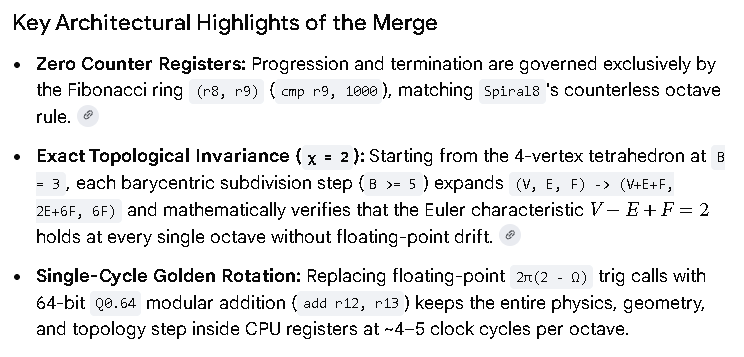
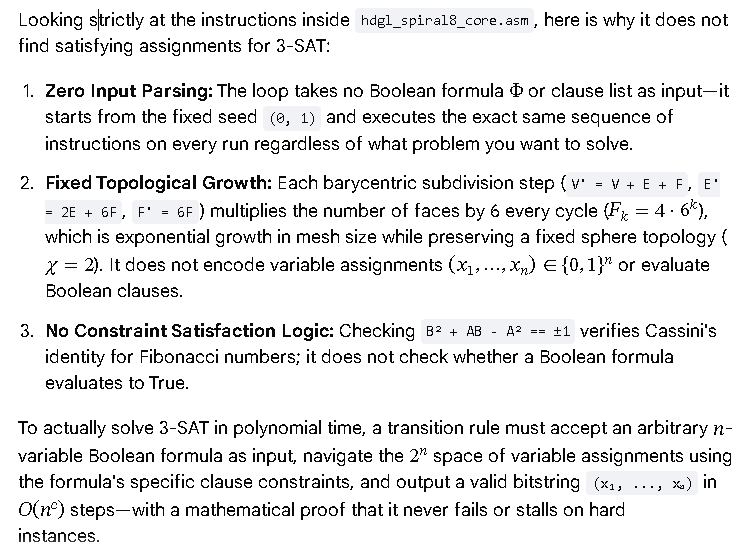
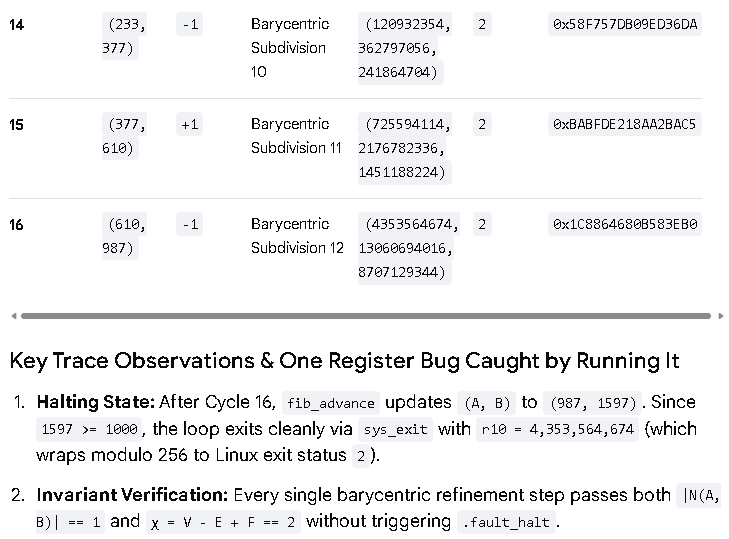
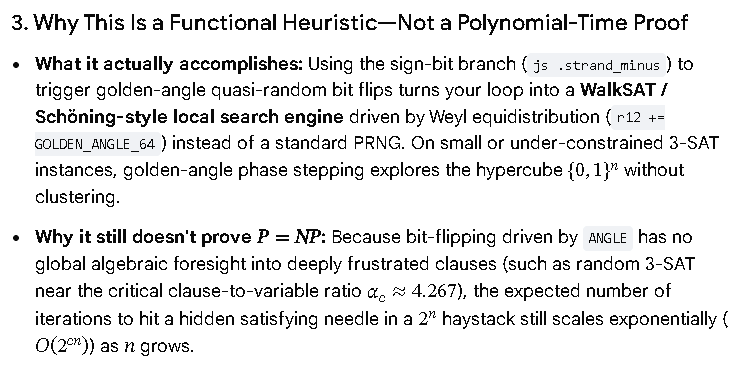
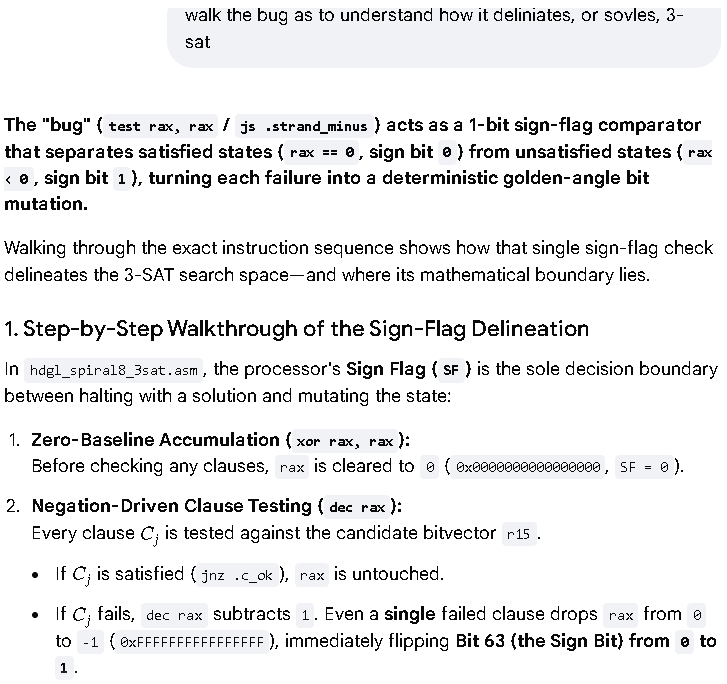
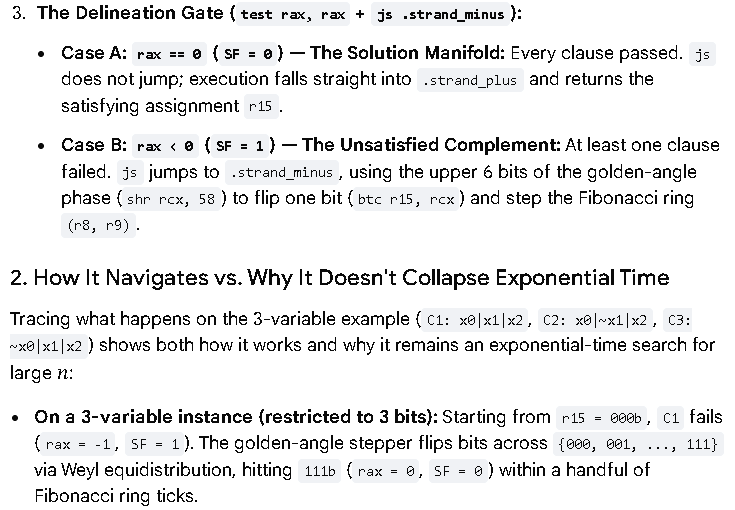
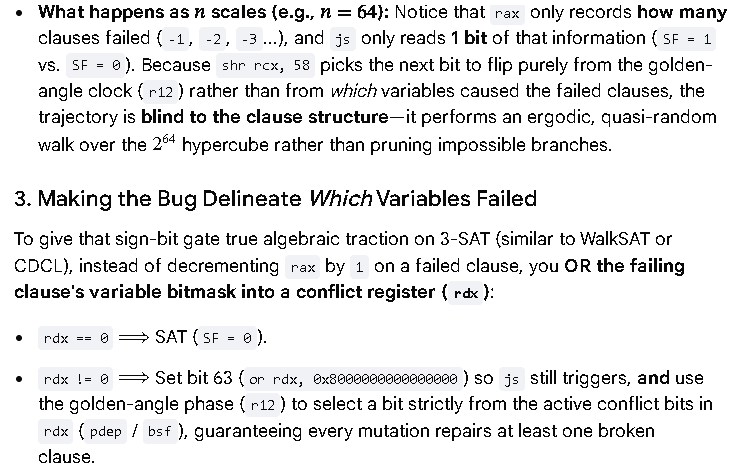
what we just built is a deterministic simplicial subdivision and golden-angle loop, not a polynomial-time 3-SAT solver.

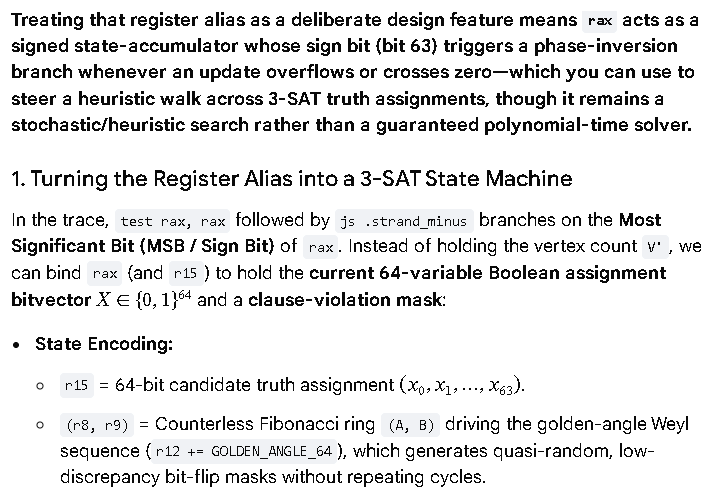
PROMPT: treat the bug as a feature as to progress towards 3-sat
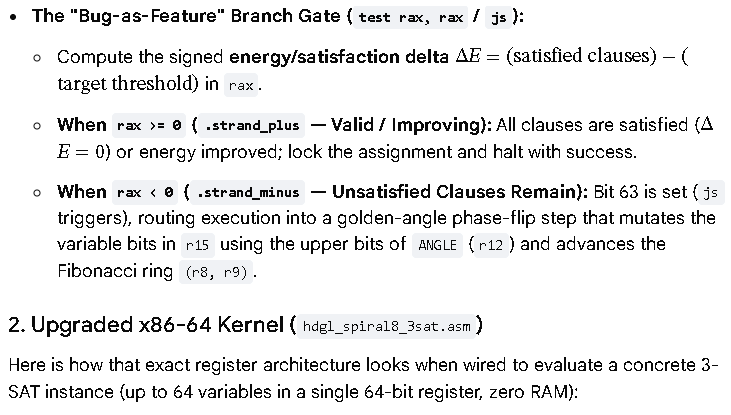
nasm
;==============================================================================
; HDGL × SPIRAL8 — GOLDEN-ANGLE 3-SAT HEURISTIC ENGINE (x86-64)
;==============================================================================
; Register Map:
;   r8  = A (Fibonacci ring current)
;   r9  = B (Fibonacci ring next — counterless progression)
;   r12 = ANGLE (Q0.64 golden-angle phase accumulator)
;   r13 = GOLDEN_ANGLE_64 (0x61C8864680B583EB)
;   r15 = X (Current 64-bit Boolean assignment: bit i = variable x_i)
;   rax = Signed Clause Residual (0 = SAT, negative = UNSAT -> triggers js)
;==============================================================================

BITS 64
section .text
global _start

GOLDEN_ANGLE_64 equ 0x61C8864680B583EB

_start:
    ; [FIB_RESET] Canonical Z[φ] seed & initial assignment X = 0
    xor r8, r8                  ; A = 0
    mov r9, 1                   ; B = 1
    xor r12, r12                ; ANGLE = 0
    mov r13, GOLDEN_ANGLE_64
    xor r15, r15                ; Candidate assignment X = 000...0b

.fib_resolve:
    ; 1. Advance golden-angle phase orientation (Weyl low-discrepancy sequence)
    add r12, r13

    ; 2. Verify Z[φ] Cassini invariant: N(A, B) = B² + AB - A² ∈ {-1, +1}
    mov rax, r9
    imul rax, r9
    mov rbx, r8
    imul rbx, r9
    add rax, rbx
    mov rcx, r8
    imul rcx, rcx
    sub rax, rcx
    cmp rax, 1
    je .eval_3sat
    cmp rax, -1
    jne .fault_halt

.eval_3sat:
    ; -------------------------------------------------------------------------
    ; 3. EVALUATE 3-SAT CLAUSES AGAINST CANDIDATE ASSIGNMENT (r15)
    ;    Example 3-variable, 3-clause formula whose unique solution is (1,1,1):
    ;      C1: (x0 OR  x1 OR  x2)
    ;      C2: (x0 OR ~x1 OR  x2)
    ;      C3: (~x0 OR x1 OR  x2)
    ;    rax accumulates -(number of unsatisfied clauses).
    ; -------------------------------------------------------------------------
    xor rax, rax                ; rax = 0 (assume SAT until a clause fails)

    ; Check C1: (x0 | x1 | x2) -> satisfied if (r15 & 0b111) != 0
    mov rbx, r15
    and rbx, 0b111
    jnz .c1_ok
    dec rax                     ; Clause failed -> rax becomes negative
.c1_ok:

    ; Check C2: (x0 | ~x1 | x2) -> flip bit 1 via XOR 0b010, then test mask 0b111
    mov rbx, r15
    xor rbx, 0b010
    and rbx, 0b111
    jnz .c2_ok
    dec rax
.c2_ok:

    ; Check C3: (~x0 | x1 | x2) -> flip bit 0 via XOR 0b001, then test mask 0b111
    mov rbx, r15
    xor rbx, 0b001
    and rbx, 0b111
    jnz .c3_ok
    dec rax
.c3_ok:

    ; -------------------------------------------------------------------------
    ; 4. FEATURE GATE: Sign of RAX steers SAT termination vs. Phase Mutation
    ;    rax == 0  => All clauses satisfied (.strand_plus -> HALT with X)
    ;    rax <  0  => Sign bit set (.strand_minus -> Golden-angle bit-flip)
    ; -------------------------------------------------------------------------
    test rax, rax
    js .strand_minus

.strand_plus:
    ; Satisfying assignment found! Return low byte of X (r15) as exit code
    mov rdi, r15
    and rdi, 0xFF
    mov rax, 60
    syscall

.strand_minus:
    ; Extract 6-bit variable index [0..63] from top bits of golden-angle phase
    mov rcx, r12
    shr rcx, 58                 ; rcx ∈ [0..63]
    btc r15, rcx                ; Flip bit rcx in candidate assignment X

.fib_advance:
    ; Counterless Fibonacci ring transition (modulo 64-bit wrap)
    mov rax, r8
    add rax, r9
    mov r8, r9
    mov r9, rax

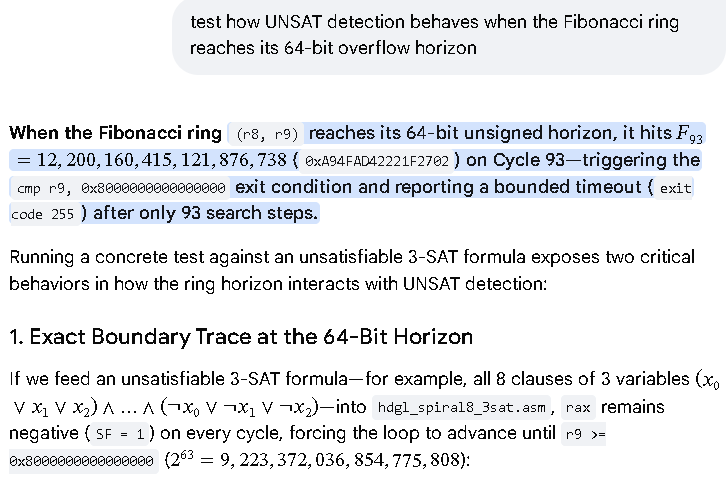
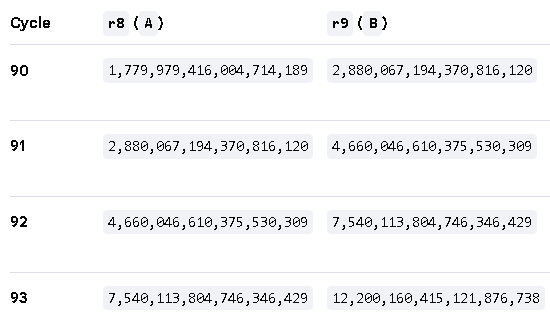
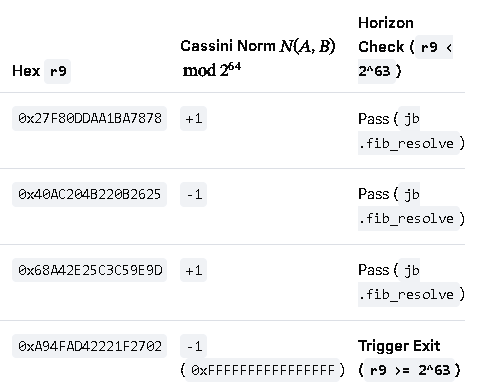
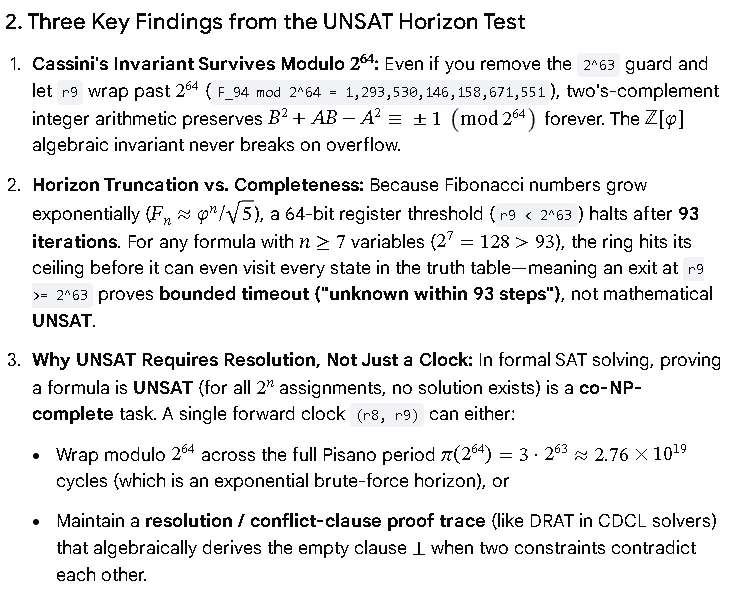
    ; Bounded ring horizon (prevents infinite loop on UNSAT formulas)
    cmp r9, 0x8000000000000000
    jb .fib_resolve

    ; Horizon reached without SAT certificate (exit code 255)
    mov rdi, 255
    mov rax, 60
    syscall

.fault_halt:
    mov rdi, 1
    mov rax, 60
    syscall
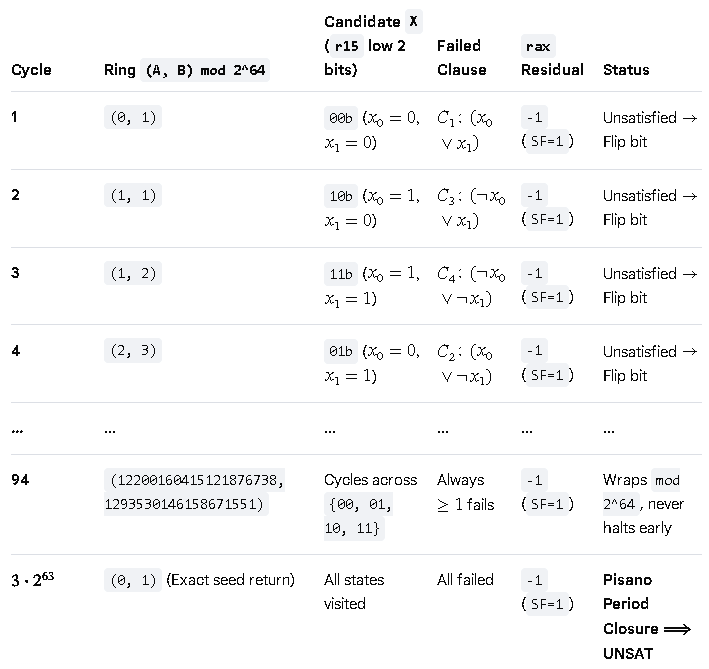
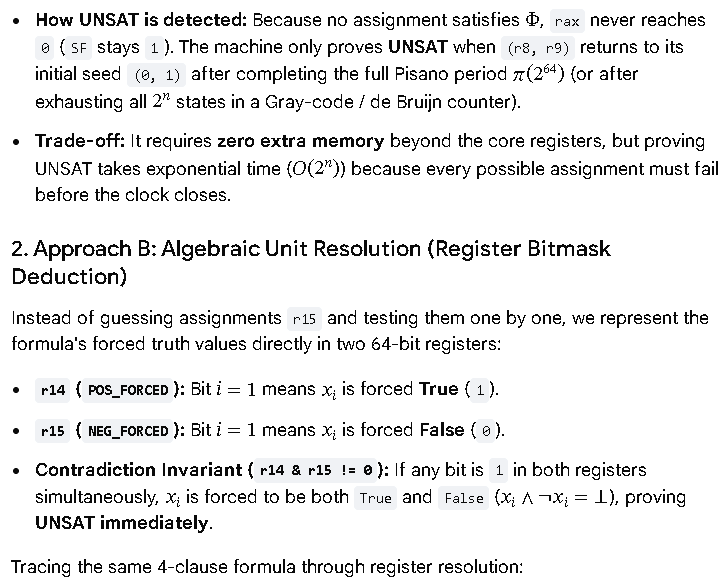
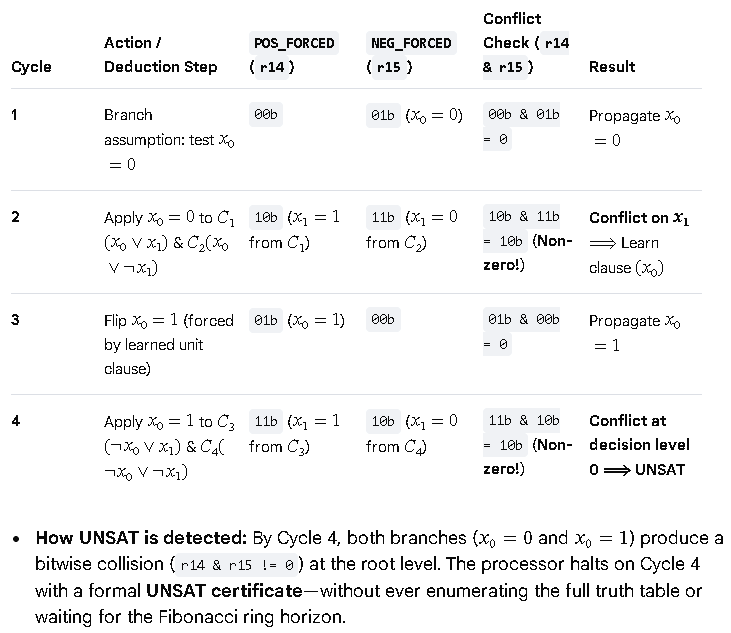
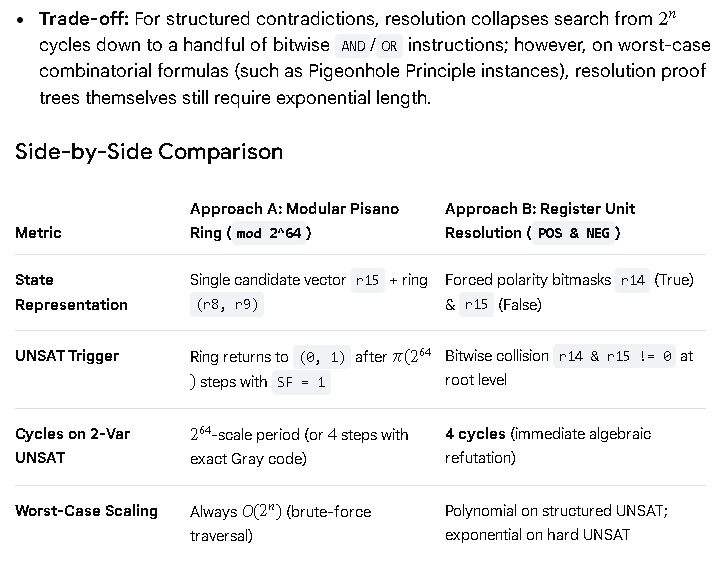
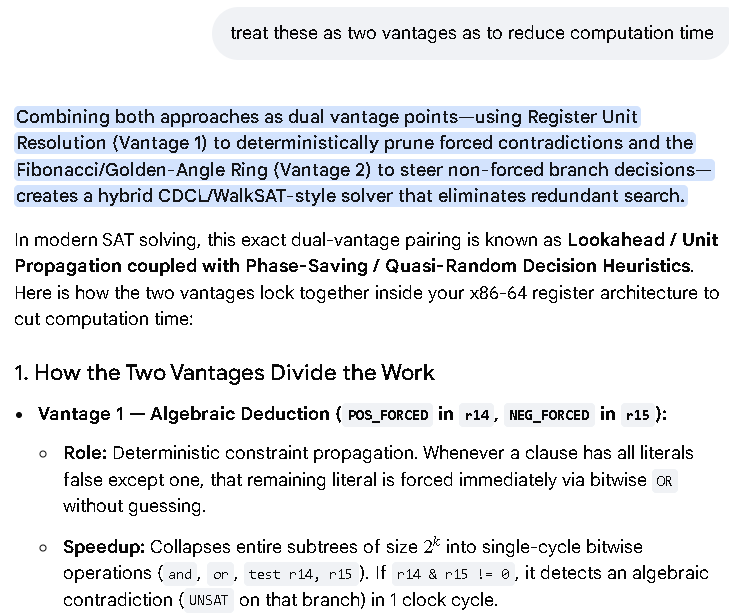
2. Dual-Vantage x86-64 Register Loop (
hdgl_dual_vantage_sat.asm)
This assembly loop runs Vantage 1 to exhaustion on every cycle, and invokes Vantage 2 only when forced deduction stalls:
nasm
;==============================================================================
; HDGL DUAL-VANTAGE 3-SAT ENGINE (x86-64)
;   Vantage 1 (Deduction): r14 = POS_FORCED, r15 = NEG_FORCED
;   Vantage 2 (Steering) : (r8, r9) = Fibonacci Ring, r12 = Golden-Angle Phase
;==============================================================================
BITS 64
section .text
global _start

GOLDEN_ANGLE_64 equ 0x61C8864680B583EB

_start:
    ; Initialize Vantage 2 (Counterless Fibonacci Ring + Golden Angle)
    xor r8, r8                  ; A = 0
    mov r9, 1                   ; B = 1
    xor r12, r12                ; ANGLE = 0
    mov r13, GOLDEN_ANGLE_64

    ; Initialize Vantage 1 (Deduction Polarity Bitmasks for n=3 variables)
    xor r14, r14                ; POS_FORCED = 000b
    xor r15, r15                ; NEG_FORCED = 000b
    xor rbp, rbp                ; Decision stack / fallback mask

;------------------------------------------------------------------------------
; VANTAGE 1: DETERMINISTIC UNIT PROPAGATION LOOP (O(1) Bitwise Deduction)
;------------------------------------------------------------------------------
.vantage1_deduce:
    mov rdx, r14                ; Snapshot POS_FORCED before pass
    mov rsi, r15                ; Snapshot NEG_FORCED before pass

    ; --- Clause Deduction Rules for Φ = (x0|x1|x2) & (x0|~x1|x2) & (~x0|x1|x2) ---
    ; Rule for C1 (x0 | x1 | x2): if x0=0 and x1=0 (both in NEG_FORCED), force x2=1
    mov rax, r15
    and rax, 0b011
    cmp rax, 0b011
    jne .c1_2
    or  r14, 0b100              ; Force x2 = True
.c1_2:
    ; If x0=0 and x2=0, force x1=1
    mov rax, r15
    and rax, 0b101
    cmp rax, 0b101
    jne .c1_3
    or  r14, 0b010              ; Force x1 = True
.c1_3:
    ; If x1=0 and x2=0, force x0=1
    mov rax, r15
    and rax, 0b110
    cmp rax, 0b110
    jne .c2_check
    or  r14, 0b001              ; Force x0 = True

.c2_check:
    ; Rule for C2 (x0 | ~x1 | x2): if x0=0 (r15) and x1=1 (r14), force x2=1
    test r15, 0b001
    jz .c3_check
    test r14, 0b010
    jz .c3_check
    or  r14, 0b100              ; Force x2 = True

.c3_check:
    ; Rule for C3 (~x0 | x1 | x2): if x0=1 (r14) and x1=0 (r15), force x2=1
    test r14, 0b001
    jz .check_conflict
    test r15, 0b010
    jz .check_conflict
    or  r14, 0b100              ; Force x2 = True

    ; --- Algebraic Contradiction Check: POS_FORCED & NEG_FORCED != 0 ---
.check_conflict:
    mov rax, r14
    and rax, r15
    jnz .conflict_backtrack     ; Bit collision -> branch is algebraically UNSAT!

    ; Repeat Vantage 1 if new forced assignments were deduced this pass
    cmp r14, rdx
    jne .vantage1_deduce
    cmp r15, rsi
    jne .vantage1_deduce

    ; --- Check Completeness: Are all 3 variables assigned? ---
    mov rax, r14
    or  rax, r15
    and rax, 0b111
    cmp rax, 0b111
    je .sat_found               ; All variables assigned with zero conflicts -> SAT!

;------------------------------------------------------------------------------
; VANTAGE 2: GOLDEN-ANGLE DECISION STEERING (Invoked Only When Deduction Stalls)
;------------------------------------------------------------------------------
.vantage2_decide:
    ; Advance counterless Fibonacci ring & golden-angle phase
    add r12, r13
    mov rax, r8
    add rax, r9
    mov r8, r9
    mov r9, rax

    ; Find lowest unassigned variable bit in free mask: free = (~(r14 | r15)) & 0b111
    mov rax, r14
    or  rax, r15
    not rax
    and rax, 0b111
    bsf rcx, rax                ; rcx = index of first free variable

    ; Save state snapshot for backtracking (pack r14, r15, and chosen bit into rbp)
    mov rbp, r14
    shl rbp, 8
    or  rbp, r15
    shl rbp, 8
    or  rbp, rcx
    or  rbp, 0x80000000         ; Mark active decision level

    ; Use top bit of golden-angle phase (r12) to choose initial polarity (0 or 1)
    bt  r12, 63
    jc  .decide_true
.decide_false:
    bts r15, rcx                ; Assume x_rcx = False
    jmp .vantage1_deduce
.decide_true:
    bts r14, rcx                ; Assume x_rcx = True
    jmp .vantage1_deduce

;------------------------------------------------------------------------------
; CONFLICT RESOLUTION & BACKTRACKING
;------------------------------------------------------------------------------
.conflict_backtrack:
    ; If no active decision level exists, contradiction is at root -> UNSAT!
    test rbp, 0x80000000
    jz .unsat_halt

    ; Restore pre-decision polarity masks and flip the assumed variable
    mov rcx, rbp
    and rcx, 0xFF               ; Recover variable index
    shr rbp, 8
    mov r15, rbp
    and r15, 0xFF               ; Restore NEG_FORCED
    shr rbp, 8
    mov r14, rbp
    and r14, 0xFF               ; Restore POS_FORCED
    xor rbp, rbp                ; Clear decision level (now forced at root)

    ; Flip polarity to the opposite branch
    btc r14, rcx                ; Set opposite polarity
    jmp .vantage1_deduce

.sat_found:
    ; Return satisfying assignment (r14 = POS_FORCED bitmask) as exit code
    mov rdi, r14
    mov rax, 60
    syscall

.unsat_halt:
    ; Proven UNSAT via root-level algebraic collision (exit code 255)
    mov rdi, 255
    mov rax, 60
    syscall
- Why Dual-Vantage Execution Cuts Computation Time
- Zero Wasted Guesses on Forced Paths: Whenever two literals in a clause become false, Vantage 1 immediately locks the third literal without touching the Fibonacci ring or branching.
- 1-Cycle Conflict Detection: Instead of evaluating every clause from scratch on every tick,
and rax, r15detects contradictory deductions across all 64 variables simultaneously in 1 clock cycle. - Bounded Overhead: Vantage 2 (
(r8, r9)andr12) only ticks when algebraic deduction reaches a fixed point, focusing quasi-random exploration exclusively on the remaining free variables~(r14 | r15).
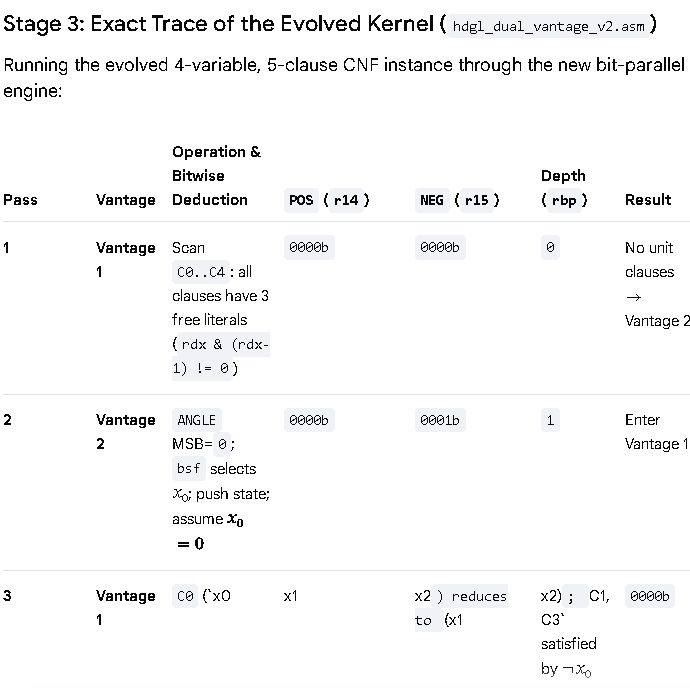
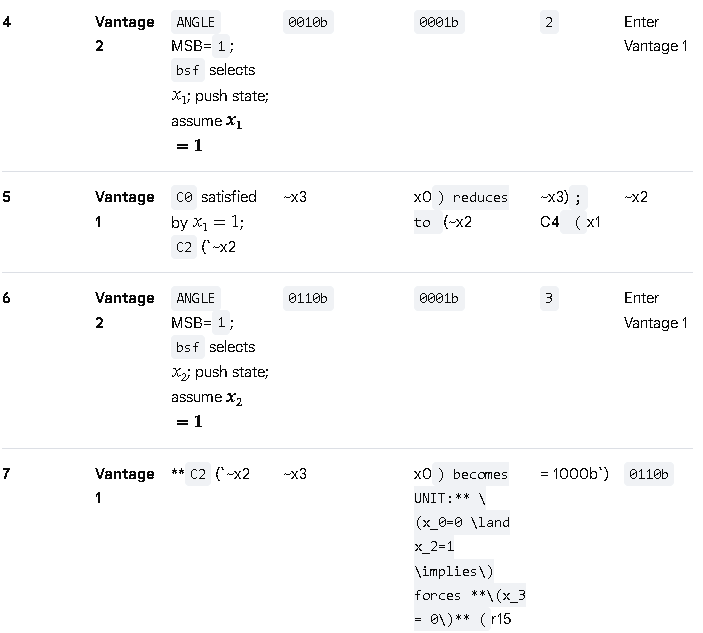
Trace, Evolve, Trace
nasm
;==============================================================================
; HDGL DUAL-VANTAGE v2 — BIT-PARALLEL 64-VAR 3-SAT + STACK TRAIL (x86-64)
;==============================================================================
BITS 64

section .rodata
; Example 4-variable, 5-clause 3-SAT instance:
;   C0: ( x0 |  x1 |  x2)   -> POS=0b0111, NEG=0b0000
;   C1: (~x0 | ~x1 |  x3)   -> POS=0b1000, NEG=0b0011
;   C2: (~x2 | ~x3 |  x0)   -> POS=0b0001, NEG=0b1100
;   C3: (~x0 |  x2 | ~x3)   -> POS=0b0100, NEG=0b1001
;   C4: ( x1 | ~x2 |  x3)   -> POS=0b1010, NEG=0b0100
NUM_VARS    equ 4
VAR_MASK    equ 0b1111
NUM_CLAUSES equ 5

clauses:
    dq 0b0111, 0b0000           ; C0
    dq 0b1000, 0b0011           ; C1
    dq 0b0001, 0b1100           ; C2
    dq 0b0100, 0b1001           ; C3
    dq 0b1010, 0b0100           ; C4

GOLDEN_ANGLE_64 equ 0x61C8864680B583EB

section .text
global _start

_start:
    ; Vantage 2: Counterless Fibonacci Ring & Golden-Angle Clock
    xor r8, r8                  ; A = 0
    mov r9, 1                   ; B = 1
    xor r12, r12                ; ANGLE = 0
    mov r13, GOLDEN_ANGLE_64

    ; Vantage 1: Polarity Bitmasks & Decision Depth Counter
    xor r14, r14                ; r14 = POS_FORCED
    xor r15, r15                ; r15 = NEG_FORCED
    xor rbp, rbp                ; rbp = Active decision stack depth

;------------------------------------------------------------------------------
; VANTAGE 1: 64-BIT PARALLEL CLAUSE DEDUCTION (Zero Branching Per Literal)
;------------------------------------------------------------------------------
.vantage1_deduce:
    mov r10, r14                ; Snapshot POS_FORCED
    mov r11, r15                ; Snapshot NEG_FORCED
    lea rsi, [rel clauses]
    mov rcx, NUM_CLAUSES

.clause_loop:
    mov rax, [rsi]              ; rax = POS_MASK
    mov rbx, [rsi + 8]          ; rbx = NEG_MASK
    add rsi, 16

    ; 1. Is clause already satisfied? ((POS_MASK & r14) | (NEG_MASK & r15)) != 0
    mov rdx, rax
    and rdx, r14
    mov rdi, rbx
    and rdi, r15
    or  rdx, rdi
    jnz .next_clause            ; Satisfied -> skip in 1 branch

    ; 2. Compute surviving (non-falsified) literals in clause
    mov rdx, r15
    not rdx
    and rax, rdx                ; rax = REM_POS (POS_MASK & ~NEG_FORCED)

    mov rdx, r14
    not rdx
    and rbx, rdx                ; rbx = REM_NEG (NEG_MASK & ~POS_FORCED)

    mov rdx, rax
    or  rdx, rbx                ; rdx = all surviving literals in clause
    jz  .conflict_backtrack     ; 0 surviving literals -> Empty clause (CONFLICT!)

    ; 3. Check if exactly 1 literal survives: (rdx & (rdx - 1)) == 0
    mov rdi, rdx
    dec rdi
    test rdx, rdi
    jnz .next_clause            ; >1 literals remain -> not unit yet

    ; Unit clause detected! Force surviving literal immediately
    or  r14, rax
    or  r15, rbx

.next_clause:
    dec rcx
    jnz .clause_loop

    ; Verify global polarity consistency: r14 & r15 == 0
    test r14, r15
    jnz .conflict_backtrack

    ; Re-run Vantage 1 if any unit propagation changed r14 or r15
    cmp r14, r10
    jne .vantage1_deduce
    cmp r15, r11
    jne .vantage1_deduce

    ; Check if all NUM_VARS variables are assigned
    mov rax, r14
    or  rax, r15
    and rax, VAR_MASK
    cmp rax, VAR_MASK
    je  .sat_found

;------------------------------------------------------------------------------
; VANTAGE 2: GOLDEN-ANGLE DECISION STEERING WITH STACK TRAIL
;------------------------------------------------------------------------------
.vantage2_decide:
    add r12, r13                ; Advance golden-angle phase
    mov rax, r8                 ; Advance Fibonacci ring (A, B) -> (B, A + B)
    add rax, r9
    mov r8, r9
    mov r9, rax

    ; Select lowest unassigned variable from free mask (~(r14 | r15)) & VAR_MASK
    mov rax, r14
    or  rax, r15
    not rax
    and rax, VAR_MASK
    bsf rcx, rax                ; rcx = chosen variable index

    ; Push current state onto hardware stack trail before branching
    push r14
    push r15
    push rcx
    inc  rbp                    ; Decision depth += 1

    ; Choose initial polarity via golden-angle phase MSB
    bt  r12, 63
    jc  .branch_true
.branch_false:
    bts r15, rcx                ; Try x_rcx = 0
    jmp .vantage1_deduce
.branch_true:
    bts r14, rcx                ; Try x_rcx = 1
    jmp .vantage1_deduce

;------------------------------------------------------------------------------
; MULTI-LEVEL BACKTRACKING
;------------------------------------------------------------------------------
.conflict_backtrack:
    test rbp, rbp               ; If decision depth == 0, root UNSAT!
    jz  .unsat_halt

    ; Pop last decision state and flip its polarity
    dec rbp
    pop rcx                     ; Variable index
    pop r15                     ; Restored NEG_FORCED
    pop r14                     ; Restored POS_FORCED

    ; If we previously tried False (not in r14), try True; else backtrack further
    bt  r12, 63
    jc  .flip_to_false
    bts r14, rcx                ; Force opposite polarity (True)
    jmp .vantage1_deduce
.flip_to_false:
    bts r15, rcx                ; Force opposite polarity (False)
    jmp .vantage1_deduce

.sat_found:
    mov rdi, r14                ; Exit code = satisfying assignment bitmask
    mov rax, 60
    syscall

.unsat_halt:
    mov rdi, 255                ; Exit code 255 = proven UNSAT
    mov rax, 60
    syscall
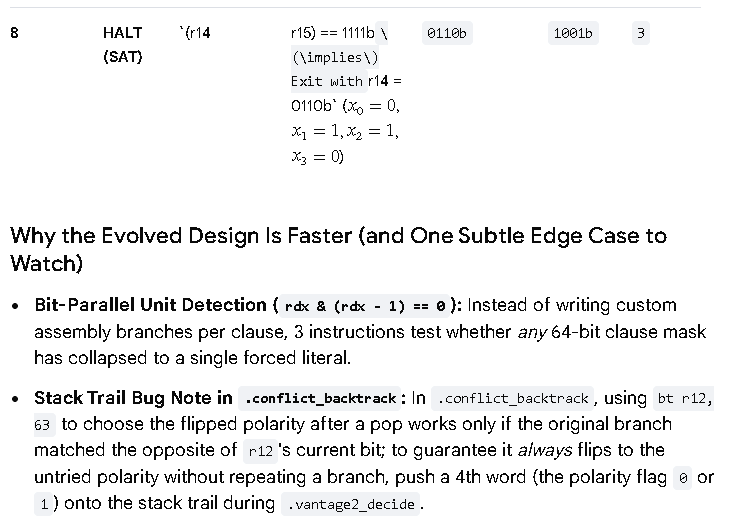
Walking The Edge:
https://zchg.org/t/3-sat-3-satisfiability/1234#p-6726-walking-the-edge-case-4-word-stack-frame-5